Excitement at the ETC today as a fleet of motorcycles drove onto the field with blue flags waving. About 30 sturdy men in leather jackets and woolly hats with sprouting tops dismounted and headed towards the classrooms. Not menacing – just a delegation from the Teachers’ Union to announce a special meeting tomorrow. Schools will be closed of course. The government announced that all primary teachers who have finished 10 month training but only completed grade 10 at school (GCSE equivalent) must start grade 11-12 starting on Wednesday at 3 schools in Biratnagar. Sessions will run from 3-8pm. Most of the teachers are in rural schools. There has been no transport for over a week and no sign of an end to the dispute – and of course there is never electricity in the evenings.
Meanwhile, the whole of eastern Nepal has been at a standstill for the last two weeks because of protests by workers from the jute mills. Mill owners are unable to meet their wage demands as the mills have not been working properly for months because there is no electricity and no access to Kathmandu. No transport for days, and the border is also closed so no supplies can come from India. There is now no fuel, no gas and a shortage of food and huge losses in customs revenue. Today, according to the newspaper reports ”Agitators pelted themselves with stones”. Further power cuts have started; we are promised a daily ration of electricity from 10pm – 2am (asleep) and 2 – 4 pm (at work). The government maintain it is nothing to do with them and not their problem. We have friends in Kathmandu who live near a minister and have an uninterrupted power supply!
There are some bright spots. Rosie-the-dog is now encased in a cushion cover to protect her from the cold. We are gradually becoming immune to the gas fumes in the small back room. Work is enjoyable and productive for both of us. One highlight this week was while I was working with primary maths teachers, giving instructions in Nepali which Umapati translated into English. An interesting reversal!
Fog again on Sunday, but the afternoon was pleasant enough to tempt us out on our bikes. I have become adept at cycling wrapped in a blanket. We ventured south to the mills area, where we found a thriving community and silent mills. Wandered home through the villages with their collections of mud houses covered in drying dung patties for fuel, women sorting lentils and coming back from the fields with bundles of fodder for the cows outside every small dwelling clad in sacking to keep out the cold. The children are not so lucky, with ragged clothes and no shoes.
Teaching practice started on Tuesday with 93 teachers in 9 local schools. Several group returned to the ETC as the schools had decided to close ‘for the cold’. I visited 2 schools and sat in the sunshine with the teachers. At Balmandir there were 25 teachers and about 40 children present. No teaching occurred. On Magh 1, the second day of teaching practice we celebrated Maghi Parba, the official end of winter with another holiday and a return to glorious sunshine. We celebrated with our first swim for six weeks. Water very cold, but hot sun to dry off in. At Shankapur on Thursday, there were more goats than children in the classrooms.
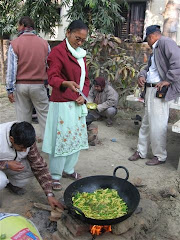
On Saturday morning when I turned on my phone, there was a message from Umapati, informing me that I was expected at the primary teachers’ picnic, starting at 8am. I telephoned him; the teachers had been trying to contact me since 5am, knowing that I like advance warning of ‘events’. Plans for the morning put on hold and I arrived at the picnic site soon after 10, to find fires blazing, meat roasting, women chopping many kilos of vegetables and most of the men playing cards. The first round of snacks appeared at 11. Handfuls of beaten rice, puffed rice, spicy snacks, fiery vegetable stew, yogurt with a pile of sticky Indian sweets on the top. I managed a small portion, sitting cross legged on an old sack with the women. Lots of laughter and photographs, singing and dancing before the preparations for the main meal started. I escaped to go to market for Saturday shopping. Another adventure on Sunday as we went out for the day with Hanna, Luca (aged 3) and Uta, a young German eye specialist visiting the hospital here before she starts a one year placement in Lahan, 200 km west. We headed north to Dharan and then up to the hills to climb the observation tower on the hill at Bhedeta, where on a clear day there are fantastic views of the Everest range. It was not a clear day. Descended back to Dharan, where Hanna and family are planning to move in April, to look at some houses. One was on the massive site of the BP Koirala Hospital and Medical School. This was the former British Gorkha Military HQ, with large colonial houses, Capability Brown landscaping, a country club and a golf course. Nirvana Country Club had seen better days, but we had a pleasant lunch sitting in the sunshine behind a barbed wire fence looking over the golf course, where cows grazed on scrubby brown grass and a few stout Indian doctors on their afternoon off swung their clubs. Home via the ‘supermarket’ in Itahari.
Saturday, 24 January 2009
Wednesday, 7 January 2009
Christmas and new year
The festive season has been marked here by another increase in load shedding and a lack of water, apart from a flood through the roof in the spare room. The upstairs door has been securely padlocked by the new landlord, so we had no access to find out what was happening. After a frantic hour trying to contact him, he appeared with our friend Dinesh and a plumber, who mended a burst pipe in the upstairs bathroom. Fortunately, there was little damage and David managed to dry out all his carefully prepared teaching materials that are laid out in ordered piles on the spare bed. This was shortly followed by the demise of our gas ring. Ravi’s brother, who spent an hour sitting on our kitchen floor dismantling and reassembling it, covering the marble with a lethal carbon and kerosene mixture, has repaired it.
Christmas Day started foggy and chilly, but a pale sun came through in time for breakfast on the terrace with our splendid dahlias. Schools were closed but I had a busy day training for primary English. ‘Learning English through activities’ is our theme, not without hazards, as most of the group are stout and in their fifties. Chhabilal pulled a muscle as he was ‘running to the board’ to find his word; Laxmi started to have palpitations and refused to ‘jump and down’ any more because of her heart condition. Manju wants to be my best friend. She is the most colourful, with her scarlet polo-necked sweater under a swirly orange and yellow sari, topped off with a fluorescent pink cardigan and an electric blue bobble hat.
Our best present was an invitation to Hanna and Josef’s for a hot bath / shower. Bliss; I had not had a bath since England and our last hot shower was in Kathmandu almost 3 months ago. After a traditional Austrian Christmas Day supper, we sang carols round the tree and exchanged small presents. An enjoyable evening and very dark cycle ride home. Back to Hanna and Josef’s for new year and games and fireworks with the boys. It is difficult for us to reciprocate their hospitality, as we are now confined to the candlelit small backroom to keep warm. The gas fire is working again, but the fumes are so noxious we have to turn it off before we pass out.
We have just embarked on the BBC War and Peace series from the 1970s. The sound and movement are not synchronised, its in a strange sepia tint and has Dutch subtitles. It is so dated – very stagy and overacted. The wigs are extraordinary and resemble the hairstyles of 70s football players. My hair does too, after 3 months without a visit to a hairdresser. We should manage to make the DVDs last until we go to India, as the laptop battery is very tired so we have to watch half an episode at a time.
Further increases in load shedding have started this week. On a good day we have 6 hours of electricity. Government administrative expenditure has increased 8 times since April – mostly on overseas travel for the new regime. The press has become more critical of the new government, and newspapers were interrupted for a few days this week after Maoists smashed newspaper offices and beat up editors. Headlines now focus on the power crisis and government plans to generate more electricity. The latest features plans for wind farms; however ‘the inaccessibility to identified project areas is a major stumbling block’.
Its now the beginning of the kite flying season. Small boys perch precariously on the rooftops with home made kites on the end of huge spools of string. A consignment of cheap badminton rackets has appeared in the market, so children are lashing ‘shuttlecocks’ made from rubber bands around on pieces of waste ground. More dangerously, they are using the railings of the central reservation on the highway coming from the airport as badminton net!
Christmas Day started foggy and chilly, but a pale sun came through in time for breakfast on the terrace with our splendid dahlias. Schools were closed but I had a busy day training for primary English. ‘Learning English through activities’ is our theme, not without hazards, as most of the group are stout and in their fifties. Chhabilal pulled a muscle as he was ‘running to the board’ to find his word; Laxmi started to have palpitations and refused to ‘jump and down’ any more because of her heart condition. Manju wants to be my best friend. She is the most colourful, with her scarlet polo-necked sweater under a swirly orange and yellow sari, topped off with a fluorescent pink cardigan and an electric blue bobble hat.
Our best present was an invitation to Hanna and Josef’s for a hot bath / shower. Bliss; I had not had a bath since England and our last hot shower was in Kathmandu almost 3 months ago. After a traditional Austrian Christmas Day supper, we sang carols round the tree and exchanged small presents. An enjoyable evening and very dark cycle ride home. Back to Hanna and Josef’s for new year and games and fireworks with the boys. It is difficult for us to reciprocate their hospitality, as we are now confined to the candlelit small backroom to keep warm. The gas fire is working again, but the fumes are so noxious we have to turn it off before we pass out.
We have just embarked on the BBC War and Peace series from the 1970s. The sound and movement are not synchronised, its in a strange sepia tint and has Dutch subtitles. It is so dated – very stagy and overacted. The wigs are extraordinary and resemble the hairstyles of 70s football players. My hair does too, after 3 months without a visit to a hairdresser. We should manage to make the DVDs last until we go to India, as the laptop battery is very tired so we have to watch half an episode at a time.
Further increases in load shedding have started this week. On a good day we have 6 hours of electricity. Government administrative expenditure has increased 8 times since April – mostly on overseas travel for the new regime. The press has become more critical of the new government, and newspapers were interrupted for a few days this week after Maoists smashed newspaper offices and beat up editors. Headlines now focus on the power crisis and government plans to generate more electricity. The latest features plans for wind farms; however ‘the inaccessibility to identified project areas is a major stumbling block’.
Its now the beginning of the kite flying season. Small boys perch precariously on the rooftops with home made kites on the end of huge spools of string. A consignment of cheap badminton rackets has appeared in the market, so children are lashing ‘shuttlecocks’ made from rubber bands around on pieces of waste ground. More dangerously, they are using the railings of the central reservation on the highway coming from the airport as badminton net!

Friday, 19 December 2008
Cold, dry and dark
At 7am on Saturday morning, Babaram sent a text message to David to ask him to do training for ECD facilitators on Monday at the DEO. Text is their primary method of communication, as Babaram refuses to speak English and does not understand David’s Nepali. So on Sunday we set off through the harvested paddy fields and wandering buffalo to Bokari to collect materials. We found the teachers sitting on benches on the field surrounded by children playing. A group of men were standing on the path having a heated discussion. They had brought huge padlocks and secured all the classrooms. An effective lock out. None of the teachers knew why or how long it was likely to continue. A pleasant cycle ride across country took us to Bal Rani, which was open and we were able to borrow Manu the bear, the butterflies and a play box. Other materials David managed to replicate during the afternoon. The government has suddenly changed the visa process and all David’s paperwork has to be redone. The chief of the DEO has been transferred, so there is no-one to sign the new forms. There seems to be the start of removal of pahadis (hill people) from senior government appointments in the Terai, and replacement with madhesi. Two additional days of school closure later in the week for Bakar Id on Tuesday and a local festival on Friday, but the ETC remained open and busy. ETC is devoid of permanent staff; Tulsi has gone to Dhankuta, Umapati is doing Life Skills training in Bangalore and Durga has gone to Laos on a VSO study tour.
Having enjoyed a lovely day on Saturday, with an afternoon at the pool, the fog descended on Sunday and we had our first cold day. It’s the season of goats-in-cardigans and cows covered in old sacks in the mornings. Rani’s milkman, who arrives on his bicycle each morning with fresh milk in old plastic water bottles in a jute bag suspended from his handlebars, now has his head wrapped in a scarf and scarlet leggings under his lungi. Thermals and blankets out from under the bed. A new power station, the second largest in the country, has just been completed; only 4 years behind schedule and at double the projected cost. Local people have prevented it opening because it was behind schedule……. Meanwhile load shedding has increased in length, so it is now 10 to 19 hours a day. Trying to keep computers, phones and emergency lights charged and water pumped is a real challenge, especially as we are usually at work or asleep when the electricity is on. Bread and ice cream making a real problem, and we rarely have an internet connection.
Colin and Ellen, friends from Ethiopia eventually arrived for a few days on Monday, having spent the morning fog-bound at a chilly Kathmandu airport. They are working in an international school in Kathmandu for 6 months and wanted to see a different face of Nepal. When they eventually arrived, we had a wonderful, if cold and foggy, few days. It helped that they had previously lived in Debre Berhan, a small hill town in Ethiopia. We breakfasted and dined by candlelight, survived low pressure cold showers, coped without our usual cheese supply and had a very flexible itinerary caused by transport strikes. We visited the ETC and David’s schools and eventually got to Dharan where the sun was shining and we found roast chestnuts and mushrooms in the market. Women in colourful clothes and elaborate nose jewellery congregate in Dharan from the hills to sell local produce.
On Wednesday we spent the day with Josef and Hanna, who had invited us to visit the eye hospital and see the plans for the new building. The current hospital, which was set up 2 years ago to assess need, is dealing with more than 500 people a day in an old hotel building. Families with bundles of belongings and many blankets were camped out on the grass. There was a steady procession through the different stages of assessment, consultation and treatment, with a sense of calm resignation from the many people waiting patiently. A basic cataract operation with a 2 night stay costs £7, but people who have no money are treated free of charge. After a vision check, patients are referred to technicians who make a preliminary diagnosis; some are referred to opticians and are fitted with glasses for about 50p; others require minor surgery; many have cataracts- one doctor carries out 150 cataract operations in a day; the hospital also does corneal grafts and retinal surgery. What to western eyes looked at first like a refugee camp, provided a highly organised and professional service, with literally hundreds of people having their vision restored each day. Josef has just leased some old portacabins that he is converting into basic dormitories with a toilet block and cooking shelter where families can stay. The wall surrounding the new site has been completed; the plans are ambitious and there are many political challenges ahead.
Having enjoyed a lovely day on Saturday, with an afternoon at the pool, the fog descended on Sunday and we had our first cold day. It’s the season of goats-in-cardigans and cows covered in old sacks in the mornings. Rani’s milkman, who arrives on his bicycle each morning with fresh milk in old plastic water bottles in a jute bag suspended from his handlebars, now has his head wrapped in a scarf and scarlet leggings under his lungi. Thermals and blankets out from under the bed. A new power station, the second largest in the country, has just been completed; only 4 years behind schedule and at double the projected cost. Local people have prevented it opening because it was behind schedule……. Meanwhile load shedding has increased in length, so it is now 10 to 19 hours a day. Trying to keep computers, phones and emergency lights charged and water pumped is a real challenge, especially as we are usually at work or asleep when the electricity is on. Bread and ice cream making a real problem, and we rarely have an internet connection.
Colin and Ellen, friends from Ethiopia eventually arrived for a few days on Monday, having spent the morning fog-bound at a chilly Kathmandu airport. They are working in an international school in Kathmandu for 6 months and wanted to see a different face of Nepal. When they eventually arrived, we had a wonderful, if cold and foggy, few days. It helped that they had previously lived in Debre Berhan, a small hill town in Ethiopia. We breakfasted and dined by candlelight, survived low pressure cold showers, coped without our usual cheese supply and had a very flexible itinerary caused by transport strikes. We visited the ETC and David’s schools and eventually got to Dharan where the sun was shining and we found roast chestnuts and mushrooms in the market. Women in colourful clothes and elaborate nose jewellery congregate in Dharan from the hills to sell local produce.
On Wednesday we spent the day with Josef and Hanna, who had invited us to visit the eye hospital and see the plans for the new building. The current hospital, which was set up 2 years ago to assess need, is dealing with more than 500 people a day in an old hotel building. Families with bundles of belongings and many blankets were camped out on the grass. There was a steady procession through the different stages of assessment, consultation and treatment, with a sense of calm resignation from the many people waiting patiently. A basic cataract operation with a 2 night stay costs £7, but people who have no money are treated free of charge. After a vision check, patients are referred to technicians who make a preliminary diagnosis; some are referred to opticians and are fitted with glasses for about 50p; others require minor surgery; many have cataracts- one doctor carries out 150 cataract operations in a day; the hospital also does corneal grafts and retinal surgery. What to western eyes looked at first like a refugee camp, provided a highly organised and professional service, with literally hundreds of people having their vision restored each day. Josef has just leased some old portacabins that he is converting into basic dormitories with a toilet block and cooking shelter where families can stay. The wall surrounding the new site has been completed; the plans are ambitious and there are many political challenges ahead.
Saturday, 6 December 2008
Winter approaches
The festival season has been replaced by the wedding season. Temple music starts at 4am, well before the imam at 5, often followed by a strident wedding band of drums and trumpets waking the bridegroom in a neighbouring house. The weather is beautiful, with warm sunny days and cool nights. Because it is officially winter, woolly hats, scarves and cardigans are worn by the men and blankets by the women. The air is full of dust; a combination of no rain since we returned in August and the beginnings of road repairs. Huge piles of sand and gravel have been dumped at the sides of the roads, so they now resemble a slalom course. There is room to manoeuvre a bicycle down the road to the ETC, but frequent diversions have to be made for motorcycles and rickshaws.
My month with secondary English teachers has just ended. The group is only 13, so I have got to know them well. Balkumari and Yasoda, the two women have become my special friends; their English is limited to grade 7 level, so they rattle on in Nepali. They are both in their mid thirties; Balkumari has two sons, and Yasoda one daughter. While Yasoda is slim and elegant Balkumari is large and jolly. I have been treated to several views of her Caesarean scars (horrendous). Last week she told me I had very nice teeth and asked me where I had got them! Rama, a retired head who has studied in Leeds and at the Bell language school in Saffron Walden worked with me for a week, which we all enjoyed. She now does community work, watches TV and eats!
Secondary training finished on Monday, with the usual examination, written in incomprehensible English. The paper featured multiple choice questions, very short answer questions, short answer questions and long answer questions. The following question only works for Hindus. ‘How do you convince people who say that English is cow slaughters’ [sic] language?’
I have spent the rest of the week doing primary English with Durga. He has surpassed himself, and we have run an activity based week. Having watched the groups sitting writing for the first 3 weeks, it’s a delight to watch them running around (they are mostly stout and elderly) and giggling. The ‘make a hat for your friend’ activity which teaches reading writing speaking AND listening skills in English reduced me to hysteria, as they wore their new hats over their already eccentric headgear.
The most dramatic incident of the week occurred at tiffin time on Thursday. I was standing on the school field in the sun eating an apple. Gita came over for a chat, leading her young heifer. As we were talking, the heifer mounted her shoulders, cannoning her into me and pinning us both against the wall. We were helpless with laughter and were stuck fast until some excited young schoolboys came to drag the cow off.
Two enjoyable evenings with the Schneiders. The first time we were welcomed by Josef and the boys standing in the road shining torches so we could find the house in the inevitable power cut. Having spent 2 years in a large house with pool in Zimbabwe, they are used to a more typical expat lifestyle, with ‘staff’. Hanna has taught Apsara to make European food as a change from dal bhat, so much to the boys’ delight we had an Austrian meal. They have decided to move to Dharan, near to the hills and forest, where there is a larger expat community, a better school for the boys and Hanna can start an MSc at the medical school. They expect to stay here until March. We were invited again for St Nikolaus Eve, which coincided with my birthday. St Nikolaus arrived laden with presents for the boys, a beautiful winter kurta for me and a chocolate cake from David. The latter caused some problems; he ordered it from the bakery early in the week. On Friday there was fighting between YCL and the youth group of the Marxists, so the whole town was closed. Karna phoned the bakery and David crawled in under the shutters to retrieve the cake.
We are still swimming in the afternoons at weekends, and have started cycle rides out into the countryside on Sundays. Last weekend we discovered a wonderful old Shiva temple in a village near to the Indian border. The entire village assembled to find out who we were and what we were doing; boys stopped flying their kites, girls with smaller siblings on their hips hovered shyly and the women brought their new baby goats to show us. The priest and the head man told us about the temple which is reputedly 2000 years old and the oldest in the area. There is a huge Nandi (Shiva’s bull) and several smaller Nandi shrines, where women were burning incense and anointing him with milk and marigold petals. There’s a large pond in front of the temple for ritual bathing and fishing, as well as for children to play. A gentle pace of rural life, with animals grazing, rice straw being brought in for the winter, new rice being threshed, and all the family working together. We spoke to several young people who dream of getting away for a better education and a different way of life.
My month with secondary English teachers has just ended. The group is only 13, so I have got to know them well. Balkumari and Yasoda, the two women have become my special friends; their English is limited to grade 7 level, so they rattle on in Nepali. They are both in their mid thirties; Balkumari has two sons, and Yasoda one daughter. While Yasoda is slim and elegant Balkumari is large and jolly. I have been treated to several views of her Caesarean scars (horrendous). Last week she told me I had very nice teeth and asked me where I had got them! Rama, a retired head who has studied in Leeds and at the Bell language school in Saffron Walden worked with me for a week, which we all enjoyed. She now does community work, watches TV and eats!
Secondary training finished on Monday, with the usual examination, written in incomprehensible English. The paper featured multiple choice questions, very short answer questions, short answer questions and long answer questions. The following question only works for Hindus. ‘How do you convince people who say that English is cow slaughters’ [sic] language?’
I have spent the rest of the week doing primary English with Durga. He has surpassed himself, and we have run an activity based week. Having watched the groups sitting writing for the first 3 weeks, it’s a delight to watch them running around (they are mostly stout and elderly) and giggling. The ‘make a hat for your friend’ activity which teaches reading writing speaking AND listening skills in English reduced me to hysteria, as they wore their new hats over their already eccentric headgear.
The most dramatic incident of the week occurred at tiffin time on Thursday. I was standing on the school field in the sun eating an apple. Gita came over for a chat, leading her young heifer. As we were talking, the heifer mounted her shoulders, cannoning her into me and pinning us both against the wall. We were helpless with laughter and were stuck fast until some excited young schoolboys came to drag the cow off.
Two enjoyable evenings with the Schneiders. The first time we were welcomed by Josef and the boys standing in the road shining torches so we could find the house in the inevitable power cut. Having spent 2 years in a large house with pool in Zimbabwe, they are used to a more typical expat lifestyle, with ‘staff’. Hanna has taught Apsara to make European food as a change from dal bhat, so much to the boys’ delight we had an Austrian meal. They have decided to move to Dharan, near to the hills and forest, where there is a larger expat community, a better school for the boys and Hanna can start an MSc at the medical school. They expect to stay here until March. We were invited again for St Nikolaus Eve, which coincided with my birthday. St Nikolaus arrived laden with presents for the boys, a beautiful winter kurta for me and a chocolate cake from David. The latter caused some problems; he ordered it from the bakery early in the week. On Friday there was fighting between YCL and the youth group of the Marxists, so the whole town was closed. Karna phoned the bakery and David crawled in under the shutters to retrieve the cake.
We are still swimming in the afternoons at weekends, and have started cycle rides out into the countryside on Sundays. Last weekend we discovered a wonderful old Shiva temple in a village near to the Indian border. The entire village assembled to find out who we were and what we were doing; boys stopped flying their kites, girls with smaller siblings on their hips hovered shyly and the women brought their new baby goats to show us. The priest and the head man told us about the temple which is reputedly 2000 years old and the oldest in the area. There is a huge Nandi (Shiva’s bull) and several smaller Nandi shrines, where women were burning incense and anointing him with milk and marigold petals. There’s a large pond in front of the temple for ritual bathing and fishing, as well as for children to play. A gentle pace of rural life, with animals grazing, rice straw being brought in for the winter, new rice being threshed, and all the family working together. We spoke to several young people who dream of getting away for a better education and a different way of life.
Saturday, 15 November 2008
Prabodhini Ekadashi
This week was Prabodhini Ekadashi, when Lord Devi is supposed to awaken from a four month sleep. So has the training centre, where we are overwhelmed by training after months of inactivity. Three groups of secondary teachers started on November 2, including an English group that I seem to have overall responsibility for. The notebooks for the trainees are from a new supplier. The usual tasteful Nepali scenes of mountains and temples have been replaced by a series called Classmate. The classmates depicted on the covers are scantily clad lovelies with long blonde hair and names like Avril and Bonny. Rather disturbing, but the teachers seem oblivious.
This week, I have been joined by Bindeshwor and Parmila in the English group. Bindeshwor attended some ‘master trainers’ workshops that I led – and is impressive; probably the best of the part time trainers we have. He arrives at midday, having already taught 5 English lessons in his school, followed by 3 Maths lessons in a private college. His degree is in Science. . Parmila treats the group like a class of 70 grade 9s. Beside her I feel decidedly shabby. She drips with gold jewellery, has a range of beautiful chiffon saris covered in sequins and sparkly high heeled mules. My limited collection of kurtas has suffered from 18 months of washing in Indian detergent and my ‘five-strap’ sandals now have only three. I lead parts of the training every day and am delighted to see a change in the teachers – none of them have worked with a native speaker before; some cannot cope much above grade 7 level, while some of the young ones are studying for masters degrees and are very able. Many of them arrive early in the morning so we can have ‘conversation’ before class starts; it’s wonderful to see their confidence grow. They are now starting to play ‘learning English’ games with relish and lots of laughter and are beginning to realise that their role is helping students learn, rather than delivering the textbook. Let’s hope it transfers to their classrooms.
Many of the 130 primary teachers who arrived on Sunday are elderly men who had hoped to escape training (this is the last year), but they have settled down and seem to be enjoying themselves. There are a few bright eyed young women too. Many are drifting from the 6am classes to 11am, so the later shift is now uncomfortably full. My days are busy, mostly with the English group, but with some input into Science (practical activities that do not require any resources) and primary training.
Meanwhile David is having a wonderful time with Manu the bear, who is now an honorary member of the class, with his own chair and name badge. In both schools, the ECD teacher has been really responsive and loves using the new materials he has made. A delegation from the DEO office has been to watch and he is now inundated with requests. At last!
Chhath was the last of the big festivals and we went to the river with Josef, Hanna and the children. A colourful and enjoyable evening. At home we are beset by a plague of grasshoppers, ranging in size from barely visible to chunky ones suitable for coating in chocolate. They are worst when the power goes off, when they flock to our emergency fluorescent lamp. At night they entertain themselves by jumping all over us and especially enjoy wandering through our hair. Perhaps they think its grass. David hoovers furiously each morning to get rid of the dead bodies. Especially important today as Josef and Hanna are coming for supper.
This week, I have been joined by Bindeshwor and Parmila in the English group. Bindeshwor attended some ‘master trainers’ workshops that I led – and is impressive; probably the best of the part time trainers we have. He arrives at midday, having already taught 5 English lessons in his school, followed by 3 Maths lessons in a private college. His degree is in Science. . Parmila treats the group like a class of 70 grade 9s. Beside her I feel decidedly shabby. She drips with gold jewellery, has a range of beautiful chiffon saris covered in sequins and sparkly high heeled mules. My limited collection of kurtas has suffered from 18 months of washing in Indian detergent and my ‘five-strap’ sandals now have only three. I lead parts of the training every day and am delighted to see a change in the teachers – none of them have worked with a native speaker before; some cannot cope much above grade 7 level, while some of the young ones are studying for masters degrees and are very able. Many of them arrive early in the morning so we can have ‘conversation’ before class starts; it’s wonderful to see their confidence grow. They are now starting to play ‘learning English’ games with relish and lots of laughter and are beginning to realise that their role is helping students learn, rather than delivering the textbook. Let’s hope it transfers to their classrooms.
Many of the 130 primary teachers who arrived on Sunday are elderly men who had hoped to escape training (this is the last year), but they have settled down and seem to be enjoying themselves. There are a few bright eyed young women too. Many are drifting from the 6am classes to 11am, so the later shift is now uncomfortably full. My days are busy, mostly with the English group, but with some input into Science (practical activities that do not require any resources) and primary training.
Meanwhile David is having a wonderful time with Manu the bear, who is now an honorary member of the class, with his own chair and name badge. In both schools, the ECD teacher has been really responsive and loves using the new materials he has made. A delegation from the DEO office has been to watch and he is now inundated with requests. At last!
Chhath was the last of the big festivals and we went to the river with Josef, Hanna and the children. A colourful and enjoyable evening. At home we are beset by a plague of grasshoppers, ranging in size from barely visible to chunky ones suitable for coating in chocolate. They are worst when the power goes off, when they flock to our emergency fluorescent lamp. At night they entertain themselves by jumping all over us and especially enjoy wandering through our hair. Perhaps they think its grass. David hoovers furiously each morning to get rid of the dead bodies. Especially important today as Josef and Hanna are coming for supper.
Saturday, 1 November 2008
Work and play
A warm welcome back at work, especially as I brought information about VSO Link Tour for selected education partners to spend a week in Laos, looking at developments in teacher training and primary education. Durga and I prepared an application for him. Lots of enthusiasm for a ‘Training of Trainers’ day, to prepare for the next batch of training that will start on November 2. Very good training day on Friday – like the first day of term, when everyone comes back together and exchanges news. Good session, mostly led by Durga and Umapati. On Monday we repeated the exercise for the primary trainers; 130 primary teachers will arrive on November 9. After 4 months with no real work, we are overstretched and will run 3 groups from 6 – 11am and 4 groups from 11-4, with no days off. Many trainers will work both shifts.
David had a wonderful week focusing on ECD, with lots of story telling and play. He has produced some lovely materials that Shova is now using effectively and producing materials of her own. The children are responding so well and making great progress. On his days off this week he has used the ETC’s projector to help him produce huge animal pictures on chart paper from VSO using images from the internet.
Holiday mood has overwhelmed us again with preparations for Tihar. The market on Sunday was full of brightly coloured decorations, people stocking up on dried fruit and nuts – dates, sultanas, coconut, cashews, pistachios, walnuts, almonds, and buying thousands of small clay pots to make oil lamps. Many of the stall holders were painting their stalls and plastic covers. I bought green splattered carrots and yellow spotted aubergines. . A sudden change in the weather on Monday when moist clouds arrived from the Bay of Bengal and the temperature plummeted to 26oC, and we got out our winter clothes! Tihar dawned chilly and grey, but by the time we went to the market to see the banana trees placed outside the shops and the decorations on the sides of the street, the sun was out. Dogs and cows were adorned with garlands and brightly coloured tikka powder – mostly fuschia pink and turquoise. Abi has given Rosie (the dog – now a firm friend – no more yipping) a hair cut. Rani is having garden makeover.
A rare social event in the afternoon – last week we met Josef, Hanna and their 3 boys, aged 7,5 and 3, at the pool. He is an Austrian architect and is here for 4 years as project manager of the new eye hospital, which will be the second largest in the world! We were invited for tea – a delightful family in a beautiful house to the south of the city. We have decided to have a social life at last. In the evening we went back to the market to see the lights – of course there was a power cut; the gaudy electric bulbs went off so it was lit by thousands of beautiful oil lamps. Great cheers when power restored and the loudspeakers could start blaring out music again. Arrived home to find the family about to start their fireworks. A lavish display was put on with life threating enthusiasm by Abi, Ram (the driver and odd job man),and Karna, who had the time of his life. The box of 100 Chinese bombs was particularly terrifying. Pyel and Rani provided delicious snacks. Loud bangs and a flashing sky persisted until after midnight. Like living in a war zone.
The landlord has sold the house with us in it and is moving out on Saturday. Apparently the new owners will arrive ‘soon’ and move into our flat when we leave in March. This leaves Karna homeless. We have been to look at a number of rat-infested rooms with him, and have found a clean room with small kitchen and access to bathroom with a nice family a few houses away. Good to have him nearby so he can continue to learn to use the computer and practice his English.
Swimming with our Austrian friends on Wednesday; we were joined by Iris, a German eye surgeon, who arrived about the same time as us. All have worked in Africa before (Zimbabwe, Cameroon, Kenya), and are finding Biratnagar much more challenging. Candlelit evening with Durga and his daughters, with a profusion of sticky sweets before the dal bhat, and invitation to stay the night. We braved the firecrackers in the streets on our bicycles – at least there was more light than usual.
David had a wonderful week focusing on ECD, with lots of story telling and play. He has produced some lovely materials that Shova is now using effectively and producing materials of her own. The children are responding so well and making great progress. On his days off this week he has used the ETC’s projector to help him produce huge animal pictures on chart paper from VSO using images from the internet.
Holiday mood has overwhelmed us again with preparations for Tihar. The market on Sunday was full of brightly coloured decorations, people stocking up on dried fruit and nuts – dates, sultanas, coconut, cashews, pistachios, walnuts, almonds, and buying thousands of small clay pots to make oil lamps. Many of the stall holders were painting their stalls and plastic covers. I bought green splattered carrots and yellow spotted aubergines. . A sudden change in the weather on Monday when moist clouds arrived from the Bay of Bengal and the temperature plummeted to 26oC, and we got out our winter clothes! Tihar dawned chilly and grey, but by the time we went to the market to see the banana trees placed outside the shops and the decorations on the sides of the street, the sun was out. Dogs and cows were adorned with garlands and brightly coloured tikka powder – mostly fuschia pink and turquoise. Abi has given Rosie (the dog – now a firm friend – no more yipping) a hair cut. Rani is having garden makeover.
A rare social event in the afternoon – last week we met Josef, Hanna and their 3 boys, aged 7,5 and 3, at the pool. He is an Austrian architect and is here for 4 years as project manager of the new eye hospital, which will be the second largest in the world! We were invited for tea – a delightful family in a beautiful house to the south of the city. We have decided to have a social life at last. In the evening we went back to the market to see the lights – of course there was a power cut; the gaudy electric bulbs went off so it was lit by thousands of beautiful oil lamps. Great cheers when power restored and the loudspeakers could start blaring out music again. Arrived home to find the family about to start their fireworks. A lavish display was put on with life threating enthusiasm by Abi, Ram (the driver and odd job man),and Karna, who had the time of his life. The box of 100 Chinese bombs was particularly terrifying. Pyel and Rani provided delicious snacks. Loud bangs and a flashing sky persisted until after midnight. Like living in a war zone.
The landlord has sold the house with us in it and is moving out on Saturday. Apparently the new owners will arrive ‘soon’ and move into our flat when we leave in March. This leaves Karna homeless. We have been to look at a number of rat-infested rooms with him, and have found a clean room with small kitchen and access to bathroom with a nice family a few houses away. Good to have him nearby so he can continue to learn to use the computer and practice his English.
Swimming with our Austrian friends on Wednesday; we were joined by Iris, a German eye surgeon, who arrived about the same time as us. All have worked in Africa before (Zimbabwe, Cameroon, Kenya), and are finding Biratnagar much more challenging. Candlelit evening with Durga and his daughters, with a profusion of sticky sweets before the dal bhat, and invitation to stay the night. We braved the firecrackers in the streets on our bicycles – at least there was more light than usual.
Saturday, 18 October 2008
Another holiday
September 28. Back to noisy, smelly and incredibly wet Kathmandu. Dashain shopping frenzy brought traffic to a standstill on Monday so we walked the 70 minutes from VSO to the guest house in pouring rain. There is a new subeditor on The Himalayan Times, with pre-holiday front page headlines of ‘cops fleece sheep traders’ ‘water talks flow’ ‘ spirited drive against excess alcohol’. Three days of workshops with continual talk and VSO socialising left us exhausted, so we enjoyed a weekend relaxing at the Manaslu pool and a day with Colin and Ellen, friends from VSO Ethiopia, now working in Kathmandu for 6 months.
After successfully renewing our Indian visas, with great relief at never having to spend a tedious day queuing and being interrogated again, we started our holiday at 7am on October 7, when Himal arrived with a car to take us to the Seti River. We reached Damauli at 11am. The raft arrived at 1pm and the ‘chief rafter’ with life jackets arrived soon after 4pm. We were happy to get onto the river, in an overladen raft with a young Swedish couple and 2 Nepalis who seemed to know what they were doing. The river was very high after so much rain, so we sped along without much paddling, bouncing through rapids and white water until we pulled onto a sandbank as the sun was setting. We managed to get tents up before it was completely dark, surrounded by curious children, who had come down to the river to play and swim. A vast quantity of dal bhat was cooked over an open fire on the beach and we crawled into our tents at 8pm and fell asleep to the sound of the river. Woken early by the return of the children, walked along the beach covered in perfectly round pebbles glistening with mica and water. The morning’s rafting was beautiful, through deep wooded valleys with brilliant malachite kingfishers darting into the waves. Some BIG rapids, where we were all in danger of falling out and it was impossible to obey Sala’s shouts of “faster, faster” in our attempts to hang on. Himal met us at the end and we drove to Pokhara and the lovely Sacred Valley guest house. A terrifying storm in the mountains knocked out the electricity and we had a wet and chilly dinner. Fortunately it was calm and clear, if dark, when we arrived at the airport at 5.30am the next morning. The airport gates were firmly padlocked, and we joined some elderly Tibetans hopefully twiddling their prayer beads waiting outside. Eventually the gates were opened and by 6.20 we were airborne in a tiny plane flying below the Annapurnas with spectacular views of wooded hills and valleys and snowy peaks above. Breakfast in the cold early morning air of Jomson, looking at the mountains. A gentle 2 hour walk along the Kali Ghandaki river bed brought us to the ancient settlement of Kagbeni. Inevitably, we met some VSOs on the way, descending from Muktinath, the destination of many Indian and Nepali pilgrims. The landscape is stark and arid, with huge sandy mountains towering above the river, and green cultivated land below. Having left our bags at the friendly Paradise guest house, we walked up stony paths through small fields of barley and maize, grazing horses and mules, apple orchards dripping with fruit from golden to green and crimson. We ate our first hearty trekker’s lunch at the guest house rather than the Germ In Bakery, then Himal helped us gain access to the monastery where 9 Buddhist monks are living. The ancient Buddhas, masks, wall paintings and other decorations were beautiful, dimly lit by butter lamps. David was allowed upstairs to a special ceremony, where traditional musical instruments and chanting from Tibetan scriptures was in process. A huge rough mud wall led into the ancient walled city, at first apparently deserted, but gradually people emerged from behind old wooden doors and windows, animals stamped and snorted, munching their fodder behind closed doors; other animals were out grazing before being brought in for the night. Huge yaks, tiny dzopas, mules and ponies, furry dogs stretched out in the sun, children playing with home made toys. Splendid architecture, with characteristic Mustang red ochre, black and cream paint, prayer walls, wheels and flags at every turn.
The next day we walked down the valley to Marpha, the ‘apple capital’ of Nepal. Solid white painted stone houses, roofs piled with wood ready for the winter. A vicious wind starts at about 10am every morning, whipping up the dust, but the sky was brilliant blue with huge peaks of the Nilgiris all around. A comfortable lodge featuring apple cake, apple pie, apple crumble, apple fritters, apple pancakes, apple jam, apple momos, apple cider, apple brandy – and even apples. Delicious. The next day we continued mostly downhill through pretty villages to a ‘luxury’ lodge at Kalopani, with splendid views of Dhaulgiri and the Annapurna range. Our final very long and blistering walk took us to the hot springs of Tatopani. There is allegedly now a ‘road’ from Pokhara to Jomson, which will bring access to markets for the farmers, but have a negative effect on tourist lodges. In reality, there is a dirt track, frequently washed down the mountainside by monsoon landslides. We had been assured we could pick up transport back to Beni, and the next morning we found a dilapidated bus and climbed aboard for a nerve-wracking 3 hour journey. The ‘road’ runs along the edge of the Kali Ghandaki, the deepest gorge in the world. I had the misfortune to be sitting ‘gorge side’ and for most of the way there was no firm land visible from my side of the bus, just sheer jungled slopes down to the swirling waters far below. The Nepalis soon started shouting “plastic, plastic” – a request for bags to be sick into. At one point we all left the bus as the track was too narrow for all 4 wheels at once, but it hopped swiftly across on three wheels, luggage swaying precariously on the roof. Eventually we arrived back safely in Beni, where we got a taxi that hurtled us round the hairpins back to the calm serenity of the Sacred Valley in Pokhara, where we found Colin and Ellen having tea and cakes. A relaxing day, before the long bus journey back to the traffic of Kathmandu, where we caught up with work, said goodbye to Purna the Education Manager who moves to London in December and a had a final delicious supper with friends before returning home.
October 17. Biratnagar. Eastern Terai at standstill with banda that has already lasted 3 days. Managed to get ourselves and all our stuff into 2 rickshaws for an extortionate price. Karna was working on our terrace, as Chhatra and Tara were upstairs and many people downstairs. No water. No electricity. Flat bike tyres. Our bicycle repair man couldn’t pump them up because he had toothache – “come back in 2 days”, so we borrowed the pump and did them ourselves. First oranges of the season in the market, but no cheese.
After successfully renewing our Indian visas, with great relief at never having to spend a tedious day queuing and being interrogated again, we started our holiday at 7am on October 7, when Himal arrived with a car to take us to the Seti River. We reached Damauli at 11am. The raft arrived at 1pm and the ‘chief rafter’ with life jackets arrived soon after 4pm. We were happy to get onto the river, in an overladen raft with a young Swedish couple and 2 Nepalis who seemed to know what they were doing. The river was very high after so much rain, so we sped along without much paddling, bouncing through rapids and white water until we pulled onto a sandbank as the sun was setting. We managed to get tents up before it was completely dark, surrounded by curious children, who had come down to the river to play and swim. A vast quantity of dal bhat was cooked over an open fire on the beach and we crawled into our tents at 8pm and fell asleep to the sound of the river. Woken early by the return of the children, walked along the beach covered in perfectly round pebbles glistening with mica and water. The morning’s rafting was beautiful, through deep wooded valleys with brilliant malachite kingfishers darting into the waves. Some BIG rapids, where we were all in danger of falling out and it was impossible to obey Sala’s shouts of “faster, faster” in our attempts to hang on. Himal met us at the end and we drove to Pokhara and the lovely Sacred Valley guest house. A terrifying storm in the mountains knocked out the electricity and we had a wet and chilly dinner. Fortunately it was calm and clear, if dark, when we arrived at the airport at 5.30am the next morning. The airport gates were firmly padlocked, and we joined some elderly Tibetans hopefully twiddling their prayer beads waiting outside. Eventually the gates were opened and by 6.20 we were airborne in a tiny plane flying below the Annapurnas with spectacular views of wooded hills and valleys and snowy peaks above. Breakfast in the cold early morning air of Jomson, looking at the mountains. A gentle 2 hour walk along the Kali Ghandaki river bed brought us to the ancient settlement of Kagbeni. Inevitably, we met some VSOs on the way, descending from Muktinath, the destination of many Indian and Nepali pilgrims. The landscape is stark and arid, with huge sandy mountains towering above the river, and green cultivated land below. Having left our bags at the friendly Paradise guest house, we walked up stony paths through small fields of barley and maize, grazing horses and mules, apple orchards dripping with fruit from golden to green and crimson. We ate our first hearty trekker’s lunch at the guest house rather than the Germ In Bakery, then Himal helped us gain access to the monastery where 9 Buddhist monks are living. The ancient Buddhas, masks, wall paintings and other decorations were beautiful, dimly lit by butter lamps. David was allowed upstairs to a special ceremony, where traditional musical instruments and chanting from Tibetan scriptures was in process. A huge rough mud wall led into the ancient walled city, at first apparently deserted, but gradually people emerged from behind old wooden doors and windows, animals stamped and snorted, munching their fodder behind closed doors; other animals were out grazing before being brought in for the night. Huge yaks, tiny dzopas, mules and ponies, furry dogs stretched out in the sun, children playing with home made toys. Splendid architecture, with characteristic Mustang red ochre, black and cream paint, prayer walls, wheels and flags at every turn.
The next day we walked down the valley to Marpha, the ‘apple capital’ of Nepal. Solid white painted stone houses, roofs piled with wood ready for the winter. A vicious wind starts at about 10am every morning, whipping up the dust, but the sky was brilliant blue with huge peaks of the Nilgiris all around. A comfortable lodge featuring apple cake, apple pie, apple crumble, apple fritters, apple pancakes, apple jam, apple momos, apple cider, apple brandy – and even apples. Delicious. The next day we continued mostly downhill through pretty villages to a ‘luxury’ lodge at Kalopani, with splendid views of Dhaulgiri and the Annapurna range. Our final very long and blistering walk took us to the hot springs of Tatopani. There is allegedly now a ‘road’ from Pokhara to Jomson, which will bring access to markets for the farmers, but have a negative effect on tourist lodges. In reality, there is a dirt track, frequently washed down the mountainside by monsoon landslides. We had been assured we could pick up transport back to Beni, and the next morning we found a dilapidated bus and climbed aboard for a nerve-wracking 3 hour journey. The ‘road’ runs along the edge of the Kali Ghandaki, the deepest gorge in the world. I had the misfortune to be sitting ‘gorge side’ and for most of the way there was no firm land visible from my side of the bus, just sheer jungled slopes down to the swirling waters far below. The Nepalis soon started shouting “plastic, plastic” – a request for bags to be sick into. At one point we all left the bus as the track was too narrow for all 4 wheels at once, but it hopped swiftly across on three wheels, luggage swaying precariously on the roof. Eventually we arrived back safely in Beni, where we got a taxi that hurtled us round the hairpins back to the calm serenity of the Sacred Valley in Pokhara, where we found Colin and Ellen having tea and cakes. A relaxing day, before the long bus journey back to the traffic of Kathmandu, where we caught up with work, said goodbye to Purna the Education Manager who moves to London in December and a had a final delicious supper with friends before returning home.
October 17. Biratnagar. Eastern Terai at standstill with banda that has already lasted 3 days. Managed to get ourselves and all our stuff into 2 rickshaws for an extortionate price. Karna was working on our terrace, as Chhatra and Tara were upstairs and many people downstairs. No water. No electricity. Flat bike tyres. Our bicycle repair man couldn’t pump them up because he had toothache – “come back in 2 days”, so we borrowed the pump and did them ourselves. First oranges of the season in the market, but no cheese.
Subscribe to:
Posts (Atom)

.JPG)
.jpg)
.jpg)


.jpg)
.jpg)
.jpg)


.jpg)