We arrived home on Monday evening to find water pouring from the roof. Predictably none in the taps in our flat. A hose pipe was shooting a healthy jet of clean water across the roof from a feed pipe coming from below. It took some time to work out why this hose going nowhere had suddenly started spouting water. Eventually realisation dawned. The hose used to connect a metal pipe to the outside tap on the roof. The water pipes were the strange pieces of metal we found inside our flat that had been used to force the padlock. Quite why the water supply to the roof seemed to have resumed when there is no water anywhere else is yet to be understood. Tried to call a plumber, but too late in the day. Then the storms that have been pounding Myanmar arrived with torrents of rain and high winds. An eventful evening and night, with the bedroom lit by sheltering fireflies.
It had been a lovely day at the ETC, with some much improved micro-teaching in the morning, and a special presentation for Nepali Mother’s Day in the afternoon. I, of course, am now haamro aama, and was serenaded and festooned with jewellery. The bracelets are so tight I am unable to get them off and swam many lengths of the pool with 16 red and gold bracelets tinkling. I left my bindi stuck to the changing room wall, where I suspect it will stay for several months.
David, having managed to do some team teaching last week, arrived on Monday to find the staff and about 200 children about to set off into the countryside with a huge red and yellow banner to attract more children into school. They roamed the lanes and villages Pied Piper-like, collecting tiny children on the way. Yet more name cards to be made and laminated.
My primary group has been joined by one of Lalmani’s goats – a frisky young kid with a bell round his neck who loves jumping over the chair struts and rubbing against teachers’ legs. He was chased out as he tried to chew through the power cable, thus avoiding roast goat for khaja break. Every day the training gets a little better, with more preparation and more variety. I have a set of alphabet cards and number cards that I use for different simple activities suitable for children that we use every day, similar to the activities that David is trialling in schools with his teachers.
A day out on Friday. Anil (the sophisticated and efficient administrator at the ETC) introduced me to his sister before the election; she and some friends have started a kindergarten in Itahari, and wanted some advice. Although we are not the best people to offer advice on nursery education, we promised to visit. We caught the bus, while Anil, who understandably does not trust Nepali buses, went by motorcycle. His map was easy to follow, and we arrived at the Blooming Kindergarten at 10:30am. We were garlanded and presented with flowers by tiny children in pink checked shirts and chatted to Srijana, Smriti and Manju in the office in a mixture of English and Nepali. They have 50 children aged 2 ½ - 5, and are desperate for more training. We have found training providers and hope they will be able to find some locally. We were really impressed by what they have achieved with bright airy classrooms, beautifully decorated, lots of toys and play space, tiny tables and chairs for more formal work. We were of course given their full repertoire of English and Nepali songs before joining them in a classroom, and best of all, playing on the floor with the little ones. School finishes early on Friday (1pm), so Srijana had arranged transport to local places of interest, a landscaped picnic area in the countryside and a sculpture park – a wild garden where an artist makes and displays Hindu and Buddhist figures. This was followed by lunch at another resort spot and the presentation of gifts. Anil sped back to Birtanagar, while we returned to the centre of Itahari and the Gorkha Department Store – the nearest thing to a proper shop in the eastern Terai. After a bit of retail therapy, we found pineapples, not seen in Birtanagar since September, in the market and caught a speedy but more hazardous microbus, complete with Barbie doll stickers, back to Biratnagar. To our delight, there was water in the flat, so we had a proper shower.
Karna, the charming Dalit boy who used to work for Chhatra and sleep here, has returned; he appeared one evening last week, hoping to find Chhatra and Tara back from America. He has finished his exams (School Leaving Certificate) and is currently working as labourer to save enough money for the next phase of his education (equivalent to sixth form) which starts next month. After a series of daily e-mails back and forth to America, Karna has moved into a small room of the upstairs flat tonight, ‘for security’, and to clean the flat and tidy the garden before Chhatra comes home. Its good to have him back.
Taking advantage of the new transport strike free Nepal, on Sunday we went with Joseph to meet Etienne in Dharan, for our VSO regional meeting. This is our last meeting, as Joseph returns to Uganda in June and Etienne finishes in September. We decided to head up to Bhedetar, at 1500m, where it is cooler and there are spectacular mountain views on a clear day. It was not a clear day, so we continued north to Dhankuta. We ordered lunch at the best hotel in town and walked along the ridge during the one hour wait. Joseph’s roast chicken arrived looking like something rubber from a joke shop, while the rest of us stuck to vegetables. Later we walked through the small town, with some traditional old houses with intricately carved windows, surrounded by excited school children – black and white bideshi were a real novelty.
We arrived back in Dharan after hurtling the 50km downhill, freewheeling most of the way to save fuel, just in time to catch the last bus back to Biratnagar. We were lashed by ferocious winds and joined by market traders at the end of the day. At Itahari, at least 100 women and children boarded the already full bus, with the remains of their day’s produce. Unfortunately most of it was fish, and although the crates were heaved onto the roof, the smell lingered on. David described it as being inside a mobile lunatic asylum. We arrived back in Biratnagar as the first huge drops of rain fell and sheets of lightening flashed across the sky. We sheltered under a shop awning until the shopkeeper decided to pull down the shutters for the night, so set off for home, wading over our ankles in water. My hands were so wet I could not slide the bolt to the gate, then realised that it was padlocked on the inside. How carefully Karna is looking after us! I was about to ring the bell when there was a huge thunderclap and the power went, thus preventing the bell from working. David was about to attempt to heave me over the wall when the power returned and we were able to rouse a very embarrassed Karna.
Work has suddenly become incredibly busy. The schools are still in start stop mode, but David’s grade 1 class that started with 20 students, now has 95. I am much in demand by all the trainers to ‘help’ with their sessions, which usually means planning the activities for the day. Sometimes I am given clues about what might be useful so I can do proper preparation. There are currently 2 primary groups, life skills training and one month headteacher training. Secondary English, Nepali and Social studies starts on June 4.
And on the waterfront, the day after the water supply to the house resumed, Chhatra’s sister arrived with a team of men and a tube well was installed in the back yard. Two days later, her husband came with another group of men and removed all the pipes ….
Saturday, 17 May 2008
Saturday, 3 May 2008
Nepali wedding
Tulsi was absent most of last week preparing for his son’s wedding. He appeared on Friday, his hair and moustache dyed black to an extraordinary intensity, with piles of wedding invitations for Sunday and Monday. The event started with a band and wedding procession from the bride’s house somewhere in Sunsari, followed by days of partying at the bride’s home and later at his house.
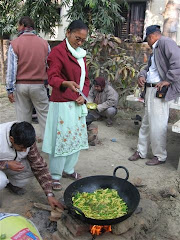
On Monday, we learnt that the wedding had taken place as planned on Sunday, and we were all expected at Tulsi’s house as soon as the training was over for the day. A topical day on the development of community schools, as upstairs a delegation from the Ministry in Kathmandu were running a workshop on the development of community managed schools, which is likely to be a priority for the new government. Meanwhile, Gita and the rest of Lalmani’s extended family were hovering on the field dressed in their best, waiting for a rickshaw to take them to the wedding party. At 4pm the rest of us prepared to leave. We resisted attempts to get us on the back of motorbikes so we could make our own way home, so set off in a cycle procession with elderly Govinda and the peons. Half way there, David got a puncture, so we abandoned him at a cycle stall while I cycled with the others to locate Tulsi’s house, then rode back to collect David. 10 minutes and 10 rupees is enough to repair a tyre. Tulsi lives in a newly built – or partially built – bungalow north of the city. The lane outside was full of motorbikes and cycles, with many people milling about, a splendidly decorated awning over the front porch and a makeshift tent on the patch of waste ground next door. The women were splendid in red saris, dripping with gold jewellery, while most of the men were in food stained shirts, shorts and flipflops. The bride and groom were sitting on overstuffed chairs in the porch looking tired and fed up. We greeted them, and then jumped the ditch into the field where buckets of food were waiting inside the tent. The field is grazed by cows, and one had to be careful where one sat. Rice, daal, various vegetable dishes, a steaming pile of buffalo and greasy cardboard boxes full of pakora and puris were frequently replenished from cauldrons over 2 gas burners by grubby boys in frayed shorts and T shirts. Delicious; washed down with metal beakers full of water. Bones were spat onto the grass with other food debris, to the delight of the neighbourhood dogs that sneaked in to snatch morsels of food before being pelted with stones. As we were attempting to leave, a group of children attached themselves to us “auntie, uncle you must come and dance”. There was no escape and we were forced to provide the evening’s main entertainment.
Trying to perfect our water collection and usage is a challenge; it’s fine when we are at home and can wash clothes and hair at the outside tap when the supply comes on at midday. During the working week it is more difficult; we sometimes have a trickle in the morning to start to fill the buckets, and if we are lucky we can complete the task when we get home, avoiding the mosquitoes that swarm round the tap at the end of the day. The swimming pool, although increasingly green and murky, is a welcome relief. A violent storm on Thursday evening filled the flat with dust and bits of tree. David’s cleaning routine is severely compromised.
At last Bal Rani has started teaching lessons, so David is busy making name cards for all the new children. I have been training primary teachers with Bishnu, a retired secondary head, very open to new ideas and doing things differently, so we and the teachers have had a lot of fun and they have done some much improved micro-teaching.
On Monday, we learnt that the wedding had taken place as planned on Sunday, and we were all expected at Tulsi’s house as soon as the training was over for the day. A topical day on the development of community schools, as upstairs a delegation from the Ministry in Kathmandu were running a workshop on the development of community managed schools, which is likely to be a priority for the new government. Meanwhile, Gita and the rest of Lalmani’s extended family were hovering on the field dressed in their best, waiting for a rickshaw to take them to the wedding party. At 4pm the rest of us prepared to leave. We resisted attempts to get us on the back of motorbikes so we could make our own way home, so set off in a cycle procession with elderly Govinda and the peons. Half way there, David got a puncture, so we abandoned him at a cycle stall while I cycled with the others to locate Tulsi’s house, then rode back to collect David. 10 minutes and 10 rupees is enough to repair a tyre. Tulsi lives in a newly built – or partially built – bungalow north of the city. The lane outside was full of motorbikes and cycles, with many people milling about, a splendidly decorated awning over the front porch and a makeshift tent on the patch of waste ground next door. The women were splendid in red saris, dripping with gold jewellery, while most of the men were in food stained shirts, shorts and flipflops. The bride and groom were sitting on overstuffed chairs in the porch looking tired and fed up. We greeted them, and then jumped the ditch into the field where buckets of food were waiting inside the tent. The field is grazed by cows, and one had to be careful where one sat. Rice, daal, various vegetable dishes, a steaming pile of buffalo and greasy cardboard boxes full of pakora and puris were frequently replenished from cauldrons over 2 gas burners by grubby boys in frayed shorts and T shirts. Delicious; washed down with metal beakers full of water. Bones were spat onto the grass with other food debris, to the delight of the neighbourhood dogs that sneaked in to snatch morsels of food before being pelted with stones. As we were attempting to leave, a group of children attached themselves to us “auntie, uncle you must come and dance”. There was no escape and we were forced to provide the evening’s main entertainment.
Trying to perfect our water collection and usage is a challenge; it’s fine when we are at home and can wash clothes and hair at the outside tap when the supply comes on at midday. During the working week it is more difficult; we sometimes have a trickle in the morning to start to fill the buckets, and if we are lucky we can complete the task when we get home, avoiding the mosquitoes that swarm round the tap at the end of the day. The swimming pool, although increasingly green and murky, is a welcome relief. A violent storm on Thursday evening filled the flat with dust and bits of tree. David’s cleaning routine is severely compromised.
At last Bal Rani has started teaching lessons, so David is busy making name cards for all the new children. I have been training primary teachers with Bishnu, a retired secondary head, very open to new ideas and doing things differently, so we and the teachers have had a lot of fun and they have done some much improved micro-teaching.

Saturday, 26 April 2008
Police procedure
Season of ants, cockroaches and orange and turquoise butterflies the size of dinner plates. Mobile crumbs scurrying across kitchen surfaces. Baby buffalo and ducklings. Handcarts of sliced water melon and cucumbers; children sucking luridly coloured frozen water on sticks.
We spent most of our first day home reporting our burglary to the police. Our friend Narayan came in the morning and we went together to the local police station, where two women in uniform were sitting cross legged on a bench spinning cotton. They were not very interested. A young man in a red T shirt emerged from a room where a manual typewriter clattered. He took a brief statement, then directed us to the district police office. We cycled north passed the birthday celebrations at the Hanuman temple and several wedding processions and after questioning were allowed into the yard at police HQ. There were several civilians in the yard taking statements from Nepalis; we were escorted across the road into a local tea shop, where we sat on rickety wooden benches painted sky blue beneath pictures of Shiva and Parvati and the royal family (not for much longer) accompanied by the smell of boiling milk. We were questioned (thank goodness for Narayan) and could manage part of the dialogue eg “tapaaiko security guard kahaa chha?” We are of course the only videshi with out a guarded house. Statement signed in triplicate by David. We then had to purchase a 5 rupee postage stamp to be fixed to the statement, and after paying 50 rupees baksheesh were taken back to the station. We walked along grubby corridors, past open boxes of rifles and dusty dogs sleeping in the shade to the inspector’s office, where he sat and read the newspaper. We waited on a saggy sofa while many people came in to have a look at us. The report was eventually ‘filed’ and a boy who looked about 12 appeared with a camera. I think he was a ‘detective’. Narayan brought him back to our house on his crossbar, where he took many photographs, checked all the locks and sat at our desk and wrote another report, again signed by David in triplicate. We await the next instalment. In the meantime, Chhatra’s (the landlord) sister has appeared to take care of repairs. She’s a retired primary head, and on her second visit brought her English speaking (privately educated of course) daughter.
Just time to plant some lettuces and get to the swimming pool to cool down. Surly but lovable Suresh has gone to Dubai to work, presumably not as a swimming pool attendant, and has been replaced by smiling Shyam. We finished our shopping at our Indian family grocery on the way home; new stocks of special treats for us, many of which we had brought with us as usual from Kathmandu, so had to buy duplicates. We were taken into the backyard to see their own Hanuman temple, decorated for his birthday with flowers, flashing lights and music.
Back to work on Monday. The new school year has started at Adarsha; Ramanath the head was organising assembly; tiny (grade 6) new children in oversized trousers bullied into lines. Big meeting at the ETC for DEO, NGOs, INGOs, teachers’ unions and political parties, to discuss recruitment for the new school year (already started, except in the schools where David is trying to work). Arjun, the DEO, made a rousing speech about the importance of quality education to keep children in school. ,A man with a big stick now guards the gate of Adarsha, presumably in the interests of retention.
My colleagues were full of election stories; most are happy that the polls were peaceful and that there has been a decisive result, even though the PR seats are not yet announced. The Maoists have won 120 of the 240 first past the post seats. Anil and Govind were polling officers in Rangeli and had to wait from 6pm when polls closed until their transport arrived at 4am the following morning, besieged by YCL and madhesi cadres trying to tamper with the ballot boxes. Durga walked 1 ½ hours to his polling station to find no accommodation or food, and had to spend 2 nights on the floor and beg food from local families.
Primary training started on Tuesday for 2.5 months, which will take me through to the summer. Attempts to forward plan have failed. We started 2 hours late as we had to wait for the DEO to lead the speeches. I declined to make one. Durga started the training well but had to go on ‘other business’ on Wednesday, so Umapati was drafted in at the last minute. We started the day with both groups together to sing the national anthem. This was repeated many times, accompanied, unaccompanied, music fade in (just like ‘I’m sorry I haven’t a clue’), half class, other half, all together …. led by Govinda, looking like a craggy skewbald pony after using both henna and black dye unsuccessfully on his white hair. I have managed to learn everyone’s names as a ‘model of good practice’.
Load shedding now for 4 hours every morning and 3 hours each evening, plus sporadic power cuts each day; we miss the cooling effect of the fans most. Candles make it even hotter. The whole city has a water problem now, but not as desperate as Kathmandu. We were spoiled by accumulation of water during our absence that kept us going for the first few days. Now we have water outside for 3 hours a day. We are trying to work out when the 3 hours are so one of us can come home to fill buckets. It should get better when the monsoon starts, but that’s still 2 – 3 months away.
We spent most of our first day home reporting our burglary to the police. Our friend Narayan came in the morning and we went together to the local police station, where two women in uniform were sitting cross legged on a bench spinning cotton. They were not very interested. A young man in a red T shirt emerged from a room where a manual typewriter clattered. He took a brief statement, then directed us to the district police office. We cycled north passed the birthday celebrations at the Hanuman temple and several wedding processions and after questioning were allowed into the yard at police HQ. There were several civilians in the yard taking statements from Nepalis; we were escorted across the road into a local tea shop, where we sat on rickety wooden benches painted sky blue beneath pictures of Shiva and Parvati and the royal family (not for much longer) accompanied by the smell of boiling milk. We were questioned (thank goodness for Narayan) and could manage part of the dialogue eg “tapaaiko security guard kahaa chha?” We are of course the only videshi with out a guarded house. Statement signed in triplicate by David. We then had to purchase a 5 rupee postage stamp to be fixed to the statement, and after paying 50 rupees baksheesh were taken back to the station. We walked along grubby corridors, past open boxes of rifles and dusty dogs sleeping in the shade to the inspector’s office, where he sat and read the newspaper. We waited on a saggy sofa while many people came in to have a look at us. The report was eventually ‘filed’ and a boy who looked about 12 appeared with a camera. I think he was a ‘detective’. Narayan brought him back to our house on his crossbar, where he took many photographs, checked all the locks and sat at our desk and wrote another report, again signed by David in triplicate. We await the next instalment. In the meantime, Chhatra’s (the landlord) sister has appeared to take care of repairs. She’s a retired primary head, and on her second visit brought her English speaking (privately educated of course) daughter.
Just time to plant some lettuces and get to the swimming pool to cool down. Surly but lovable Suresh has gone to Dubai to work, presumably not as a swimming pool attendant, and has been replaced by smiling Shyam. We finished our shopping at our Indian family grocery on the way home; new stocks of special treats for us, many of which we had brought with us as usual from Kathmandu, so had to buy duplicates. We were taken into the backyard to see their own Hanuman temple, decorated for his birthday with flowers, flashing lights and music.
Back to work on Monday. The new school year has started at Adarsha; Ramanath the head was organising assembly; tiny (grade 6) new children in oversized trousers bullied into lines. Big meeting at the ETC for DEO, NGOs, INGOs, teachers’ unions and political parties, to discuss recruitment for the new school year (already started, except in the schools where David is trying to work). Arjun, the DEO, made a rousing speech about the importance of quality education to keep children in school. ,A man with a big stick now guards the gate of Adarsha, presumably in the interests of retention.
My colleagues were full of election stories; most are happy that the polls were peaceful and that there has been a decisive result, even though the PR seats are not yet announced. The Maoists have won 120 of the 240 first past the post seats. Anil and Govind were polling officers in Rangeli and had to wait from 6pm when polls closed until their transport arrived at 4am the following morning, besieged by YCL and madhesi cadres trying to tamper with the ballot boxes. Durga walked 1 ½ hours to his polling station to find no accommodation or food, and had to spend 2 nights on the floor and beg food from local families.
Primary training started on Tuesday for 2.5 months, which will take me through to the summer. Attempts to forward plan have failed. We started 2 hours late as we had to wait for the DEO to lead the speeches. I declined to make one. Durga started the training well but had to go on ‘other business’ on Wednesday, so Umapati was drafted in at the last minute. We started the day with both groups together to sing the national anthem. This was repeated many times, accompanied, unaccompanied, music fade in (just like ‘I’m sorry I haven’t a clue’), half class, other half, all together …. led by Govinda, looking like a craggy skewbald pony after using both henna and black dye unsuccessfully on his white hair. I have managed to learn everyone’s names as a ‘model of good practice’.
Load shedding now for 4 hours every morning and 3 hours each evening, plus sporadic power cuts each day; we miss the cooling effect of the fans most. Candles make it even hotter. The whole city has a water problem now, but not as desperate as Kathmandu. We were spoiled by accumulation of water during our absence that kept us going for the first few days. Now we have water outside for 3 hours a day. We are trying to work out when the 3 hours are so one of us can come home to fill buckets. It should get better when the monsoon starts, but that’s still 2 – 3 months away.
Saturday, 19 April 2008
Election and after
We left Biratnagar on March 24, taking our few valuable possessions and plenty of work to the airport by rickshaw, waving goodbye, hopefully temporarily, to our shopkeeper friends. When the small plane arrived, a goat in a plastic linen basket was unloaded from the hold along with the inanimate luggage. We had an uneventful journey, with splendid views of the mountains and arrived at the Pacific Guest House by midday in time to get our passports to immigration for new work visas.
On our first evening I was phoned by someone from VSO London thanking us for agreeing to facilitate a workshop the following day – this was news to us, but we had an interesting time working with Nepali NGOs on NDVP (Nepali Diaspora Volunteer Programme). This is a new project for Nepalis in the UK to come ‘home’ for a short term placement. It is already operating successfully in India, Sierra Leone, Ghana and Cameroon. On Friday, with Sheila, the ECD ‘expert’ to buy puppets for the ‘puppets against discrimination’ workshops, which will start in the Kathmandu valley and probably Biratnagar – a new challenge for David! The rest of the week was spent planning the VSO conference, meetings with VSO education staff, ‘networking’ and chatting with the new group of volunteers. Evenings out with old friends, including Helen and Ian who we worked with in Ethiopia. Exhausting, after our solitary existence in Biratnagar.
After a week, we moved into Judith’s apartment as she was going to China on holiday. We arrived on Sunday morning to find her still there, having been to the airport for the 11:30 flight to Beijing, to find that no such flight existed. She eventually left on Tuesday. We squatted there happily for the next 3 weeks. The landlady, Bagwati, is a retired teacher, with hair an unlikely shade of orange who spends her days tending her orchids, while her husband still works part time at the university. We have shopped at the supermarket, spending more in one visit than usually do in a month on treats such as goats cheese, strawberries and olives. The price of fruit and vegetables has shot up, and supplies are short. Load shedding is worse than in Biratnagar, with only a few hours of power most days. There is no water in our neighbourhood; we are fortunate to have a hand pump and well in the garden, and pass huge queues of people at standpipes whenever we go out. On days when we don’t need to go to the office we work by the swimming pool at the Manaslu hotel, where we can not only swim, but also shower in hot water.
The temperature has increased daily, with thunderstorms most afternoons, reflecting a stormy run up to the election. One of the mosques in Biratnagar was bombed, killing three people, and the city has been under curfew. Joseph has arrived safely. More reports of violence each day, with the PM urging restraint. Many government employees are protesting about their roles as polling officers; the government has offered each one of them a life insurance policy of Rs1.5m as an incentive. An eight day public holiday starting on April 7 has been announced, helicopters have started security reconnaissance, and the borders have closed.
On April 9 we carried our bags along the road north of the palace, passing the back of the royal stables; we had identified these by the smell walking home late one night, and were delighted to stand on tip toes and see beautiful horses in spacious stalls with their own electric lights, while the rest of the city was in darkness. What will happen to all the king’s horses and all the king’s men after the election? 57 of us managed to squeeze onto a bus for 30 that bumped along the dirt track by the Bagamati river to the Vajra hotel, a traditional Newari building, now pleasantly shabby, with beautiful gardens. Three days of intensive workshops and discussions, where we enjoyed working with other volunteers. A very interesting mix of volunteers here, with almost half from the Philippines, Uganda and India. We finished with a riotous party on Friday night, fuelled by rum punch. New Year celebrations in the rest of Kathmandu (it is now 2065) were sober affairs, following a ban on alcohol over the election period. We were able to keep in touch with news by satellite phone to the risk management office; election day was eerily quiet, with no public transport and all traffic banned from the streets. We were delighted to read the headlines on Friday morning “Nepal stuns itself and world”, referring to the relatively smooth and peaceful electoral process. Only 4 people were killed (!) and problems of violence and intimidation at less than 100 of the 21,860 booths. There are a few constituencies where the polls have been delayed by a week, following the murder of candidates during campaigning. Early results show a lead for the Maoists. It will take some time for all results to be declared as there are both first-past-the-post elections and a complex system of proportional representation.
The Maoist lead has increased daily. Some claim it is the result of intimidation, but young people seem overwhelming to have supported the Maoists as a way of getting rid of the ‘old guard’ and the stagnation of many years. I was greeted by “hullo comrade” when I went to the dentist.
We have been given the ‘all clear’ to go home as soon as our workplaces are open. My ETC is currently used as a counting centre but we have tickets for Saturday 19th. Our enforced stay here has passed relatively easily, helped by having a place to stay, and we have been busy with VSO work, planning strategies with other volunteers doing similar jobs and visits to the Ministry of Education. The MoE complex is at Sanothimi 16km east of Kathmandu, a journey that can take 2 hours in traffic. We are so grateful for our 10 minute bike ride to work in Biratanagar.
We had a lovely last evening in Kathmandu in the Garden of Dreams, a beautiful restored garden in the grounds of an old Rana palace. Peter had planned a surprise birthday party for his wife Rosemary; there was a full moon, delicious food and drink with many friends and some goodbyes to those ending their placements next month.
Saturday April 19 – flew home along the eastern Himalaya. We got off the plane into what felt like a hot bath. Although all our outside gates were still locked, the padlock on the front door had gone and the flat had been searched. Apart from our stash of Indian rupees, we don’t think anything else is missing and there was no damage. The thieves must have scaled the back wall onto the top floor, where they broke the door down to get access to our staircase. The good news is that we have both water and electricity this evening, and the mango season has started.
On our first evening I was phoned by someone from VSO London thanking us for agreeing to facilitate a workshop the following day – this was news to us, but we had an interesting time working with Nepali NGOs on NDVP (Nepali Diaspora Volunteer Programme). This is a new project for Nepalis in the UK to come ‘home’ for a short term placement. It is already operating successfully in India, Sierra Leone, Ghana and Cameroon. On Friday, with Sheila, the ECD ‘expert’ to buy puppets for the ‘puppets against discrimination’ workshops, which will start in the Kathmandu valley and probably Biratnagar – a new challenge for David! The rest of the week was spent planning the VSO conference, meetings with VSO education staff, ‘networking’ and chatting with the new group of volunteers. Evenings out with old friends, including Helen and Ian who we worked with in Ethiopia. Exhausting, after our solitary existence in Biratnagar.
After a week, we moved into Judith’s apartment as she was going to China on holiday. We arrived on Sunday morning to find her still there, having been to the airport for the 11:30 flight to Beijing, to find that no such flight existed. She eventually left on Tuesday. We squatted there happily for the next 3 weeks. The landlady, Bagwati, is a retired teacher, with hair an unlikely shade of orange who spends her days tending her orchids, while her husband still works part time at the university. We have shopped at the supermarket, spending more in one visit than usually do in a month on treats such as goats cheese, strawberries and olives. The price of fruit and vegetables has shot up, and supplies are short. Load shedding is worse than in Biratnagar, with only a few hours of power most days. There is no water in our neighbourhood; we are fortunate to have a hand pump and well in the garden, and pass huge queues of people at standpipes whenever we go out. On days when we don’t need to go to the office we work by the swimming pool at the Manaslu hotel, where we can not only swim, but also shower in hot water.
The temperature has increased daily, with thunderstorms most afternoons, reflecting a stormy run up to the election. One of the mosques in Biratnagar was bombed, killing three people, and the city has been under curfew. Joseph has arrived safely. More reports of violence each day, with the PM urging restraint. Many government employees are protesting about their roles as polling officers; the government has offered each one of them a life insurance policy of Rs1.5m as an incentive. An eight day public holiday starting on April 7 has been announced, helicopters have started security reconnaissance, and the borders have closed.
On April 9 we carried our bags along the road north of the palace, passing the back of the royal stables; we had identified these by the smell walking home late one night, and were delighted to stand on tip toes and see beautiful horses in spacious stalls with their own electric lights, while the rest of the city was in darkness. What will happen to all the king’s horses and all the king’s men after the election? 57 of us managed to squeeze onto a bus for 30 that bumped along the dirt track by the Bagamati river to the Vajra hotel, a traditional Newari building, now pleasantly shabby, with beautiful gardens. Three days of intensive workshops and discussions, where we enjoyed working with other volunteers. A very interesting mix of volunteers here, with almost half from the Philippines, Uganda and India. We finished with a riotous party on Friday night, fuelled by rum punch. New Year celebrations in the rest of Kathmandu (it is now 2065) were sober affairs, following a ban on alcohol over the election period. We were able to keep in touch with news by satellite phone to the risk management office; election day was eerily quiet, with no public transport and all traffic banned from the streets. We were delighted to read the headlines on Friday morning “Nepal stuns itself and world”, referring to the relatively smooth and peaceful electoral process. Only 4 people were killed (!) and problems of violence and intimidation at less than 100 of the 21,860 booths. There are a few constituencies where the polls have been delayed by a week, following the murder of candidates during campaigning. Early results show a lead for the Maoists. It will take some time for all results to be declared as there are both first-past-the-post elections and a complex system of proportional representation.
The Maoist lead has increased daily. Some claim it is the result of intimidation, but young people seem overwhelming to have supported the Maoists as a way of getting rid of the ‘old guard’ and the stagnation of many years. I was greeted by “hullo comrade” when I went to the dentist.
We have been given the ‘all clear’ to go home as soon as our workplaces are open. My ETC is currently used as a counting centre but we have tickets for Saturday 19th. Our enforced stay here has passed relatively easily, helped by having a place to stay, and we have been busy with VSO work, planning strategies with other volunteers doing similar jobs and visits to the Ministry of Education. The MoE complex is at Sanothimi 16km east of Kathmandu, a journey that can take 2 hours in traffic. We are so grateful for our 10 minute bike ride to work in Biratanagar.
We had a lovely last evening in Kathmandu in the Garden of Dreams, a beautiful restored garden in the grounds of an old Rana palace. Peter had planned a surprise birthday party for his wife Rosemary; there was a full moon, delicious food and drink with many friends and some goodbyes to those ending their placements next month.
Saturday April 19 – flew home along the eastern Himalaya. We got off the plane into what felt like a hot bath. Although all our outside gates were still locked, the padlock on the front door had gone and the flat had been searched. Apart from our stash of Indian rupees, we don’t think anything else is missing and there was no damage. The thieves must have scaled the back wall onto the top floor, where they broke the door down to get access to our staircase. The good news is that we have both water and electricity this evening, and the mango season has started.
Saturday, 22 March 2008
Examinations and elections
SLC examinations (equivalent to GCSE) started on Monday. I was surprised to find the gates to the ETC and Adarsha High School padlocked and guarded by police armed with lathis (big sticks) when I arrived at work. Eventually I persuaded them to let me through, promising that I would not disturb the examinations or smuggle in answers. The reason for the security became apparent when we read the newspaper report about an examination centre in the next town: “Police had to fire 17 rounds of ammunition to prevent parents throwing pieces of paper with answers written on them into the exam room. Parents pelted the police with stones, who had to resort to lathi charges to disperse the mob”. Grade 10 students are sent to examination centres (not their own school) to sit the exams, which last for 8 days. Question papers are in both Nepali and English, and private school students answer in English, while those from government schools write in Nepali. The papers are almost entirely factual recall from the grade 10 curriculum. Government school students are severely disadvantaged by the huge amount of time they have missed because of strike action this year.
We went early to Janapath on Wednesday to meet Buddhi for the science paper. He is justifiably proud of the way in which he organises the exams there. I was delighted to find I could remember enough to do well on the biology questions, if not the physics. ‘Good old-fashioned’ biology, including classification of a sea horse, of which, unsurprisingly none of the teachers except Buddhi had never heard. I was able to provide a drawing and impersonation.
Election momentum is gathering. Competing loud hailers go by all day, and flag waving crowds gather on street corners and outside temples. 25% of the candidates are teachers. 600 election observers from 14 different international organisations have arrived and are in evidence in white land cruisers. 90,000 national observers have been appointed. My colleagues have all had election training. Koirala, the 85 year old Prime Minister has stated that the current seven party alliance should continue to govern for the next 10 years; Deuba (Nepali Congress) has announced that he will be Prime Minister and Prachanda (Maoist leader) has declared that he will be President. An interesting take on democracy. Meanwhile in Kathmandu there are royalist plots hatching to reinstate the king, and dissident groups in the Terai are threatening further action to disrupt the polls.
On Thursday, a polling booth was set up on the school field, surrounded by flags on bamboo poles and information posters for a mock election. Thousands of people flocked in and were organised into orderly lines of men and women. It was far more lively than voting in England – and more complex, with two different ballot papers, one for proportional representation and one for first-past- the post. Several international UNMIN observers were there, plus a TV crew. A group was organised to create a disturbance, so the police could practice quelling it, which they did with great enthusiasm and much waving of lathis. We hope the real event will pass off as smoothly.
David’s production of teaching materials has been disrupted this week, as his tailor is too busy making election flags and banners. However, the prototype of the pocket chart is completed, and he has demonstrated it at the ETC. The photograph shows it in action with mero kitab - my book. He has made sets of Nepali and English alphabets and sets of numbers for mathematics teaching. We fear for the carpenter’s feet as he holds strips off wood between them while he saws off blocks, then files them smooth. We hope to use them at the ETC when primary teacher training starts again after the election.
At home, power cuts are increasing and we have been without water in the flat for nearly two weeks. There had been no water in the ETC since I arrived last May (one reason for never going to the toilet during the day), but it started flooding through the roof on Wednesday. Unfortunately this abundance did not spread to Tintolya where we live. . It is surprisingly easy to manage without, as long as we can fill buckets from the outside tap. Our neighbours, who rely on bore hole water, are amused by us carrying buckets indoors and washing our hair outside. We attract a large audience – including the beautiful new striped cow over the wall. We get daily phone calls from VSO about the security situation; for us security is two full buckets.
Friday and Saturday - Fagu Purnima (Holi), the Hindu festival of colour, celebrated by smearing heads and faces with luridly coloured powder, and flinging it about with water and ruining clothes. The children opposite are currently attacking our neighbours with giant waterpistols, while the children next door retaliate with full buckets. What a waste! They are calling to us ‘tapaaiharu uslaai khelna aaunus!’ (come and play with us!)
So, Kathmandu on Monday, and we will have to stay for ‘the duration’, however long that is. No-one knows how long it will take before election results are declared, and what repercussions there will be …….
We went early to Janapath on Wednesday to meet Buddhi for the science paper. He is justifiably proud of the way in which he organises the exams there. I was delighted to find I could remember enough to do well on the biology questions, if not the physics. ‘Good old-fashioned’ biology, including classification of a sea horse, of which, unsurprisingly none of the teachers except Buddhi had never heard. I was able to provide a drawing and impersonation.
Election momentum is gathering. Competing loud hailers go by all day, and flag waving crowds gather on street corners and outside temples. 25% of the candidates are teachers. 600 election observers from 14 different international organisations have arrived and are in evidence in white land cruisers. 90,000 national observers have been appointed. My colleagues have all had election training. Koirala, the 85 year old Prime Minister has stated that the current seven party alliance should continue to govern for the next 10 years; Deuba (Nepali Congress) has announced that he will be Prime Minister and Prachanda (Maoist leader) has declared that he will be President. An interesting take on democracy. Meanwhile in Kathmandu there are royalist plots hatching to reinstate the king, and dissident groups in the Terai are threatening further action to disrupt the polls.
On Thursday, a polling booth was set up on the school field, surrounded by flags on bamboo poles and information posters for a mock election. Thousands of people flocked in and were organised into orderly lines of men and women. It was far more lively than voting in England – and more complex, with two different ballot papers, one for proportional representation and one for first-past- the post. Several international UNMIN observers were there, plus a TV crew. A group was organised to create a disturbance, so the police could practice quelling it, which they did with great enthusiasm and much waving of lathis. We hope the real event will pass off as smoothly.
David’s production of teaching materials has been disrupted this week, as his tailor is too busy making election flags and banners. However, the prototype of the pocket chart is completed, and he has demonstrated it at the ETC. The photograph shows it in action with mero kitab - my book. He has made sets of Nepali and English alphabets and sets of numbers for mathematics teaching. We fear for the carpenter’s feet as he holds strips off wood between them while he saws off blocks, then files them smooth. We hope to use them at the ETC when primary teacher training starts again after the election.
At home, power cuts are increasing and we have been without water in the flat for nearly two weeks. There had been no water in the ETC since I arrived last May (one reason for never going to the toilet during the day), but it started flooding through the roof on Wednesday. Unfortunately this abundance did not spread to Tintolya where we live. . It is surprisingly easy to manage without, as long as we can fill buckets from the outside tap. Our neighbours, who rely on bore hole water, are amused by us carrying buckets indoors and washing our hair outside. We attract a large audience – including the beautiful new striped cow over the wall. We get daily phone calls from VSO about the security situation; for us security is two full buckets.
Friday and Saturday - Fagu Purnima (Holi), the Hindu festival of colour, celebrated by smearing heads and faces with luridly coloured powder, and flinging it about with water and ruining clothes. The children opposite are currently attacking our neighbours with giant waterpistols, while the children next door retaliate with full buckets. What a waste! They are calling to us ‘tapaaiharu uslaai khelna aaunus!’ (come and play with us!)
So, Kathmandu on Monday, and we will have to stay for ‘the duration’, however long that is. No-one knows how long it will take before election results are declared, and what repercussions there will be …….
Saturday, 15 March 2008
Nepali spring
The Terai spring is characterised by leaf fall and the instantaneous sprouting of green buds. It lasted for 3 days before the temperature rose dramatically. It is now over 30oC in the day and this week the night temperature has risen from 7 – 21oC. Nepalis are shedding their layers of winter clothes; a few hardy men are back in sandals and their woolly hats have been replaced by traditional topis. Women are wearing scarves instead of blankets over their kurtas. It’s the wedding season, so each morning we are woken by wedding bands, and chanting and singing goes on until the early hours of the morning, when the new loudspeaker at the mosque starts, accompanied by a strident dawn chorus of courting birds.
We have both been working ‘early shift’; David visiting schools where tiny children who rarely attend school are sitting on benches doing formal examinations. For most of them this means copying the paper with a small stub of blunt pencil. During the rest of the day he is developing materials for early years teaching, and I arrive home to find the floor covered with alphabet letters and multiplication tables. He has enlisted the help of the carpenter who made our furniture to make building blocks from scrap wood, the stationers for paper items and plastic balls, and Umesh at the fabric shop for pocket boards and children’s socks to make small puppets. After exams are over, the schools close for teachers to mark the papers – given that most children can’t do the papers, this seems an unnecessary indulgence. Then its holiday time again, followed by the start of the new Nepali year (mid-April); the first 2 weeks are spent registering the children before any teaching starts.
Meanwhile I have been taking training sessions on action research for secondary school teachers, cycling off just after dawn with the sun low and red in the sky and the orange neon street lights still on. Scabby dogs stretch out to catch the first rays of the sun; men in lungis and blankets are huddled at tea stalls; women in red saris are on their way to the temple for puja, while others are lighting fires to make breakfast and sweeping the dirt from one pile to another. People are coming in to town with sacks of vegetables for the market; bicycles are laden with sugar cane while others have a pair of goats suspended in jute bags from the handlebars and a cage of scrawny chickens on the carrier. Children on early shift are straggling to school and the cows and goats are still curled up under the trees.
March 13 - David’s birthday. He was still sleeping when I left at 6:30 for the ETC to teach action research to social studies teachers, leaving a candle stuck in the last slice of homemade bread in the kitchen. The social studies teachers speak no English, and Govind, their trainer speaks about as much English as I do Nepali. It was remarkably successful, with lots of laughter, many different activities and the help of my dictionary. At 9, a visitor arrived and joined in – I later discovered he is the deputy director of NCED (National Centre for Educational Development) on a monitoring visit, who will be a useful contact; we were able to spend most of the day together. At the end of the session, the 2 women took me off to the photographer, combed my hair and adjusted my clothes to pose for a photograph ‘for memory’. We finished the 3 day workshop for secondary teachers at the end of the morning. At 1:50 the papers for the 2pm examination arrived on the back of a motorcycle in a carefully stitched cloth bag, double sealed with sealing wax. On the way home I bought luridly coloured birthday cake at ‘Kiran’s cake parlour’, and was delighted to find that we had running water at home again after 2 days without any. The electricity was off, of course, but after a candlelit dinner (again) it was restored in time for us to watch ‘Elizabeth’, one of the many DVDs we bought in Kathmandu for £1 each. From time to time the language changed from English to Russian, adding new interest.
The election campaign is gathering momentum, with daily rallies and heavy police presence. There have been no unpleasant political incidents here since we returned. The only recent fatalities have been as a result of ‘huge tuskers run amok in Jhapa’. To our dismay, we have been recalled to Kathmandu on March 24 (although as we have just had another day without water or electricity there may be some compensations), as our passports need to go to immigration for new work visas. We will have to stay until after the election. The VSO annual conference has been rescheduled for election week, so we can all be incarcerated together. A group of new volunteers has just arrived, and we will spend some time helping with their initial training, planning conference activities and training materials for when we return.
We have both been working ‘early shift’; David visiting schools where tiny children who rarely attend school are sitting on benches doing formal examinations. For most of them this means copying the paper with a small stub of blunt pencil. During the rest of the day he is developing materials for early years teaching, and I arrive home to find the floor covered with alphabet letters and multiplication tables. He has enlisted the help of the carpenter who made our furniture to make building blocks from scrap wood, the stationers for paper items and plastic balls, and Umesh at the fabric shop for pocket boards and children’s socks to make small puppets. After exams are over, the schools close for teachers to mark the papers – given that most children can’t do the papers, this seems an unnecessary indulgence. Then its holiday time again, followed by the start of the new Nepali year (mid-April); the first 2 weeks are spent registering the children before any teaching starts.
Meanwhile I have been taking training sessions on action research for secondary school teachers, cycling off just after dawn with the sun low and red in the sky and the orange neon street lights still on. Scabby dogs stretch out to catch the first rays of the sun; men in lungis and blankets are huddled at tea stalls; women in red saris are on their way to the temple for puja, while others are lighting fires to make breakfast and sweeping the dirt from one pile to another. People are coming in to town with sacks of vegetables for the market; bicycles are laden with sugar cane while others have a pair of goats suspended in jute bags from the handlebars and a cage of scrawny chickens on the carrier. Children on early shift are straggling to school and the cows and goats are still curled up under the trees.
March 13 - David’s birthday. He was still sleeping when I left at 6:30 for the ETC to teach action research to social studies teachers, leaving a candle stuck in the last slice of homemade bread in the kitchen. The social studies teachers speak no English, and Govind, their trainer speaks about as much English as I do Nepali. It was remarkably successful, with lots of laughter, many different activities and the help of my dictionary. At 9, a visitor arrived and joined in – I later discovered he is the deputy director of NCED (National Centre for Educational Development) on a monitoring visit, who will be a useful contact; we were able to spend most of the day together. At the end of the session, the 2 women took me off to the photographer, combed my hair and adjusted my clothes to pose for a photograph ‘for memory’. We finished the 3 day workshop for secondary teachers at the end of the morning. At 1:50 the papers for the 2pm examination arrived on the back of a motorcycle in a carefully stitched cloth bag, double sealed with sealing wax. On the way home I bought luridly coloured birthday cake at ‘Kiran’s cake parlour’, and was delighted to find that we had running water at home again after 2 days without any. The electricity was off, of course, but after a candlelit dinner (again) it was restored in time for us to watch ‘Elizabeth’, one of the many DVDs we bought in Kathmandu for £1 each. From time to time the language changed from English to Russian, adding new interest.
The election campaign is gathering momentum, with daily rallies and heavy police presence. There have been no unpleasant political incidents here since we returned. The only recent fatalities have been as a result of ‘huge tuskers run amok in Jhapa’. To our dismay, we have been recalled to Kathmandu on March 24 (although as we have just had another day without water or electricity there may be some compensations), as our passports need to go to immigration for new work visas. We will have to stay until after the election. The VSO annual conference has been rescheduled for election week, so we can all be incarcerated together. A group of new volunteers has just arrived, and we will spend some time helping with their initial training, planning conference activities and training materials for when we return.
Saturday, 8 March 2008
Holiday and home again
February 7. From Biratnagar to Delhi in a few hours. We sped through clean, green New Delhi – majestic tree lined avenues, new (but frequently dented) private cars (Tata of course), gas powered autorickshaws, buses and even rubbish disposal carts. Our friendly hotel in Karol Bagh was surrounded by the usual jumble of street vendors, garish colours, vibrant advertising hoardings, tea shops, beggars, stray dogs and piles of debris. We spent the next day in the sophisticated Khan Market, buying books (what choices! 3 international bookshops, including the one William Dalrymple claims as his favourite) a few clothes at the irresistible Fabindia, and eating delicious food. Part of the ‘old India’ survives and I was able to get a haircut and head massage for less than £1.
South to Kerala, where we stayed in the small guest house on the cliff top in Varkala that we discovered when it first opened 5 years ago. Ten wonderfully relaxing days of beach, sun, big seas, new books and quiet evenings eating dinner under the stars, listening to the waves pounding against the cliff. We made occasional trips to town to buy fruit, passing flatbed lorries carrying elephants between temple festivals, and enjoyed an evening at the local temple with a colourful parade, marvellous drummers and a procession of highly decorated elephants. On the way back to Kathmandu we spent a night in the relatively posh Jorbagh colony in South Delhi, although we were reminded that it was Indian by the ‘do not spit in the flowerbeds’ signs, and ‘do not use the towels to clean your shoes’ notice on the back of the door to our room. We strolled thorough the beautiful Lodhi Gardens, full of mynah birds and green parakeets flitting between the magnificent 15th century Moghal tombs, to replenish our books and our stock cupboard. At the airport the next day attempts were made to confiscate my supplies of pesto and tahini, bought at great expense in the Delhi deli. Eventually they compromised by opening all the jars and digging around with a pair of scissors for WMDs. They didn’t find any.
Back to a Kathmandu almost at a standstill. Two week bandh in the Terai had prevented any petrol, diesel, kerosene or gas reaching the capital. Huge hopeful queues at fuel stations which remained closed, food supplies reduced, restaurants shut, friends running out of fuel for cooking and heating. We managed to escape for the weekend to the beautiful Newari hill town of Bandipur, where the paved streets have only human traffic and many of the buildings have been lovingly restored.
Our VSO Education review workshop was a safari and logistical nightmare. We started as volunteers only with breakfast in a hotel in Kathmandu. After a morning of heated discussion, we managed to reshape the subsequent days into a more coherent programme. At the end of the day we were bussed from Kathmandu to Dhulikel, 25km into the mountains, picking up our chilly Nepali partners at various points along the way. The journey – normally 1½ hours, took more than 4, with frequent jams and blockades near petrol stations. There was the compensation of dinner waiting, comfortable beds with huge fluffy duvets and hot waterbottles when we eventually arrived. After a good day working with our partners (Durga and Tulsi from the ETC, and Babaram from the DEO office, who appears keen and committed to support David’s project), we had an early night before setting off at the crack of dawn for our next destination, where we joined the HIV and Governance volunteers in Godavari for a day of ‘sharing’. A long journey through Friday night traffic back to the city, where David joined a group of VSO fundraisers about to start a trek to Everest base camp at the Summit Hotel in Patan.
At last, clearance to go home, and after a frustrating 5 hours at the airport on Monday while the backlog of Sunday’s flights cancelled by torrential rain were cleared, we arrived in hot, humid and thundery Biratnagar. We were delighted to open up our dusty flat, cycle to the market where we were warmly greeted by our usual suppliers, especially as they have been suffering by almost 3 weeks of closure, and load up our baskets. At home, the women were quickly into the compound to cut the grass for their animals, while the children were blowing kisses and shouting their newly acquired English phrases. Having unpacked, we received a phone call from the VSO office, informing us of more Madhesi bandhs starting tomorrow……
South to Kerala, where we stayed in the small guest house on the cliff top in Varkala that we discovered when it first opened 5 years ago. Ten wonderfully relaxing days of beach, sun, big seas, new books and quiet evenings eating dinner under the stars, listening to the waves pounding against the cliff. We made occasional trips to town to buy fruit, passing flatbed lorries carrying elephants between temple festivals, and enjoyed an evening at the local temple with a colourful parade, marvellous drummers and a procession of highly decorated elephants. On the way back to Kathmandu we spent a night in the relatively posh Jorbagh colony in South Delhi, although we were reminded that it was Indian by the ‘do not spit in the flowerbeds’ signs, and ‘do not use the towels to clean your shoes’ notice on the back of the door to our room. We strolled thorough the beautiful Lodhi Gardens, full of mynah birds and green parakeets flitting between the magnificent 15th century Moghal tombs, to replenish our books and our stock cupboard. At the airport the next day attempts were made to confiscate my supplies of pesto and tahini, bought at great expense in the Delhi deli. Eventually they compromised by opening all the jars and digging around with a pair of scissors for WMDs. They didn’t find any.
Back to a Kathmandu almost at a standstill. Two week bandh in the Terai had prevented any petrol, diesel, kerosene or gas reaching the capital. Huge hopeful queues at fuel stations which remained closed, food supplies reduced, restaurants shut, friends running out of fuel for cooking and heating. We managed to escape for the weekend to the beautiful Newari hill town of Bandipur, where the paved streets have only human traffic and many of the buildings have been lovingly restored.
Our VSO Education review workshop was a safari and logistical nightmare. We started as volunteers only with breakfast in a hotel in Kathmandu. After a morning of heated discussion, we managed to reshape the subsequent days into a more coherent programme. At the end of the day we were bussed from Kathmandu to Dhulikel, 25km into the mountains, picking up our chilly Nepali partners at various points along the way. The journey – normally 1½ hours, took more than 4, with frequent jams and blockades near petrol stations. There was the compensation of dinner waiting, comfortable beds with huge fluffy duvets and hot waterbottles when we eventually arrived. After a good day working with our partners (Durga and Tulsi from the ETC, and Babaram from the DEO office, who appears keen and committed to support David’s project), we had an early night before setting off at the crack of dawn for our next destination, where we joined the HIV and Governance volunteers in Godavari for a day of ‘sharing’. A long journey through Friday night traffic back to the city, where David joined a group of VSO fundraisers about to start a trek to Everest base camp at the Summit Hotel in Patan.
At last, clearance to go home, and after a frustrating 5 hours at the airport on Monday while the backlog of Sunday’s flights cancelled by torrential rain were cleared, we arrived in hot, humid and thundery Biratnagar. We were delighted to open up our dusty flat, cycle to the market where we were warmly greeted by our usual suppliers, especially as they have been suffering by almost 3 weeks of closure, and load up our baskets. At home, the women were quickly into the compound to cut the grass for their animals, while the children were blowing kisses and shouting their newly acquired English phrases. Having unpacked, we received a phone call from the VSO office, informing us of more Madhesi bandhs starting tomorrow……
Subscribe to:
Posts (Atom)

.JPG)
.jpg)
.jpg)


.jpg)
.jpg)
.jpg)


.jpg)