SLC examinations (equivalent to GCSE) started on Monday. I was surprised to find the gates to the ETC and Adarsha High School padlocked and guarded by police armed with lathis (big sticks) when I arrived at work. Eventually I persuaded them to let me through, promising that I would not disturb the examinations or smuggle in answers. The reason for the security became apparent when we read the newspaper report about an examination centre in the next town: “Police had to fire 17 rounds of ammunition to prevent parents throwing pieces of paper with answers written on them into the exam room. Parents pelted the police with stones, who had to resort to lathi charges to disperse the mob”. Grade 10 students are sent to examination centres (not their own school) to sit the exams, which last for 8 days. Question papers are in both Nepali and English, and private school students answer in English, while those from government schools write in Nepali. The papers are almost entirely factual recall from the grade 10 curriculum. Government school students are severely disadvantaged by the huge amount of time they have missed because of strike action this year.
We went early to Janapath on Wednesday to meet Buddhi for the science paper. He is justifiably proud of the way in which he organises the exams there. I was delighted to find I could remember enough to do well on the biology questions, if not the physics. ‘Good old-fashioned’ biology, including classification of a sea horse, of which, unsurprisingly none of the teachers except Buddhi had never heard. I was able to provide a drawing and impersonation.
Election momentum is gathering. Competing loud hailers go by all day, and flag waving crowds gather on street corners and outside temples. 25% of the candidates are teachers. 600 election observers from 14 different international organisations have arrived and are in evidence in white land cruisers. 90,000 national observers have been appointed. My colleagues have all had election training. Koirala, the 85 year old Prime Minister has stated that the current seven party alliance should continue to govern for the next 10 years; Deuba (Nepali Congress) has announced that he will be Prime Minister and Prachanda (Maoist leader) has declared that he will be President. An interesting take on democracy. Meanwhile in Kathmandu there are royalist plots hatching to reinstate the king, and dissident groups in the Terai are threatening further action to disrupt the polls.
On Thursday, a polling booth was set up on the school field, surrounded by flags on bamboo poles and information posters for a mock election. Thousands of people flocked in and were organised into orderly lines of men and women. It was far more lively than voting in England – and more complex, with two different ballot papers, one for proportional representation and one for first-past- the post. Several international UNMIN observers were there, plus a TV crew. A group was organised to create a disturbance, so the police could practice quelling it, which they did with great enthusiasm and much waving of lathis. We hope the real event will pass off as smoothly.
David’s production of teaching materials has been disrupted this week, as his tailor is too busy making election flags and banners. However, the prototype of the pocket chart is completed, and he has demonstrated it at the ETC. The photograph shows it in action with mero kitab - my book. He has made sets of Nepali and English alphabets and sets of numbers for mathematics teaching. We fear for the carpenter’s feet as he holds strips off wood between them while he saws off blocks, then files them smooth. We hope to use them at the ETC when primary teacher training starts again after the election.
At home, power cuts are increasing and we have been without water in the flat for nearly two weeks. There had been no water in the ETC since I arrived last May (one reason for never going to the toilet during the day), but it started flooding through the roof on Wednesday. Unfortunately this abundance did not spread to Tintolya where we live. . It is surprisingly easy to manage without, as long as we can fill buckets from the outside tap. Our neighbours, who rely on bore hole water, are amused by us carrying buckets indoors and washing our hair outside. We attract a large audience – including the beautiful new striped cow over the wall. We get daily phone calls from VSO about the security situation; for us security is two full buckets.
Friday and Saturday - Fagu Purnima (Holi), the Hindu festival of colour, celebrated by smearing heads and faces with luridly coloured powder, and flinging it about with water and ruining clothes. The children opposite are currently attacking our neighbours with giant waterpistols, while the children next door retaliate with full buckets. What a waste! They are calling to us ‘tapaaiharu uslaai khelna aaunus!’ (come and play with us!)
So, Kathmandu on Monday, and we will have to stay for ‘the duration’, however long that is. No-one knows how long it will take before election results are declared, and what repercussions there will be …….
Saturday, 22 March 2008
Saturday, 15 March 2008
Nepali spring
The Terai spring is characterised by leaf fall and the instantaneous sprouting of green buds. It lasted for 3 days before the temperature rose dramatically. It is now over 30oC in the day and this week the night temperature has risen from 7 – 21oC. Nepalis are shedding their layers of winter clothes; a few hardy men are back in sandals and their woolly hats have been replaced by traditional topis. Women are wearing scarves instead of blankets over their kurtas. It’s the wedding season, so each morning we are woken by wedding bands, and chanting and singing goes on until the early hours of the morning, when the new loudspeaker at the mosque starts, accompanied by a strident dawn chorus of courting birds.
We have both been working ‘early shift’; David visiting schools where tiny children who rarely attend school are sitting on benches doing formal examinations. For most of them this means copying the paper with a small stub of blunt pencil. During the rest of the day he is developing materials for early years teaching, and I arrive home to find the floor covered with alphabet letters and multiplication tables. He has enlisted the help of the carpenter who made our furniture to make building blocks from scrap wood, the stationers for paper items and plastic balls, and Umesh at the fabric shop for pocket boards and children’s socks to make small puppets. After exams are over, the schools close for teachers to mark the papers – given that most children can’t do the papers, this seems an unnecessary indulgence. Then its holiday time again, followed by the start of the new Nepali year (mid-April); the first 2 weeks are spent registering the children before any teaching starts.
Meanwhile I have been taking training sessions on action research for secondary school teachers, cycling off just after dawn with the sun low and red in the sky and the orange neon street lights still on. Scabby dogs stretch out to catch the first rays of the sun; men in lungis and blankets are huddled at tea stalls; women in red saris are on their way to the temple for puja, while others are lighting fires to make breakfast and sweeping the dirt from one pile to another. People are coming in to town with sacks of vegetables for the market; bicycles are laden with sugar cane while others have a pair of goats suspended in jute bags from the handlebars and a cage of scrawny chickens on the carrier. Children on early shift are straggling to school and the cows and goats are still curled up under the trees.
March 13 - David’s birthday. He was still sleeping when I left at 6:30 for the ETC to teach action research to social studies teachers, leaving a candle stuck in the last slice of homemade bread in the kitchen. The social studies teachers speak no English, and Govind, their trainer speaks about as much English as I do Nepali. It was remarkably successful, with lots of laughter, many different activities and the help of my dictionary. At 9, a visitor arrived and joined in – I later discovered he is the deputy director of NCED (National Centre for Educational Development) on a monitoring visit, who will be a useful contact; we were able to spend most of the day together. At the end of the session, the 2 women took me off to the photographer, combed my hair and adjusted my clothes to pose for a photograph ‘for memory’. We finished the 3 day workshop for secondary teachers at the end of the morning. At 1:50 the papers for the 2pm examination arrived on the back of a motorcycle in a carefully stitched cloth bag, double sealed with sealing wax. On the way home I bought luridly coloured birthday cake at ‘Kiran’s cake parlour’, and was delighted to find that we had running water at home again after 2 days without any. The electricity was off, of course, but after a candlelit dinner (again) it was restored in time for us to watch ‘Elizabeth’, one of the many DVDs we bought in Kathmandu for £1 each. From time to time the language changed from English to Russian, adding new interest.
The election campaign is gathering momentum, with daily rallies and heavy police presence. There have been no unpleasant political incidents here since we returned. The only recent fatalities have been as a result of ‘huge tuskers run amok in Jhapa’. To our dismay, we have been recalled to Kathmandu on March 24 (although as we have just had another day without water or electricity there may be some compensations), as our passports need to go to immigration for new work visas. We will have to stay until after the election. The VSO annual conference has been rescheduled for election week, so we can all be incarcerated together. A group of new volunteers has just arrived, and we will spend some time helping with their initial training, planning conference activities and training materials for when we return.
We have both been working ‘early shift’; David visiting schools where tiny children who rarely attend school are sitting on benches doing formal examinations. For most of them this means copying the paper with a small stub of blunt pencil. During the rest of the day he is developing materials for early years teaching, and I arrive home to find the floor covered with alphabet letters and multiplication tables. He has enlisted the help of the carpenter who made our furniture to make building blocks from scrap wood, the stationers for paper items and plastic balls, and Umesh at the fabric shop for pocket boards and children’s socks to make small puppets. After exams are over, the schools close for teachers to mark the papers – given that most children can’t do the papers, this seems an unnecessary indulgence. Then its holiday time again, followed by the start of the new Nepali year (mid-April); the first 2 weeks are spent registering the children before any teaching starts.
Meanwhile I have been taking training sessions on action research for secondary school teachers, cycling off just after dawn with the sun low and red in the sky and the orange neon street lights still on. Scabby dogs stretch out to catch the first rays of the sun; men in lungis and blankets are huddled at tea stalls; women in red saris are on their way to the temple for puja, while others are lighting fires to make breakfast and sweeping the dirt from one pile to another. People are coming in to town with sacks of vegetables for the market; bicycles are laden with sugar cane while others have a pair of goats suspended in jute bags from the handlebars and a cage of scrawny chickens on the carrier. Children on early shift are straggling to school and the cows and goats are still curled up under the trees.
March 13 - David’s birthday. He was still sleeping when I left at 6:30 for the ETC to teach action research to social studies teachers, leaving a candle stuck in the last slice of homemade bread in the kitchen. The social studies teachers speak no English, and Govind, their trainer speaks about as much English as I do Nepali. It was remarkably successful, with lots of laughter, many different activities and the help of my dictionary. At 9, a visitor arrived and joined in – I later discovered he is the deputy director of NCED (National Centre for Educational Development) on a monitoring visit, who will be a useful contact; we were able to spend most of the day together. At the end of the session, the 2 women took me off to the photographer, combed my hair and adjusted my clothes to pose for a photograph ‘for memory’. We finished the 3 day workshop for secondary teachers at the end of the morning. At 1:50 the papers for the 2pm examination arrived on the back of a motorcycle in a carefully stitched cloth bag, double sealed with sealing wax. On the way home I bought luridly coloured birthday cake at ‘Kiran’s cake parlour’, and was delighted to find that we had running water at home again after 2 days without any. The electricity was off, of course, but after a candlelit dinner (again) it was restored in time for us to watch ‘Elizabeth’, one of the many DVDs we bought in Kathmandu for £1 each. From time to time the language changed from English to Russian, adding new interest.
The election campaign is gathering momentum, with daily rallies and heavy police presence. There have been no unpleasant political incidents here since we returned. The only recent fatalities have been as a result of ‘huge tuskers run amok in Jhapa’. To our dismay, we have been recalled to Kathmandu on March 24 (although as we have just had another day without water or electricity there may be some compensations), as our passports need to go to immigration for new work visas. We will have to stay until after the election. The VSO annual conference has been rescheduled for election week, so we can all be incarcerated together. A group of new volunteers has just arrived, and we will spend some time helping with their initial training, planning conference activities and training materials for when we return.

Saturday, 8 March 2008
Holiday and home again
February 7. From Biratnagar to Delhi in a few hours. We sped through clean, green New Delhi – majestic tree lined avenues, new (but frequently dented) private cars (Tata of course), gas powered autorickshaws, buses and even rubbish disposal carts. Our friendly hotel in Karol Bagh was surrounded by the usual jumble of street vendors, garish colours, vibrant advertising hoardings, tea shops, beggars, stray dogs and piles of debris. We spent the next day in the sophisticated Khan Market, buying books (what choices! 3 international bookshops, including the one William Dalrymple claims as his favourite) a few clothes at the irresistible Fabindia, and eating delicious food. Part of the ‘old India’ survives and I was able to get a haircut and head massage for less than £1.
South to Kerala, where we stayed in the small guest house on the cliff top in Varkala that we discovered when it first opened 5 years ago. Ten wonderfully relaxing days of beach, sun, big seas, new books and quiet evenings eating dinner under the stars, listening to the waves pounding against the cliff. We made occasional trips to town to buy fruit, passing flatbed lorries carrying elephants between temple festivals, and enjoyed an evening at the local temple with a colourful parade, marvellous drummers and a procession of highly decorated elephants. On the way back to Kathmandu we spent a night in the relatively posh Jorbagh colony in South Delhi, although we were reminded that it was Indian by the ‘do not spit in the flowerbeds’ signs, and ‘do not use the towels to clean your shoes’ notice on the back of the door to our room. We strolled thorough the beautiful Lodhi Gardens, full of mynah birds and green parakeets flitting between the magnificent 15th century Moghal tombs, to replenish our books and our stock cupboard. At the airport the next day attempts were made to confiscate my supplies of pesto and tahini, bought at great expense in the Delhi deli. Eventually they compromised by opening all the jars and digging around with a pair of scissors for WMDs. They didn’t find any.
Back to a Kathmandu almost at a standstill. Two week bandh in the Terai had prevented any petrol, diesel, kerosene or gas reaching the capital. Huge hopeful queues at fuel stations which remained closed, food supplies reduced, restaurants shut, friends running out of fuel for cooking and heating. We managed to escape for the weekend to the beautiful Newari hill town of Bandipur, where the paved streets have only human traffic and many of the buildings have been lovingly restored.
Our VSO Education review workshop was a safari and logistical nightmare. We started as volunteers only with breakfast in a hotel in Kathmandu. After a morning of heated discussion, we managed to reshape the subsequent days into a more coherent programme. At the end of the day we were bussed from Kathmandu to Dhulikel, 25km into the mountains, picking up our chilly Nepali partners at various points along the way. The journey – normally 1½ hours, took more than 4, with frequent jams and blockades near petrol stations. There was the compensation of dinner waiting, comfortable beds with huge fluffy duvets and hot waterbottles when we eventually arrived. After a good day working with our partners (Durga and Tulsi from the ETC, and Babaram from the DEO office, who appears keen and committed to support David’s project), we had an early night before setting off at the crack of dawn for our next destination, where we joined the HIV and Governance volunteers in Godavari for a day of ‘sharing’. A long journey through Friday night traffic back to the city, where David joined a group of VSO fundraisers about to start a trek to Everest base camp at the Summit Hotel in Patan.
At last, clearance to go home, and after a frustrating 5 hours at the airport on Monday while the backlog of Sunday’s flights cancelled by torrential rain were cleared, we arrived in hot, humid and thundery Biratnagar. We were delighted to open up our dusty flat, cycle to the market where we were warmly greeted by our usual suppliers, especially as they have been suffering by almost 3 weeks of closure, and load up our baskets. At home, the women were quickly into the compound to cut the grass for their animals, while the children were blowing kisses and shouting their newly acquired English phrases. Having unpacked, we received a phone call from the VSO office, informing us of more Madhesi bandhs starting tomorrow……
South to Kerala, where we stayed in the small guest house on the cliff top in Varkala that we discovered when it first opened 5 years ago. Ten wonderfully relaxing days of beach, sun, big seas, new books and quiet evenings eating dinner under the stars, listening to the waves pounding against the cliff. We made occasional trips to town to buy fruit, passing flatbed lorries carrying elephants between temple festivals, and enjoyed an evening at the local temple with a colourful parade, marvellous drummers and a procession of highly decorated elephants. On the way back to Kathmandu we spent a night in the relatively posh Jorbagh colony in South Delhi, although we were reminded that it was Indian by the ‘do not spit in the flowerbeds’ signs, and ‘do not use the towels to clean your shoes’ notice on the back of the door to our room. We strolled thorough the beautiful Lodhi Gardens, full of mynah birds and green parakeets flitting between the magnificent 15th century Moghal tombs, to replenish our books and our stock cupboard. At the airport the next day attempts were made to confiscate my supplies of pesto and tahini, bought at great expense in the Delhi deli. Eventually they compromised by opening all the jars and digging around with a pair of scissors for WMDs. They didn’t find any.
Back to a Kathmandu almost at a standstill. Two week bandh in the Terai had prevented any petrol, diesel, kerosene or gas reaching the capital. Huge hopeful queues at fuel stations which remained closed, food supplies reduced, restaurants shut, friends running out of fuel for cooking and heating. We managed to escape for the weekend to the beautiful Newari hill town of Bandipur, where the paved streets have only human traffic and many of the buildings have been lovingly restored.
Our VSO Education review workshop was a safari and logistical nightmare. We started as volunteers only with breakfast in a hotel in Kathmandu. After a morning of heated discussion, we managed to reshape the subsequent days into a more coherent programme. At the end of the day we were bussed from Kathmandu to Dhulikel, 25km into the mountains, picking up our chilly Nepali partners at various points along the way. The journey – normally 1½ hours, took more than 4, with frequent jams and blockades near petrol stations. There was the compensation of dinner waiting, comfortable beds with huge fluffy duvets and hot waterbottles when we eventually arrived. After a good day working with our partners (Durga and Tulsi from the ETC, and Babaram from the DEO office, who appears keen and committed to support David’s project), we had an early night before setting off at the crack of dawn for our next destination, where we joined the HIV and Governance volunteers in Godavari for a day of ‘sharing’. A long journey through Friday night traffic back to the city, where David joined a group of VSO fundraisers about to start a trek to Everest base camp at the Summit Hotel in Patan.
At last, clearance to go home, and after a frustrating 5 hours at the airport on Monday while the backlog of Sunday’s flights cancelled by torrential rain were cleared, we arrived in hot, humid and thundery Biratnagar. We were delighted to open up our dusty flat, cycle to the market where we were warmly greeted by our usual suppliers, especially as they have been suffering by almost 3 weeks of closure, and load up our baskets. At home, the women were quickly into the compound to cut the grass for their animals, while the children were blowing kisses and shouting their newly acquired English phrases. Having unpacked, we received a phone call from the VSO office, informing us of more Madhesi bandhs starting tomorrow……
Saturday, 2 February 2008
News
We were comforted to read in the newspaper this week that ‘Power cuts likely to end after 5 years’. Meanwhile we have established a routine for coping with the scheduled cuts, but it’s very disappointing when the power comes on at 8am to have a power failure at 8:05 as I put bread in the toaster in the morning (twice this week). Most other news concerns the elections ‘CA polls must go ahead as planned’; ‘CA polls impossible with Terai unrest’; ‘Madhesi agitation threatens to disrupt CA polls’ – and so on. Many political marches and demonstrations this week. David’s schools are increasingly affected by bandhs, and the next phase of ETC training has been postponed until after the election (if it happens). In spite of the difficulties we have had a productive week, with the action research project approved and funded, David’s production of sets of low-cost teaching materials and both of us observing some good teaching.
I was surprised to meet another bideshi at the post office this week – an Irish student completing a PhD in agriculture and living and working with a family north of Biratnagar. He knew about us from our recent publicity.
A real treat this week was a visit to a school for the deaf, where Lilanath, one of the English teachers from the last group of trainees, works as a volunteer. We were up before dawn and at the ETC in grey early morning light at 7am. Durga met us (he is good at ‘English time’), but Umapati was suffering from ‘fever’ so stayed in bed. I rode of the back of Durga’s motorbike while David pedalled furiously to keep us in sight as we went to collect Tulsi. Of course we had to stay for tea before setting off into the countryside. Durga’s motorcycling ability is in the early stages of development, and he can only stop and start suddenly; that combined with the potholes makes for eventful journeys. We loved the school – 118 students in grades 1 – 10, with only 5 classrooms. There are 10 teachers – 2 of them deaf and all proficient in sign language. The students come from all over eastern Nepal and the school is largely funded by an NGO with minimal support from the government. Many of the students are orphans or were abandoned by their parents. 73 of them live in a hostel, with 9 rooms, 3 beds in each, 3 to a bed. They were bright eyed and excited by our visit. Signed questions flowed; teachers were enthusiastic and responsive. A splendid example of what is possible. A Japanese charity has funded a new building and hostel due to be completed soon. We will return.
Another treat was watching the new Indian film Taare Zameen Par (every child is special) that Umapati showed as part of his training session on inclusive education. See it if you can – it may even have subtitles in English; we coped surprisingly well without.
Govind was missing at the beginning of the week, as he is meeting prospective bridegrooms for his youngest daughter, Deepti. He favours a doctor from Janakpur, but the family are demanding a dowry of 15 lakh (about £10,000). He has no assets, so does not know what to do. I asked him who Deepti favours. She has just completed her masters degree, is very pretty, with a ‘wheatish’ (light coloured) complexion – a real asset!
And now preparations for a real holiday – we fly to New Delhi on Thursday where we will enjoy shopping in Khan Market (books, Fabindia, Anoukhi) before flying south to Kerala for a couple of weeks.
I was surprised to meet another bideshi at the post office this week – an Irish student completing a PhD in agriculture and living and working with a family north of Biratnagar. He knew about us from our recent publicity.
A real treat this week was a visit to a school for the deaf, where Lilanath, one of the English teachers from the last group of trainees, works as a volunteer. We were up before dawn and at the ETC in grey early morning light at 7am. Durga met us (he is good at ‘English time’), but Umapati was suffering from ‘fever’ so stayed in bed. I rode of the back of Durga’s motorbike while David pedalled furiously to keep us in sight as we went to collect Tulsi. Of course we had to stay for tea before setting off into the countryside. Durga’s motorcycling ability is in the early stages of development, and he can only stop and start suddenly; that combined with the potholes makes for eventful journeys. We loved the school – 118 students in grades 1 – 10, with only 5 classrooms. There are 10 teachers – 2 of them deaf and all proficient in sign language. The students come from all over eastern Nepal and the school is largely funded by an NGO with minimal support from the government. Many of the students are orphans or were abandoned by their parents. 73 of them live in a hostel, with 9 rooms, 3 beds in each, 3 to a bed. They were bright eyed and excited by our visit. Signed questions flowed; teachers were enthusiastic and responsive. A splendid example of what is possible. A Japanese charity has funded a new building and hostel due to be completed soon. We will return.
Another treat was watching the new Indian film Taare Zameen Par (every child is special) that Umapati showed as part of his training session on inclusive education. See it if you can – it may even have subtitles in English; we coped surprisingly well without.
Govind was missing at the beginning of the week, as he is meeting prospective bridegrooms for his youngest daughter, Deepti. He favours a doctor from Janakpur, but the family are demanding a dowry of 15 lakh (about £10,000). He has no assets, so does not know what to do. I asked him who Deepti favours. She has just completed her masters degree, is very pretty, with a ‘wheatish’ (light coloured) complexion – a real asset!
And now preparations for a real holiday – we fly to New Delhi on Thursday where we will enjoy shopping in Khan Market (books, Fabindia, Anoukhi) before flying south to Kerala for a couple of weeks.
Saturday, 26 January 2008
Action and inaction
Cold and busy week in Kathmandu, preparing, delivering and evaluating VSO’s first action research workshop, with ‘selected’ volunteers and partners from all programme areas. Eastern Terai leads the way, with Joseph, Etienne and me all committed to projects. Pleasant evenings with friends and good food.
A new Nepali magazine, Shikshak (Teacher) appeared on the news stands this week. Imagine our shock at seeing our photograph on the front cover, and a double page spread inside with photographs of us at home and on our bicycles plus a feature article (in Nepali). VSO tells us its very flattering and almost accurate. Worse was to come when we discovered another photograph and an article with several misquotes in the Nepali Times, a quality English language weekly. Its also on the internet!
Inevitable foggy morning delay at the airport on Friday, but arrived home in time to do shopping in the heavily policed streets. Mass rallies organised by all political parties scheduled for Saturday, following announcement of April 10 as election date – the third since we have been here. Our neighbours are pleased to see us home, as they can now get into the garden to cut grass for their animals. Unfortunately the tiny children like using our path as a toilet.
Gloom settled over the Terai on Monday, with thick fog, drizzle, cold wind and escalation of Madhesi ‘agitation’; schools closed on Tuesday and Wednesday – and Thursday and Friday too at Bokhari; road blocks of burning tyres, air full of acrid smoke. The only bright spot on my ride to work was the goat on the corner wearing a pink cardigan.
Drama on Tuesday; after a wasted journey through the burning tyres to Shankapur, I returned to the ETC, where Pandit, a Hindu priest, had arrived to teach Nepali. White priest’s robes, white ‘shell’ jacket, white socks and trainers, 3 white hats – baseball cap, bobble hat and motorcycle helmet, worn simultaneously. David phoned at 11:45 from Bokhari as the man from the tea stall had just burst into school to announce that GP Koirala, the prime minister, had died. We turned on the radio to hear his doctor reporting an improvement in his condition. Spent most of the rest of the day listening to the radio with more news of improving PM and deteriorating security in the Terai, drinking tea and tin beakers of warm water, speculating about what might happen. Durga says as Koirala is 84, it is time ‘he went up’. There is no natural successor, but his daughter, an ardent royalist, is poised to take over.
Wednesday was really cold, with day time temperatures plummeting to 16oC! Female footwear sets new trends. Most are content with flesh coloured socks and sandals, but Ramita is proud of her sky blue high heeled mules with diamante trim worn with black ankle socks.
On Thursday Bokhari was still closed, but Shankapur had opened with about 30% attendance. Trainee teachers from Koshi Campus (school leavers from a private college, looking younger than many of the grade 5 students) had also arrived, but inspite of 18 trainees, most of the regular staff and minimal number of children, some classes remained untaught. Most of the ETC trainees were busy preparing materials that have little relevance to teaching and learning for an exhibition. I saw Indra teach Nepali to grade 3 with some hyperactive boys and great excitement when a black lamb joined the class. At last she started to involve the girls, and Sanjit held up little Nirmaula so she could write on the blackboard. School uniform has disappeared under layers of jumpers for the children who have them. Puja, my special tiny friend from grade 4, has socks but no shoes and a piece of wire through her nose to keep her piercing from closing. Later I went to see the trainees at Hat Khola, but attendance was even poorer so they closed the school and I resisted Nila’s invitation home to sample her radish pickle.
Friday was a ‘special event’ at Shankapur to mark the end of school-based training. Panya introduced it as an international sports day when I arrived. Lots of fun, with novelty races for excited children. Umapati, Durga and Kamchha, chair of the School Management Committee and local president of the Congress party arrived for speeches and prize giving. Kamchha looks remarkably like Humphrey Bogart in The African Queen. Raj Narayan pedalled off to the nearest tea stall and came back with tea for all the teachers swinging precariously from his handlebars. Then teachers played ‘break the pot’. A young man from Koshi Campus did break the pot and I won third prize.
Saturday, 12 January 2008
Power cuts
The electricity is now off for 15 hours a day. At least at the moment it is predictable, so we can plan around it, and are able to cook and keep warm with our gas cylinders and read by candlelight. The walls of the back room are now covered in soot. The newspapers report that further increases are likely; there are also gas and petrol shortages, with huge queues at as soon as there is a delivery from India. We are watched over by a large gilt framed picture of a benevolent Jesus with a bleeding heart – a Christmas present from Narayan at the travel agency, partly to assuage his guilt at not getting our tickets to India after we had handed over several hundred dollars before Christmas. As he is a frequent visitor, the picture is prominently displayed.
Action packed day on Monday. I went to visit the trainees at Shankapur on Monday morning. When I arrived at 10am I was surprised and delighted to see Ram Narayan organising ‘physical activities’ for the children while he waited for other teachers to arrive. By 10:30, almost 50% of the children had arrived (very good for Shankapur), 8 of the 9 trainees, the head and 4 of the regular teachers were present and the children were marched into class. I was confused by grade 4 students joining grade 5 for period 1 with Panya, and alarmed when Shyam attempted to teach grade 2 Nepali and grade 3 maths in different rooms simultaneously. Meanwhile there were 14 teachers sitting out on the field in the sunshine. Govind convinced me that ‘multi-grade teaching’ was part of the assessment. I arrived at the ETC just in time for session 2 of primary English, and obliged with teaching them ‘head and shoulders, knees and toes’, and my Nepali version of ‘Old Macdonald’. We were interrupted by the arrival of an itinerant mushroom seller with large bags of oyster mushrooms. I was summoned home at 3pm by the arrival of Purna, our VSO programme manager, here for 3 days to do the annual partnership review. At 6pm Joseph arrived back after 3 months at home in Uganda to collect his keys. Unfortunately I had just emerged from the shower and was dressed in my usual evening ‘keep warm’ outfit of long nightdress, old sweatshirt and felt boots. David says I look like a bag lady (minus bag). At least there was no electricity. Garlic mushrooms and homemade bread for another candlelit supper.
Purna came to the ETC by rickshaw on Tuesday, met my colleagues, borrowed a bike and we went to Shankapur together so he could see what the school situation is like in the Terai. We arrived just as a bandh had been called, so the shutters were being closed and the children were streaming out onto the field. He had some good discussions with teachers and trainees – partly to help with his PhD research – before they all decided to go home. A dramatic Isadora moment on our return to the ETC; my scarf (Nepali long flowing type worn backwards) caught in the back wheel of my bicycle, pulling me by the throat over the back wheel and onto the road. Fortunately my head did not fall off. I was rescued by 2 young men who up righted me and upended my bicycle to extricate the scarf. The review meeting went well, and we have set some reasonably clear objectives for the coming year. David’s day was more challenging as he never works at the DEO and they have little interest in what he is doing. Purna enjoyed his rickshaw ride into the countryside to meet the teachers that David has been working with and has agreed to buy a white board and mats for the grade 1 classrooms.
On Wednesday evening my colleagues joined us at the Namaskar hotel for a celebration meal with the signing of formal partnership agreements. The DEO appeared briefly. We ate from metal trays of daal bhat in a gloomy dining room under flickering lights powered by a generator. Umapati tells us that our electricity comes from India and the Nepali government are trying to negotiate extension of credit. Our regular on / off cycle has broken down, and I had to get up in the middle of the night to do some urgent printing.
On Thursday Govind took me on the back of his motorbike to Panchakriya, a rural school 8km north of Biratnagar where 10 of our trainees are based. A delightful journey along dirt roads through the countryside at a steady pace, breaking down 4 times on the way. The 300 children had never seen a bideshi before and mass hysteria greeted my arrival. Tiny children crammed onto benches in grades 1 & 2, ranging from those in uniform to those in rags with tangled hair and no shoes. Trainees were working very hard engaging children in activities and shouting responses, but have not yet grappled with what children are actually learning. Grade 5 was smaller, with well motivated and well dressed children. So many of them drop out before they reach grade 5. On the way back we stopped at Govind’s house that he started building 7 years ago and still has some way to go to be completed. The original wooden house now shelters his cow. His wife, 2 daughters and grandson were sitting on the porch chatting and sorting lentils. I had met his youngest daughter, Deepti, before as I was able to give her some help with her masters dissertation in zoology. She tells me that her work ‘is going on’. He has a patch of vegetables and 3 mango trees and is looking forward to his retirement in 5 years, so he can sit on the porch, look after the cow and grow vegetables. Meanwhile my lettuces (Webb’s wonderful and Sangria), rocket and basil are thriving and a healthy crop of cannabis plants has sprung up amongst them.
Back to Kathmandu on Sunday for an action research workshop.
Action packed day on Monday. I went to visit the trainees at Shankapur on Monday morning. When I arrived at 10am I was surprised and delighted to see Ram Narayan organising ‘physical activities’ for the children while he waited for other teachers to arrive. By 10:30, almost 50% of the children had arrived (very good for Shankapur), 8 of the 9 trainees, the head and 4 of the regular teachers were present and the children were marched into class. I was confused by grade 4 students joining grade 5 for period 1 with Panya, and alarmed when Shyam attempted to teach grade 2 Nepali and grade 3 maths in different rooms simultaneously. Meanwhile there were 14 teachers sitting out on the field in the sunshine. Govind convinced me that ‘multi-grade teaching’ was part of the assessment. I arrived at the ETC just in time for session 2 of primary English, and obliged with teaching them ‘head and shoulders, knees and toes’, and my Nepali version of ‘Old Macdonald’. We were interrupted by the arrival of an itinerant mushroom seller with large bags of oyster mushrooms. I was summoned home at 3pm by the arrival of Purna, our VSO programme manager, here for 3 days to do the annual partnership review. At 6pm Joseph arrived back after 3 months at home in Uganda to collect his keys. Unfortunately I had just emerged from the shower and was dressed in my usual evening ‘keep warm’ outfit of long nightdress, old sweatshirt and felt boots. David says I look like a bag lady (minus bag). At least there was no electricity. Garlic mushrooms and homemade bread for another candlelit supper.
Purna came to the ETC by rickshaw on Tuesday, met my colleagues, borrowed a bike and we went to Shankapur together so he could see what the school situation is like in the Terai. We arrived just as a bandh had been called, so the shutters were being closed and the children were streaming out onto the field. He had some good discussions with teachers and trainees – partly to help with his PhD research – before they all decided to go home. A dramatic Isadora moment on our return to the ETC; my scarf (Nepali long flowing type worn backwards) caught in the back wheel of my bicycle, pulling me by the throat over the back wheel and onto the road. Fortunately my head did not fall off. I was rescued by 2 young men who up righted me and upended my bicycle to extricate the scarf. The review meeting went well, and we have set some reasonably clear objectives for the coming year. David’s day was more challenging as he never works at the DEO and they have little interest in what he is doing. Purna enjoyed his rickshaw ride into the countryside to meet the teachers that David has been working with and has agreed to buy a white board and mats for the grade 1 classrooms.
On Wednesday evening my colleagues joined us at the Namaskar hotel for a celebration meal with the signing of formal partnership agreements. The DEO appeared briefly. We ate from metal trays of daal bhat in a gloomy dining room under flickering lights powered by a generator. Umapati tells us that our electricity comes from India and the Nepali government are trying to negotiate extension of credit. Our regular on / off cycle has broken down, and I had to get up in the middle of the night to do some urgent printing.
On Thursday Govind took me on the back of his motorbike to Panchakriya, a rural school 8km north of Biratnagar where 10 of our trainees are based. A delightful journey along dirt roads through the countryside at a steady pace, breaking down 4 times on the way. The 300 children had never seen a bideshi before and mass hysteria greeted my arrival. Tiny children crammed onto benches in grades 1 & 2, ranging from those in uniform to those in rags with tangled hair and no shoes. Trainees were working very hard engaging children in activities and shouting responses, but have not yet grappled with what children are actually learning. Grade 5 was smaller, with well motivated and well dressed children. So many of them drop out before they reach grade 5. On the way back we stopped at Govind’s house that he started building 7 years ago and still has some way to go to be completed. The original wooden house now shelters his cow. His wife, 2 daughters and grandson were sitting on the porch chatting and sorting lentils. I had met his youngest daughter, Deepti, before as I was able to give her some help with her masters dissertation in zoology. She tells me that her work ‘is going on’. He has a patch of vegetables and 3 mango trees and is looking forward to his retirement in 5 years, so he can sit on the porch, look after the cow and grow vegetables. Meanwhile my lettuces (Webb’s wonderful and Sangria), rocket and basil are thriving and a healthy crop of cannabis plants has sprung up amongst them.
Back to Kathmandu on Sunday for an action research workshop.
Saturday, 5 January 2008
A new year
Sunday December 30. Back to work as the orientation day for primary school-based training that I had suggested had been moved forward by 3 days. The primary teachers were pleased to see me back, and were particularly proud to show me the giant rabbit they have made out of cotton wool; I’m not sure how it relates to the curriculum. We had invited the primary heads, but unfortunately only one of them turned up. Everyone is wearing increasingly bizarre woolly hats, and even Lalmani, who spends most of the year in vest and pants, is wearing a shell suit (remember shell suits?).
I was able to attend the last session of the day with the English group, just in time to be invited to their end of course picnic that they had organised for the next day. I also learnt that Durga has to go to Sunsari for 3 days on Tuesday, so there is ‘no-one’ to complete the last 3 days of training. I suppose I am pleased to be trusted with it; they are a lovely group of teachers, but find working in English very difficult.
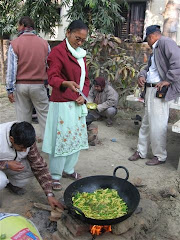
On Monday I arrived at Aqua Park at 10:30 as requested. The aqua was a green slime pond, the banks littered with the debris of previous picnics. The park was a patch of grass with a couple of metal swings, but as Lilanath said, it was the cheapest place to go. All the participants were busy cleaning pots, lighting fires and preparing the several tons of vegetables that they had brought from the market. No knives, but a dangerous sword like implements you hold between your feet and slice things against. Far too dangerous for me, so I peeled onions with my fingers while Bishnu scraped carrots and potatoes with a spoon. Nasta (breakfast) started at 11:15. A sack of beaten rice was divided onto 25 leaf plates, piles of spicy chicken, daal and vegetables added, then raw onions and chillies. As they knew I would not eat the chicken, I was also given a box of sweets, 3 oranges, apples and bananas. About 12:30, the other trainers arrived (10:30 Nepali time), ready for lunch. This consisted of goat (all body parts, fried in masala) prepared by Binod, aloo gobi prepared by Maliti, the only female teacher (2 buckets or cauliflower, 2 buckets of potatoes, 2 buckets of onions, I bucket of tomatoes, several packets of spices) and yogurt (10 litres). We sat crossed legged in a circle eating with our fingers, as the hooded crows gathered and became increasingly bold scavenging the left overs. Afterwards there were stories and songs, and Tulsi made a speech and told jokes in Sanskrit.
The first 3 days of the new year were really enjoyable, as I was able to plan and deliver the last topics of the English module. David’s attempts to start working at Janapath school were thwarted by the arrival of 20 student teachers to supplement the nine he was intending to observe, and when he decided to return to Bokari to check on progress, he found that the teachers had given themselves a week off to mark test papers. We delivered a day’s training on communication skills together, and had lots of fun – as did the teachers. Like the Ethiopians, once introduced to role play, their enthusiasm was hard to control, especially in conflict situations! Friday was the day of the examination, which Durga was scheduled to organise, and I had planned to observe primary teachers at Shankapur. As Jeevan remarked “dear respectable Deborah madam, we do not want you to come to the examination, as we are afraid you will not let us cheat”. As Durga did not arrive, there was no choice. I discovered that they could not read English silently; most of them had their manuals and notebooks on their chairs, and Surendra and Ganga (obviously influenced by Crorepati – the Indian version of ‘Who wants to be a millionaire?’, now on Nepali television) attempted to ‘phone a friend’. Fortunately Durga arrived after half an hour, so I was able to hand over my responsibility and not feel guilty. He had been to one of the teaching practice schools, to find no teachers or trainees present. The peon had rounded up the children with a stick and had them singing the national anthem while teachers drifted in up to an hour late. He waited for the head to talk to him about his responsibilities before coming to the ETC. After the exam, we had presentation of their projects – some heart rending stories of trying to improve attendance by visiting families to persuade them of the importance of education, while children were taken out of school to mind goats, work in the fields and the house. In one village, three 12 year old girls had been sold to brothels in India. Some teachers are developing extra curricular programmes to stop boys dropping out to play football, and ‘go roaming’. In some of the more affluent areas there is an increasing drug problem. The day ended with the usual ‘closing ceremony’ for both groups (Maths and English) with all the trainers at the front making long speeches (except me). It was dark by the time we had finished and the mosquitoes were rampant.
It’s the season of grapes and power cuts. The grapes – small green ones from Nepal and larger black ones from India – are delicious. The power cuts are increasingly frequent: 5:30 – 8:30 am and 5:30 – 8:30 pm most days, and for unpredictable periods during the day and night. David has bought us a gas heater, and we have moved into the small back room where we can keep warm in the evenings. Thwarted by exhaustion of battery power for computers, inability to access internet or bake bread on Saturday, we decided to cycle to India. The border was marked by a bamboo pole, a piece of string and two boys in bobble hats in a shed. We resisted the temptation to just carry on cycling in case we could not get back. On the way home we found a wonderful ‘garden centre’ with sweet williams, snapdragons, pansies, dahlias, and verbena. We rode home with flowering baskets.
I was able to attend the last session of the day with the English group, just in time to be invited to their end of course picnic that they had organised for the next day. I also learnt that Durga has to go to Sunsari for 3 days on Tuesday, so there is ‘no-one’ to complete the last 3 days of training. I suppose I am pleased to be trusted with it; they are a lovely group of teachers, but find working in English very difficult.
On Monday I arrived at Aqua Park at 10:30 as requested. The aqua was a green slime pond, the banks littered with the debris of previous picnics. The park was a patch of grass with a couple of metal swings, but as Lilanath said, it was the cheapest place to go. All the participants were busy cleaning pots, lighting fires and preparing the several tons of vegetables that they had brought from the market. No knives, but a dangerous sword like implements you hold between your feet and slice things against. Far too dangerous for me, so I peeled onions with my fingers while Bishnu scraped carrots and potatoes with a spoon. Nasta (breakfast) started at 11:15. A sack of beaten rice was divided onto 25 leaf plates, piles of spicy chicken, daal and vegetables added, then raw onions and chillies. As they knew I would not eat the chicken, I was also given a box of sweets, 3 oranges, apples and bananas. About 12:30, the other trainers arrived (10:30 Nepali time), ready for lunch. This consisted of goat (all body parts, fried in masala) prepared by Binod, aloo gobi prepared by Maliti, the only female teacher (2 buckets or cauliflower, 2 buckets of potatoes, 2 buckets of onions, I bucket of tomatoes, several packets of spices) and yogurt (10 litres). We sat crossed legged in a circle eating with our fingers, as the hooded crows gathered and became increasingly bold scavenging the left overs. Afterwards there were stories and songs, and Tulsi made a speech and told jokes in Sanskrit.
The first 3 days of the new year were really enjoyable, as I was able to plan and deliver the last topics of the English module. David’s attempts to start working at Janapath school were thwarted by the arrival of 20 student teachers to supplement the nine he was intending to observe, and when he decided to return to Bokari to check on progress, he found that the teachers had given themselves a week off to mark test papers. We delivered a day’s training on communication skills together, and had lots of fun – as did the teachers. Like the Ethiopians, once introduced to role play, their enthusiasm was hard to control, especially in conflict situations! Friday was the day of the examination, which Durga was scheduled to organise, and I had planned to observe primary teachers at Shankapur. As Jeevan remarked “dear respectable Deborah madam, we do not want you to come to the examination, as we are afraid you will not let us cheat”. As Durga did not arrive, there was no choice. I discovered that they could not read English silently; most of them had their manuals and notebooks on their chairs, and Surendra and Ganga (obviously influenced by Crorepati – the Indian version of ‘Who wants to be a millionaire?’, now on Nepali television) attempted to ‘phone a friend’. Fortunately Durga arrived after half an hour, so I was able to hand over my responsibility and not feel guilty. He had been to one of the teaching practice schools, to find no teachers or trainees present. The peon had rounded up the children with a stick and had them singing the national anthem while teachers drifted in up to an hour late. He waited for the head to talk to him about his responsibilities before coming to the ETC. After the exam, we had presentation of their projects – some heart rending stories of trying to improve attendance by visiting families to persuade them of the importance of education, while children were taken out of school to mind goats, work in the fields and the house. In one village, three 12 year old girls had been sold to brothels in India. Some teachers are developing extra curricular programmes to stop boys dropping out to play football, and ‘go roaming’. In some of the more affluent areas there is an increasing drug problem. The day ended with the usual ‘closing ceremony’ for both groups (Maths and English) with all the trainers at the front making long speeches (except me). It was dark by the time we had finished and the mosquitoes were rampant.
It’s the season of grapes and power cuts. The grapes – small green ones from Nepal and larger black ones from India – are delicious. The power cuts are increasingly frequent: 5:30 – 8:30 am and 5:30 – 8:30 pm most days, and for unpredictable periods during the day and night. David has bought us a gas heater, and we have moved into the small back room where we can keep warm in the evenings. Thwarted by exhaustion of battery power for computers, inability to access internet or bake bread on Saturday, we decided to cycle to India. The border was marked by a bamboo pole, a piece of string and two boys in bobble hats in a shed. We resisted the temptation to just carry on cycling in case we could not get back. On the way home we found a wonderful ‘garden centre’ with sweet williams, snapdragons, pansies, dahlias, and verbena. We rode home with flowering baskets.
Subscribe to:
Posts (Atom)

.JPG)
.jpg)
.jpg)


.jpg)
.jpg)
.jpg)


.jpg)