Sunday December 30. Back to work as the orientation day for primary school-based training that I had suggested had been moved forward by 3 days. The primary teachers were pleased to see me back, and were particularly proud to show me the giant rabbit they have made out of cotton wool; I’m not sure how it relates to the curriculum. We had invited the primary heads, but unfortunately only one of them turned up. Everyone is wearing increasingly bizarre woolly hats, and even Lalmani, who spends most of the year in vest and pants, is wearing a shell suit (remember shell suits?).
I was able to attend the last session of the day with the English group, just in time to be invited to their end of course picnic that they had organised for the next day. I also learnt that Durga has to go to Sunsari for 3 days on Tuesday, so there is ‘no-one’ to complete the last 3 days of training. I suppose I am pleased to be trusted with it; they are a lovely group of teachers, but find working in English very difficult.
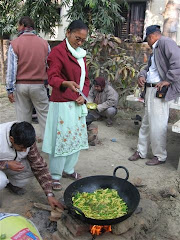
On Monday I arrived at Aqua Park at 10:30 as requested. The aqua was a green slime pond, the banks littered with the debris of previous picnics. The park was a patch of grass with a couple of metal swings, but as Lilanath said, it was the cheapest place to go. All the participants were busy cleaning pots, lighting fires and preparing the several tons of vegetables that they had brought from the market. No knives, but a dangerous sword like implements you hold between your feet and slice things against. Far too dangerous for me, so I peeled onions with my fingers while Bishnu scraped carrots and potatoes with a spoon. Nasta (breakfast) started at 11:15. A sack of beaten rice was divided onto 25 leaf plates, piles of spicy chicken, daal and vegetables added, then raw onions and chillies. As they knew I would not eat the chicken, I was also given a box of sweets, 3 oranges, apples and bananas. About 12:30, the other trainers arrived (10:30 Nepali time), ready for lunch. This consisted of goat (all body parts, fried in masala) prepared by Binod, aloo gobi prepared by Maliti, the only female teacher (2 buckets or cauliflower, 2 buckets of potatoes, 2 buckets of onions, I bucket of tomatoes, several packets of spices) and yogurt (10 litres). We sat crossed legged in a circle eating with our fingers, as the hooded crows gathered and became increasingly bold scavenging the left overs. Afterwards there were stories and songs, and Tulsi made a speech and told jokes in Sanskrit.
The first 3 days of the new year were really enjoyable, as I was able to plan and deliver the last topics of the English module. David’s attempts to start working at Janapath school were thwarted by the arrival of 20 student teachers to supplement the nine he was intending to observe, and when he decided to return to Bokari to check on progress, he found that the teachers had given themselves a week off to mark test papers. We delivered a day’s training on communication skills together, and had lots of fun – as did the teachers. Like the Ethiopians, once introduced to role play, their enthusiasm was hard to control, especially in conflict situations! Friday was the day of the examination, which Durga was scheduled to organise, and I had planned to observe primary teachers at Shankapur. As Jeevan remarked “dear respectable Deborah madam, we do not want you to come to the examination, as we are afraid you will not let us cheat”. As Durga did not arrive, there was no choice. I discovered that they could not read English silently; most of them had their manuals and notebooks on their chairs, and Surendra and Ganga (obviously influenced by Crorepati – the Indian version of ‘Who wants to be a millionaire?’, now on Nepali television) attempted to ‘phone a friend’. Fortunately Durga arrived after half an hour, so I was able to hand over my responsibility and not feel guilty. He had been to one of the teaching practice schools, to find no teachers or trainees present. The peon had rounded up the children with a stick and had them singing the national anthem while teachers drifted in up to an hour late. He waited for the head to talk to him about his responsibilities before coming to the ETC. After the exam, we had presentation of their projects – some heart rending stories of trying to improve attendance by visiting families to persuade them of the importance of education, while children were taken out of school to mind goats, work in the fields and the house. In one village, three 12 year old girls had been sold to brothels in India. Some teachers are developing extra curricular programmes to stop boys dropping out to play football, and ‘go roaming’. In some of the more affluent areas there is an increasing drug problem. The day ended with the usual ‘closing ceremony’ for both groups (Maths and English) with all the trainers at the front making long speeches (except me). It was dark by the time we had finished and the mosquitoes were rampant.
It’s the season of grapes and power cuts. The grapes – small green ones from Nepal and larger black ones from India – are delicious. The power cuts are increasingly frequent: 5:30 – 8:30 am and 5:30 – 8:30 pm most days, and for unpredictable periods during the day and night. David has bought us a gas heater, and we have moved into the small back room where we can keep warm in the evenings. Thwarted by exhaustion of battery power for computers, inability to access internet or bake bread on Saturday, we decided to cycle to India. The border was marked by a bamboo pole, a piece of string and two boys in bobble hats in a shed. We resisted the temptation to just carry on cycling in case we could not get back. On the way home we found a wonderful ‘garden centre’ with sweet williams, snapdragons, pansies, dahlias, and verbena. We rode home with flowering baskets.
Saturday, 5 January 2008
Saturday, 29 December 2007
Christmas
An inauspicious start to our Christmas holiday as we are both struck down with Giardia, David has terrible cold and cough and all flights delayed by fog in Kathmandu. When we eventually reach the Pacific Guest House, it is freezing and we have a tiny room with no natural light, cold shower and lumpy cotton mattress. Went immediately to the big shop and bought a fan heater to stop David shaking. We managed to be fairly jolly when we went out with friends about to set off for Dorset and Delhi for their Christmas treats. On Monday David felt worse and went to the clinic while I went to VSO to prepare for the action research workshop next month. Text message conveyed severe upper and lower respiratory tract infection and suspected malaria. Tests inconclusive. He spent the next few days sitting in the sun in many layers of clothing attempting to keep warm, then diving under many layers of bedcovers still fully clothed in the evenings. Shakes subsided; malaria unlikely; as the antibiotics started to alleviate the respiratory infection, his face erupted into a massive cold sore. He remained cheerful and determined that we should go to Bardia. So after a successful few days work, we returned to the airport to find no flights to the Terai because of fog, but we eventually got to Nepalgunj in south west Nepal by early afternoon on Saturday 22nd. We were met by a jeep and the charming Raju and sped along the western part of the Mahendra Highway, passing small mud villages, rice stacks, laden buffalo carts, bright yellow fields of mustard, surprisingly pink pigs, and YCL road blocks. Gradually the forest thickened on either side of the road, and we entered the national park. An hour of dirt road, fording two rivers and passing through many prosperous looking Tharu villages brought us to the lovely Tiger Mountain lodge (no tigers or mountains) in traditional mud and thatch. After a delicious daal bhat snack, we walked in the sal forest, hearing wild elephant and parakeets, seeing fresh tracks of rhino, leopard and tiger, holes of porcupines and pythons and seeing crocodiles, deer (various) and monkeys (various). We returned past the 5 domestic elephants eating their supper, and were greeted by tea and popcorn around a blazing fire, hot shower with an alarming jet propelled shower mat, dinner and a bottle of wine, before retiring to our room where hot water bottles had been placed in the huge bed. The only other guests were a white Kenyan couple doing research as part of an international rhino conservation project. Rhinos are severely threatened in Bardia. The 80 transported here from Chitwan were all poached within a year. An early morning walk on Sunday; the misty forest smelled remarkably like an English beech wood in autumn, but there the similarity ended. Many tracks and noises, but few animals. After a late breakfast and relaxing morning in a sunny hammock, we set off into the forest on top of the enormous Laxmi Kali in a sturdy howdah. A green sea of towering elephant grass opened before us and we crossed rivers of swirling waterand seemingly impenetrable thickets in search of elusive animals. After 2 hours she sank to her knees so we could dismount with some dignity, and we were jeeped to a tented camp by the massive Karnali river where we spent Christmas. Safari luxury, with big tents, hot showers, camp fire, the wine bottle and hot water bottles. There were 2 resident python beneath the camp, the female with a ‘waist’ measurement larger than mine. A perfect Christmas day, rafting down the Karnali in warm sunshine, watching birds and Gangetic dolphin playing, stopping for a picnic on the river bank, before meeting Laxmi Kali on a sand bank. Worries about mounting were short-lived, as she knelt down, hooked her tail into a stirrup and propelled us up her mountainous backside. We encountered wild elephant (surprisingly not poached for their ivory) on the way back to the lodge. Christmas dinner (lots of vegetables but no sprouts) was followed by a flat brownish cake with Merry Xmax in white icing. Two more days of elephant safaris, walks and reading in hammocks. Colonel Jim Edwards, the founder of Tiger Tops and owner of the lodge arrived on our last night with some of his children and their friends, with much hospitality and entertaining stories around the fire in the evening.
We spent 5 hours in Nepalgunj airport on Thursday afternoon waiting for a plane, and a further 4 hours at Kathmandu airport on Friday waiting for our flight home. Security tried to confiscate David’s candles as a WMD. We did not know that domestic planes flew at night – there are no lights on the planes or the runways. Everest by moonlight was spectacular and landing a big surprise!
We spent 5 hours in Nepalgunj airport on Thursday afternoon waiting for a plane, and a further 4 hours at Kathmandu airport on Friday waiting for our flight home. Security tried to confiscate David’s candles as a WMD. We did not know that domestic planes flew at night – there are no lights on the planes or the runways. Everest by moonlight was spectacular and landing a big surprise!

Saturday, 15 December 2007
Training, training, training
My naïve assumption that the English training package had been divided amongst ‘experts’ in particular areas has been shattered. After half an hour with Kumar discussing what he was planning for the next day, he confessed that he has never heard of the topic before. There is nothing helpful in the trainer’s guide. “Perhaps you can deliver it?” Perhaps not, but I was able to make some suggestions to help him out. We did some good professional development activities today, using grade 10 students from the school, to find out about students’ problems in learning English. I was happy watching the teachers sitting cross-legged on the field with a small group of students, encouraging them to talk. We had done some work on phrasing questions beforehand, getting rid of some eg ‘is your teacher bad?’ ‘does your teacher beat you when you make a mistake?’ Lots of good points, which will provide a focus for the classroom research session tomorrow. As we were finishing, a demonstration was parading past the ETC (a frequent occurrence), and a group of women came in with a petition to be delivered to the PM’s residence further down the road. It was a demand for implementation of the legislation for 33% female representation in parliament written and signed on a series of bedsheets. We all added our signatures enthusiastically. There is only one woman in the secondary group.
The atmosphere in the training room is much more positive and relaxed now we know each other better. Many come early in the morning to talk to me – the first time they have every spoken to a native English speaker – and they want me to comment on what they are trying to do in their classrooms. The delightful Lilanath stays at the end of the day, as he is late every morning. ”I do not go to temple and pray to god; I go to the deaf school to teach the children as a volunteer”. We have planned a visit when the training is over. One of Kumar’s better ideas was to form groups by making them pick from a bag of sweets. They are now proud to call themselves ‘milky bites’, ‘choc drops’, ‘mango sucker’ and ‘coffee crème’. The person selected for the house captain role each day (responsible for time management and keeping order) now has a small brass bell. Surya used it very effectively today, especially keeping the disruptive ‘milky bite’ Shiv Narayan under control. He is the class hoodie, with the fur trimmed hood of his anorak permanently up. Today he was also wearing an anti-pollution facemask. Most teachers add extra layers of clothes daily, as the temperature continues to drop; Umapati is growing a winter moustache and we all go to the field to warm up between sessions. The ‘routines’ that Durga and I have created are beginning to have some effect, so now the teachers ask “ where are your objectives?” when a new trainer comes, and point out that he is telling them to develop student-centred teaching, while demonstrating teacher-centred methods. Progress?
David’s teaching goes from good to better. More children come every day, so more name cards have to be made each evening for the following day’s activities. Farmers have also started coming from the fields to hover in the doorway of English lessons to see what the teachers and the strange man are doing. Soon they will be able to join in the chorus of ‘Old Macdonald’.
Good business for the bicycle repair man this week, as we have acquired 3 punctures and a leaking valve! A long cycle ride on Saturday to reach Kulabari, Anita’s village, to meet her family. Aama sends huge bundles of greens for us every other day. Aama was waiting to greet us, the first time I had seen her since she appeared at the end of our bed one morning. At the back of the house are 3 cows, a goat and a vegetable garden with potatoes, spinach, garlic, onions, peppers, chillies, greens, cauliflower, pumpkins, herbs… and more. It is fertilised by the waste from their own biogas producer, which provides their cooking fuel. A splendid example of self sufficient living. We had a lovely afternoon, with lots of snacks and many local children coming round to try out their few words of English.
We are going to Kathmandu on the 18th for a 3 day planning meeting at VSO for an action research workshop in January. On 22nd we are flying to Nepalgunj in SW Nepal and will be met at the airport and transported to Tiger Mountain in Bardia National Park for a Christmas treat. Back here on December 30.
The atmosphere in the training room is much more positive and relaxed now we know each other better. Many come early in the morning to talk to me – the first time they have every spoken to a native English speaker – and they want me to comment on what they are trying to do in their classrooms. The delightful Lilanath stays at the end of the day, as he is late every morning. ”I do not go to temple and pray to god; I go to the deaf school to teach the children as a volunteer”. We have planned a visit when the training is over. One of Kumar’s better ideas was to form groups by making them pick from a bag of sweets. They are now proud to call themselves ‘milky bites’, ‘choc drops’, ‘mango sucker’ and ‘coffee crème’. The person selected for the house captain role each day (responsible for time management and keeping order) now has a small brass bell. Surya used it very effectively today, especially keeping the disruptive ‘milky bite’ Shiv Narayan under control. He is the class hoodie, with the fur trimmed hood of his anorak permanently up. Today he was also wearing an anti-pollution facemask. Most teachers add extra layers of clothes daily, as the temperature continues to drop; Umapati is growing a winter moustache and we all go to the field to warm up between sessions. The ‘routines’ that Durga and I have created are beginning to have some effect, so now the teachers ask “ where are your objectives?” when a new trainer comes, and point out that he is telling them to develop student-centred teaching, while demonstrating teacher-centred methods. Progress?
David’s teaching goes from good to better. More children come every day, so more name cards have to be made each evening for the following day’s activities. Farmers have also started coming from the fields to hover in the doorway of English lessons to see what the teachers and the strange man are doing. Soon they will be able to join in the chorus of ‘Old Macdonald’.
Good business for the bicycle repair man this week, as we have acquired 3 punctures and a leaking valve! A long cycle ride on Saturday to reach Kulabari, Anita’s village, to meet her family. Aama sends huge bundles of greens for us every other day. Aama was waiting to greet us, the first time I had seen her since she appeared at the end of our bed one morning. At the back of the house are 3 cows, a goat and a vegetable garden with potatoes, spinach, garlic, onions, peppers, chillies, greens, cauliflower, pumpkins, herbs… and more. It is fertilised by the waste from their own biogas producer, which provides their cooking fuel. A splendid example of self sufficient living. We had a lovely afternoon, with lots of snacks and many local children coming round to try out their few words of English.
We are going to Kathmandu on the 18th for a 3 day planning meeting at VSO for an action research workshop in January. On 22nd we are flying to Nepalgunj in SW Nepal and will be met at the airport and transported to Tiger Mountain in Bardia National Park for a Christmas treat. Back here on December 30.
Saturday, 8 December 2007
Breakthroughs?
The pampered cow that wore a raincoat during the monsoon now has a smart paisley blanket on winter mornings. It starts getting cold about 4 pm, so we are now only swimming at weekends. David has just worked 12 days without a break at Bal Rani, as their school self assessment took place over last weekend. Teachers, students, community members, parents and the DEO have been working together on a new school improvement plan. The staff are really keen to improve both their teaching and the school, and he feels he is making some headway. Babaram from the DEO has been interested in David’s presence and involvement in the self assessment, and has come back to school to watch David’s lesson observations and feedback. He has now managed to talk through a teaching and learning action plan with the head and the DEO, and VSO are interested in using this as a model for future placements. His team teaching has been going well, and he planned to take Gayenau’s class when she was away on Thursday. The children had made name cards that he had then typed and printed for some work in English. He was disappointed that the children did not remember the alphabet song he had taught them the day before, but as he tried to match children to the name cards, realised that he was in the wrong class!
I’ve resisted invitations to work through another weekend training programme, although I’ve had great fun with a group of secondary teachers doing Life Skills this week. A really inventive programme, with lots of games and role plays. The human noughts and crosses competition on the school field drew many spectators. Cow poo was an additional hazard, and the goats became very frisky. I also did my bit for World AIDS day, with a quiz and discussion.
The primary teachers have trickled in from the hills during the week and we were up to our full compliment of 60 by Friday. They range from bright young men in smartly pressed shirts, trainers and baseball caps who call me ‘auntie’, to elderly men in traditional Nepali dress, and stout middle aged sari clad women who call me didi. We have interesting ‘mixed language’ conversations. Training for English and Maths secondary teachers has also begun, so I am working alongside Durga with the English teachers. They are finding it very difficult to work in English. Its hard to plan ahead, as training mostly follows what teachers do in class – pick up the text and see what’s next. However, he has put several suggestions from the last training into practice and we have now agreed a ‘good practice model’ for all trainers to follow. Quite how this will be done is yet to be determined, but it’s a start. Some of the training materials are good, but others range from the dull and irrelevant to the bizarre. Today’s session on social inclusion, where we organised some very effective role play (a new experience for the trainees) ended with a handout on English customs: “Do not be surprised if you are called flower, chuck, me duck, mate, gov or treacle. It is perfectly normal.” “Do not remove pickings from your nose, clean your ears (bike key is the favourite implement for this activity here), spit (frequent trips to the window to clear nose and throat and expel vast quantities of mucus is common) or pass wind in public places”. Having watched the poor young trainer today struggle with the less than helpful and largely irrelevant materials in the guide, I’ve agreed to help him do something more active and relevant on Sunday, while Durga is visiting elderly relatives in Jhapa.
My sixtieth birthday has been and gone, with party hats and cards at breakfast time and the ceremonial harvesting of our first radish. The day was not without incident; the training was probably the best we’ve done together so far, David came to meet Bedu at the end of the day and we all had pepper tea at Thapa’s mosquito infested tea stall. His arrival caused much interest amongst the primary teachers, who quizzed me about aglo manche (tall man) the next morning. My treat of a bucket of hot water at shower time was spoiled by smashing the bathroom light as I swatted a mosquito with my towel. Naked, dripping, cold, surrounded by broken glass, in the dark, and sixty. We ate dinner at Friends’ Restaurant near the bus stand; in addition to good Indian food, the menu boasts ‘hard liquor’ and single cigarettes. The bhai (waiter) is charming and looks after us well, the paper napkins are not torn in half and our elbows do not stick to the tables. Dinner for two £1:50. Very dark cycling home, under the orange saucer of a new moon, where David surprised me with birthday cake (the best attempt at chocolate cake Kiran’s bakery could manage) complete with candles (6).
Meanwhile Saroj, in the absence of Tanka and Amita who have gone to Kathmandu, has set up a slalom course in the garden in anticipation of his motorcycle test – a 5 minute exercise weaving between 6 posts without putting your feet on the ground or falling off. The rice harvest is coming in from the fields piled high on ox carts, handcarts, rickshaws and heads. An impressive pile is being built next door.
I’ve resisted invitations to work through another weekend training programme, although I’ve had great fun with a group of secondary teachers doing Life Skills this week. A really inventive programme, with lots of games and role plays. The human noughts and crosses competition on the school field drew many spectators. Cow poo was an additional hazard, and the goats became very frisky. I also did my bit for World AIDS day, with a quiz and discussion.
The primary teachers have trickled in from the hills during the week and we were up to our full compliment of 60 by Friday. They range from bright young men in smartly pressed shirts, trainers and baseball caps who call me ‘auntie’, to elderly men in traditional Nepali dress, and stout middle aged sari clad women who call me didi. We have interesting ‘mixed language’ conversations. Training for English and Maths secondary teachers has also begun, so I am working alongside Durga with the English teachers. They are finding it very difficult to work in English. Its hard to plan ahead, as training mostly follows what teachers do in class – pick up the text and see what’s next. However, he has put several suggestions from the last training into practice and we have now agreed a ‘good practice model’ for all trainers to follow. Quite how this will be done is yet to be determined, but it’s a start. Some of the training materials are good, but others range from the dull and irrelevant to the bizarre. Today’s session on social inclusion, where we organised some very effective role play (a new experience for the trainees) ended with a handout on English customs: “Do not be surprised if you are called flower, chuck, me duck, mate, gov or treacle. It is perfectly normal.” “Do not remove pickings from your nose, clean your ears (bike key is the favourite implement for this activity here), spit (frequent trips to the window to clear nose and throat and expel vast quantities of mucus is common) or pass wind in public places”. Having watched the poor young trainer today struggle with the less than helpful and largely irrelevant materials in the guide, I’ve agreed to help him do something more active and relevant on Sunday, while Durga is visiting elderly relatives in Jhapa.
My sixtieth birthday has been and gone, with party hats and cards at breakfast time and the ceremonial harvesting of our first radish. The day was not without incident; the training was probably the best we’ve done together so far, David came to meet Bedu at the end of the day and we all had pepper tea at Thapa’s mosquito infested tea stall. His arrival caused much interest amongst the primary teachers, who quizzed me about aglo manche (tall man) the next morning. My treat of a bucket of hot water at shower time was spoiled by smashing the bathroom light as I swatted a mosquito with my towel. Naked, dripping, cold, surrounded by broken glass, in the dark, and sixty. We ate dinner at Friends’ Restaurant near the bus stand; in addition to good Indian food, the menu boasts ‘hard liquor’ and single cigarettes. The bhai (waiter) is charming and looks after us well, the paper napkins are not torn in half and our elbows do not stick to the tables. Dinner for two £1:50. Very dark cycling home, under the orange saucer of a new moon, where David surprised me with birthday cake (the best attempt at chocolate cake Kiran’s bakery could manage) complete with candles (6).
Meanwhile Saroj, in the absence of Tanka and Amita who have gone to Kathmandu, has set up a slalom course in the garden in anticipation of his motorcycle test – a 5 minute exercise weaving between 6 posts without putting your feet on the ground or falling off. The rice harvest is coming in from the fields piled high on ox carts, handcarts, rickshaws and heads. An impressive pile is being built next door.
Saturday, 24 November 2007
More festivals
The 5 day Tihar festival started on Wednesday, with crows as messengers honoured, followed by garlanded (rather than usually much abused) dogs on Thursday as we set off for Janakpur. I love being at a bus station at dawn. Pink-grey sky; hustle and hassle as conductors try to fill their buses. Attempts to find a seat that was welded to the floor with the back attached to the seat and glass in the window proved impossible, so we departed precariously at 6am. Surprisingly chilly and damp as we crossed the huge Koshi barrage that supplies much of the electricity for the Terai. Endless stretches of sugar cane and rice paddy in shades from bright green to ripe yellow, with brown stalks where it had alreadybbeen harvested. Large herds of cattle and goats; the many rivers were alive with boys washing buffalo, while in the villages women were repairing their house walls with mud and cleaning for Laxmi puja.
After 6 bone shaking hours we arrived at the Rama Hotel in Janakpur, where the corridor to our room was also being cleaned, necessitating wading up to our ankles in soapy water to a depressingly brown room. But at least there was water. Janakpur is the city where Sita was born and later married to Ram (for details see the Ramayana), and is a Hindu pilgrimage city for Nepalis and Indians. We walked south to Kuwa village to the Janakpur Women’s Cooperative, where local women, previously confined to the home, are producing traditional Maithili art work; huge paintings of village life in vibrant colours, ceramics and textiles. The project is very successful, and many of the women have started their own small businesses since the project started 12 years ago. In the village, women were decorating the walls of their houses with mud relief work and painting them in traditional designs. Men were threshing rice with teams of cattle, children were playing among the rice stacks and buffaloes wallowed like hippos in the ponds.
On the morning of Tihar, huge banana plants were delivered to all the shops, erected, wrapped in brightly coloured paper and hung with decorations. We spent the day touring the ponds and temples with many gaudy statues of Ram and Sita, and visited the Big Monkey temple where a rhesus monkey is being fattened to emulate his 60kg father. As we returned to the hotel, mandalas in brightly coloured powder were being prepared outside all the shops and houses, and at dusk oil lamps were lit on every surface, from the roof tops to the streets. Beautiful. The effect was spoiled by the fireworks which are now also traditional and big on noise but not aesthetics. A combination of Christmas and bonfire night.
Saturday is the day cows are celebrated, and they were splendidly striped in shocking pink and turquoise; we watched a small girl dying her goat a vibrant green. We caught the last bus home, hoping to arrive before dark, but our progress was impeded by a puncture. Nepali buses do not carry spare wheels, so we limped backwards to the nearest town to get it repaired. We arrived home long after dark, our walk back from the bus stand lit by the Tihar lights of Biratnagar. Still no water. A promising brown trickle on Sunday morning was short-lived, so we use the outside tap like many of the other local people.
Friday (November 16), was Chhath, a huge festival in the Terai, celebrating sunset and sunrise the following morning. After work we followed the crowds to the river, where thousands of people were gathered along the banks. Every temple (there are several hundred) had its own appointed place, strung with garlands, coloured lights, tinsel and other decorations. Women in their best saris had brought huge baskets of puja offerings and tiny butter lamps were lit along the river and floated off at dusk. The women waded into the filthy water with their puja offerings and immersed themselves, while boys splashed in the shallows and emerged to let off more firecrackers. We followed the crowds back to where we had left our cycles, and eventually found our way home via a very dark, circuitous route. That seems to be the last of the festivals, and already there are strikes planned for Sunday, huge Maoist protest rallies, Madhesi bandhs called and inertia in Parliament.
We have just finished a 7 day ’training of trainers’ programme; no concession for weekends, so 12 days of real work without a break. Durga and Babaram attended a ‘master trainers’ course in Pokhara last month, and were promised a training package to deliver. This has not materialised. Durga had collected the powerpoint presentations given by the ‘experts’ and decided this should form the basis of the training. Forward planning is not a strength, but we did eventually meet to discuss the training the day before it started. I was in despair having seen the material; densely typed pages lifted from the internet, many inaccuracies and no practical application. My questions of “Do you understand this slide?” “Is it useful?” left with us with nothing after completing the exercise. Having decided what would be useful and relevant, we have had late nights preparing materials. Maybe next time we will start earlier………. We were working with 30 English and 30 secondary Science teachers from eastern Nepal – one female in each group, which is better than none. Sessions improved slowly during the week; I am trying to model what I think is good practice. I’m not sure Durga agrees. After a session with the scientists when we played at being molecules on the field, joined by goats and several stray children, I think he doubts my professional credentials. We started at 7am on the last morning so participants could catch heir buses home before an indefinite bandh started on Thursday. The week ended well, with many invitations for us to go and deliver training in the districts. Lalmani and his family prepared a feast (daal bhat) in the hostel at the end of the training. The ‘peons’ work so hard while training is on, carrying furniture and equipment, cycling to the photocopy shop, shopping for materials and looking after the hostel (a rather grim building with small 17 rooms and very basic sanitation). I’ve just finished summarising all the feedback forms and writing an evaluation, with many positive comments and a few lessons for next time.
Thursday was spent planning the next round of training; 60 primary teachers arrive on Sunday for 10 weeks, 25 for a week of Life Skills on Monday and 60 secondary teachers the following weekend for a month. Busy at last!
The cyclone in Bangladesh has resulted in the arrival of cool air; colleagues arrive at the training centre each morning wrapped in jackets and scarves. 28oC at midday today, but our cold shower (water now restored) is beginning to feel unpleasantly cold in the evenings. We have a new ‘friend’ in the shape of Amita’s mother, who is currently staying upstairs. She sent us many delicious Tihar snacks last week, and is obviously fascinated by bideshi living. David found her in the kitchen yesterday and she was standing at the foot of the bed when I woke up this morning!
Wednesday, 7 November 2007
Winter
Back to work. Glorious weather – sunny and dry with gentle breezes; the mud has dried and turned to all pervasive dust. The rice is being harvested. Colleagues are wearing socks, shoes and long sleeved shirts in recognition of the winter season. It’s a cool 30 - 32oC during the day. I’ve planted lettuces and herbs in a box on the terrace; they have germinated in 3 days. We’ve started working ‘winter hours’, as it starts it get dark soon after 5pm. The neighbours are shinning up their coconut palms to thin them, reinforcing one of the messages from the security conference that Terai volunteers are in more danger from falling coconuts than Maoist insurgency. There was an earthquake in Kathmandu on Monday, causing the temporary evacuation of parliament and the VSO offices.
Over the Dashain holiday, Durga has purchased a motorbike, Govind has acquired an unfortunate moustache, Tulsi has new trainers. A huge marquee has been erected on the school field for an international medical conference that will start ke samaya pacchi. The goats are missing – victims of Dashain. One of our new rooms is being used for some training for technical instructors by some ‘experts’ from Kathmandu. I was invited to watch their presentations and give feedback on Tuesday, with topics ranging from jam making and snake bite to castration and family planning (not related). On Wednesday I cycled with David through the countryside to Bokhari primary school so ‘his’ teachers could demonstrate their new skills. A lovely day, squashed on benches with grubby children desperate for us to mark their books. Outside the newly painted classrooms, women harvested rice while boys (who should have been in school) watched the grazing buffalo. The medical conference did start on Thursday, causing the PM to leave crucial talks to try and resolve the political stalemate to come and open it. I had to weave my way through many check points and armed police to get to work. During the day, the police use one of our training rooms to rest, parking their guns, taking off belt, shoes and shirt before turning on the fans and lying down on the tables to sleep.
Laura, our friend from the programme office in Kathmandu arrived on Friday for the weekend, so we could start to plan VSO’s project on action research. David had managed to find a reasonably priced mattress in town that arrived several hours after she did. It was good to have a visitor at last, and we had an enjoyable time introducing her to the delights of Biratnagar (not too time consuming), as well as producing a substantial proposal for VSO.
At last Bhakta has returned from his holiday so the rest of the books have been moved into the ‘library’. On Monday I was faced with 50 locked shelves and over 200 apparently identical keys entwined in string. I managed to unlock 46 shelves by the end of the first day. With Anil’s help, I completed it by day 3, and have now finished most of the sorting, reshelving and labelling. My attempts to relegate out of date curriculum books, broken books, books with covers missing, books of no relevance to anyone or anything to the store have thwarted, but I did manage to sneak some Jehovah’s Witness pamphlets into the cardboard rubbish box. I have now bought a bin. After my days of physical exertion, Tulsi decided I was looking very thin, so organised a weigh in for all the staff, followed by him taking our blood pressure with an ancient sphygmomanometer he found in the science store.
On November 5, after a late meeting at the ETC to discuss the Training for Trainers of English and Science that does not start for another 10 days (is this progress?), we cycled home through the acrid smoke and alarming bangs of firecrackers – not a Guy Fawkes memorial, but some of the many loud and enthusiastic preparations for Tihar that starts on Friday. Noisy nights all week with ferocious firecrackers. We have also been without water for 2 days, but the shower at the pool is functional and our almost buckets full.
Over the Dashain holiday, Durga has purchased a motorbike, Govind has acquired an unfortunate moustache, Tulsi has new trainers. A huge marquee has been erected on the school field for an international medical conference that will start ke samaya pacchi. The goats are missing – victims of Dashain. One of our new rooms is being used for some training for technical instructors by some ‘experts’ from Kathmandu. I was invited to watch their presentations and give feedback on Tuesday, with topics ranging from jam making and snake bite to castration and family planning (not related). On Wednesday I cycled with David through the countryside to Bokhari primary school so ‘his’ teachers could demonstrate their new skills. A lovely day, squashed on benches with grubby children desperate for us to mark their books. Outside the newly painted classrooms, women harvested rice while boys (who should have been in school) watched the grazing buffalo. The medical conference did start on Thursday, causing the PM to leave crucial talks to try and resolve the political stalemate to come and open it. I had to weave my way through many check points and armed police to get to work. During the day, the police use one of our training rooms to rest, parking their guns, taking off belt, shoes and shirt before turning on the fans and lying down on the tables to sleep.
Laura, our friend from the programme office in Kathmandu arrived on Friday for the weekend, so we could start to plan VSO’s project on action research. David had managed to find a reasonably priced mattress in town that arrived several hours after she did. It was good to have a visitor at last, and we had an enjoyable time introducing her to the delights of Biratnagar (not too time consuming), as well as producing a substantial proposal for VSO.
At last Bhakta has returned from his holiday so the rest of the books have been moved into the ‘library’. On Monday I was faced with 50 locked shelves and over 200 apparently identical keys entwined in string. I managed to unlock 46 shelves by the end of the first day. With Anil’s help, I completed it by day 3, and have now finished most of the sorting, reshelving and labelling. My attempts to relegate out of date curriculum books, broken books, books with covers missing, books of no relevance to anyone or anything to the store have thwarted, but I did manage to sneak some Jehovah’s Witness pamphlets into the cardboard rubbish box. I have now bought a bin. After my days of physical exertion, Tulsi decided I was looking very thin, so organised a weigh in for all the staff, followed by him taking our blood pressure with an ancient sphygmomanometer he found in the science store.
On November 5, after a late meeting at the ETC to discuss the Training for Trainers of English and Science that does not start for another 10 days (is this progress?), we cycled home through the acrid smoke and alarming bangs of firecrackers – not a Guy Fawkes memorial, but some of the many loud and enthusiastic preparations for Tihar that starts on Friday. Noisy nights all week with ferocious firecrackers. We have also been without water for 2 days, but the shower at the pool is functional and our almost buckets full.
Thursday, 1 November 2007
Holiday
Back to Biratnagar airport, where a furtive leap onto the baggage scales reveals either that they are grossly inaccurate or that we have lost more weight. From the traffic congested roads, department stores and supermarkets of Kathmandu, we ventured 10km south and arrived at the dusty, rusty bus stop of Bungamati, where we entered an almost mediaeval world. A walk up into the hills through terraced rice paddy and stands of bamboo gave a dramatic view of wooded hills leading up to the Himalaya. Small groups of women, bent double under huge loads of firewood and animal fodder trudged barefoot back to town. The many streets are lined with traditional three storey brick built Newari houses with intricately carved wooden balconies and windows, festooned with drying maize cobs. Ducks, chickens, dogs and cats with new families roamed everywhere. No motorised transport and few bicycles. Courtyards led into more courtyards lush with tropical plants, drying mats of chillies, small Hindu shrines, and children flying kites. The main square has a magnificent Sikhari temple, accessed through a huge gateway guarded by enormous stone lions, and leading down to narrow streets where women were sorting grain and making clay pots while many men were engaged in traditional wood carving. There were no outward signs of tourism – or indeed modern civilisation, inspite of the proximity to Kathmandu.
On Tuesday we arrived at the bus station at 7am for the “5 hour scenic journey by luxury coach” to Pokhara. The coach is comfortable, the weather is grim and the journey lasts for 11 hours. We spent the first hour stuck in Kathmandu traffic and the next 3 hours getting out of the valley around 3 horrendous accidents that had blocked the road and stopped the traffic. After more than 6 hours we reached the halfway (100km) lunch stop. The last kilometer was blocked by yet another accident, so the driver attempted a back route along a track that eventually petered out into a swamp and the bus got stuck under the branches of a huge tree. We walked the last 200 meters through steady rain and thick mud, while the driver extricated the bus from the swamp/tree. Spirits were revived by daal bhat, arrival of bus, clearance of road, lifting of cloud and stunning views of Annapurna and Machupuchhare as we eventually sped towards Pokhara. We arrived at our hotel as the sun was setting, with apricot tinged mountains reflected in Phewa Lake.
The next morning we set off for Naya Pul and the start of our trek, with a sprightly Dutti (the guide) and Baburam weighed down under our bag. We had to negotiate huge herds of woolly legged mountain sheep and goats with gaily painted horns being driven into Pokhara to be sold for Dashain (and slaughtered). We learn quickly that there is no flat in the Himalaya; a gentle ascent led to a steep descent to a valley with a bubbling milky white river over sparkling granite rocks, then up through forest dripping with epiphytes and singing with insects. Butterflies from tiny lilacs to velvet blues the size of bats fluttered in and out of the sunlight. After 5 hours we began the final punishing ascent up nearly 4000 stone ‘steps’ to Ulleri, where we were rewarded by stunning views of Annapurna South, a hot shower, large amounts of carbohydrate and a comfortable bed.
Day 2 was a steady uphill for nearly 5 hours, with the weather getting noticeably cooler and the forests becoming quiet and darker. We crossed many thundering rivers on stout iron bridges, different from the rather alarming bundles of twigs I remember from my last trek here. We overtake and are overtaken by many mule trains, transporting goods (mostly to feed tourists) up into the mountains. By the time we arrive at ‘The Sunny Hotel’ in Ghorepani, the sun has disappeared and it is cold. The rooms are named after international sports people. We are in ‘Tiger Woods’, with breathtaking views from Dhaulgiri to Annapurna. There is a warm dining room and extensive menu, with hot soup, lots of Tibetan bread and tasty yak cheese. The next day we climbed Poon Hill (3210m), avoiding those who rose at 4:30am to get to the summit for the sunrise. The view was just as good at 8am and it was silent and sunny. We were told that the next day would be downhill. It started with a rapid ascent of Gurung Hill before plunging into a deep valley and up the other side. This pattern continued for several exhausting hours until we arrived in Tadopani, shrouded in mist, with light rain falling. What seemed likely to be a very long afternoon and evening was enlivened by hot bowls of soup on a charcoal heated table surrounded by Tibetan carpets in which to wrap one’s legs and the lifting of the cloud to reveal the sunset over Machupuchhare. In the evening we were invited to a spontaneous singing and dancing Nepali Dashain party. The descent through the forest to the interesting Gurung village of Gharnruk was lovely, especially when we reached the butterfly and langur monkey belt. All the villages have erected huge bamboo swings for the children to play on over the holiday. Our last full day took us to Biretanthi; some very steep downhill was difficult for David’s collapsing knee, necessitating crossing the bamboo poles over a raging river and a landslide on his bottom.
Back in Pokhara, I had my first hot bath for 7 months, and we had a relaxing day by the lake, although disappointed by no mountain views, before flying back to Kathmandu. After a day in Kathmandu, spent mostly in the beautifully restored neo-classical ‘Garden of Dreams’ and eating dinner with friends in a traditional Newari house, we returned to Biratnagar. The security woman at the airport was bemused by the bottles of olives, pesto and balsamic vinegar that she discovered rolled in the dirty T-shirts at the bottom of my rucksack.
On Tuesday we arrived at the bus station at 7am for the “5 hour scenic journey by luxury coach” to Pokhara. The coach is comfortable, the weather is grim and the journey lasts for 11 hours. We spent the first hour stuck in Kathmandu traffic and the next 3 hours getting out of the valley around 3 horrendous accidents that had blocked the road and stopped the traffic. After more than 6 hours we reached the halfway (100km) lunch stop. The last kilometer was blocked by yet another accident, so the driver attempted a back route along a track that eventually petered out into a swamp and the bus got stuck under the branches of a huge tree. We walked the last 200 meters through steady rain and thick mud, while the driver extricated the bus from the swamp/tree. Spirits were revived by daal bhat, arrival of bus, clearance of road, lifting of cloud and stunning views of Annapurna and Machupuchhare as we eventually sped towards Pokhara. We arrived at our hotel as the sun was setting, with apricot tinged mountains reflected in Phewa Lake.
The next morning we set off for Naya Pul and the start of our trek, with a sprightly Dutti (the guide) and Baburam weighed down under our bag. We had to negotiate huge herds of woolly legged mountain sheep and goats with gaily painted horns being driven into Pokhara to be sold for Dashain (and slaughtered). We learn quickly that there is no flat in the Himalaya; a gentle ascent led to a steep descent to a valley with a bubbling milky white river over sparkling granite rocks, then up through forest dripping with epiphytes and singing with insects. Butterflies from tiny lilacs to velvet blues the size of bats fluttered in and out of the sunlight. After 5 hours we began the final punishing ascent up nearly 4000 stone ‘steps’ to Ulleri, where we were rewarded by stunning views of Annapurna South, a hot shower, large amounts of carbohydrate and a comfortable bed.
Day 2 was a steady uphill for nearly 5 hours, with the weather getting noticeably cooler and the forests becoming quiet and darker. We crossed many thundering rivers on stout iron bridges, different from the rather alarming bundles of twigs I remember from my last trek here. We overtake and are overtaken by many mule trains, transporting goods (mostly to feed tourists) up into the mountains. By the time we arrive at ‘The Sunny Hotel’ in Ghorepani, the sun has disappeared and it is cold. The rooms are named after international sports people. We are in ‘Tiger Woods’, with breathtaking views from Dhaulgiri to Annapurna. There is a warm dining room and extensive menu, with hot soup, lots of Tibetan bread and tasty yak cheese. The next day we climbed Poon Hill (3210m), avoiding those who rose at 4:30am to get to the summit for the sunrise. The view was just as good at 8am and it was silent and sunny. We were told that the next day would be downhill. It started with a rapid ascent of Gurung Hill before plunging into a deep valley and up the other side. This pattern continued for several exhausting hours until we arrived in Tadopani, shrouded in mist, with light rain falling. What seemed likely to be a very long afternoon and evening was enlivened by hot bowls of soup on a charcoal heated table surrounded by Tibetan carpets in which to wrap one’s legs and the lifting of the cloud to reveal the sunset over Machupuchhare. In the evening we were invited to a spontaneous singing and dancing Nepali Dashain party. The descent through the forest to the interesting Gurung village of Gharnruk was lovely, especially when we reached the butterfly and langur monkey belt. All the villages have erected huge bamboo swings for the children to play on over the holiday. Our last full day took us to Biretanthi; some very steep downhill was difficult for David’s collapsing knee, necessitating crossing the bamboo poles over a raging river and a landslide on his bottom.
Back in Pokhara, I had my first hot bath for 7 months, and we had a relaxing day by the lake, although disappointed by no mountain views, before flying back to Kathmandu. After a day in Kathmandu, spent mostly in the beautifully restored neo-classical ‘Garden of Dreams’ and eating dinner with friends in a traditional Newari house, we returned to Biratnagar. The security woman at the airport was bemused by the bottles of olives, pesto and balsamic vinegar that she discovered rolled in the dirty T-shirts at the bottom of my rucksack.
Subscribe to:
Posts (Atom)

.JPG)
.jpg)
.jpg)


.jpg)
.jpg)
.jpg)


.jpg)