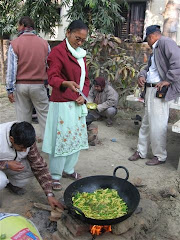
Back to work. Glorious weather – sunny and dry with gentle breezes; the mud has dried and turned to all pervasive dust. The rice is being harvested. Colleagues are wearing socks, shoes and long sleeved shirts in recognition of the winter season. It’s a cool 30 - 32oC during the day. I’ve planted lettuces and herbs in a box on the terrace; they have germinated in 3 days. We’ve started working ‘winter hours’, as it starts it get dark soon after 5pm. The neighbours are shinning up their coconut palms to thin them, reinforcing one of the messages from the security conference that Terai volunteers are in more danger from falling coconuts than Maoist insurgency. There was an earthquake in Kathmandu on Monday, causing the temporary evacuation of parliament and the VSO offices.
Over the Dashain holiday, Durga has purchased a motorbike, Govind has acquired an unfortunate moustache, Tulsi has new trainers. A huge marquee has been erected on the school field for an international medical conference that will start ke samaya pacchi. The goats are missing – victims of Dashain. One of our new rooms is being used for some training for technical instructors by some ‘experts’ from Kathmandu. I was invited to watch their presentations and give feedback on Tuesday, with topics ranging from jam making and snake bite to castration and family planning (not related). On Wednesday I cycled with David through the countryside to Bokhari primary school so ‘his’ teachers could demonstrate their new skills. A lovely day, squashed on benches with grubby children desperate for us to mark their books. Outside the newly painted classrooms, women harvested rice while boys (who should have been in school) watched the grazing buffalo. The medical conference did start on Thursday, causing the PM to leave crucial talks to try and resolve the political stalemate to come and open it. I had to weave my way through many check points and armed police to get to work. During the day, the police use one of our training rooms to rest, parking their guns, taking off belt, shoes and shirt before turning on the fans and lying down on the tables to sleep.
Laura, our friend from the programme office in Kathmandu arrived on Friday for the weekend, so we could start to plan VSO’s project on action research. David had managed to find a reasonably priced mattress in town that arrived several hours after she did. It was good to have a visitor at last, and we had an enjoyable time introducing her to the delights of Biratnagar (not too time consuming), as well as producing a substantial proposal for VSO.
At last Bhakta has returned from his holiday so the rest of the books have been moved into the ‘library’. On Monday I was faced with 50 locked shelves and over 200 apparently identical keys entwined in string. I managed to unlock 46 shelves by the end of the first day. With Anil’s help, I completed it by day 3, and have now finished most of the sorting, reshelving and labelling. My attempts to relegate out of date curriculum books, broken books, books with covers missing, books of no relevance to anyone or anything to the store have thwarted, but I did manage to sneak some Jehovah’s Witness pamphlets into the cardboard rubbish box. I have now bought a bin. After my days of physical exertion, Tulsi decided I was looking very thin, so organised a weigh in for all the staff, followed by him taking our blood pressure with an ancient sphygmomanometer he found in the science store.
On November 5, after a late meeting at the ETC to discuss the Training for Trainers of English and Science that does not start for another 10 days (is this progress?), we cycled home through the acrid smoke and alarming bangs of firecrackers – not a Guy Fawkes memorial, but some of the many loud and enthusiastic preparations for Tihar that starts on Friday. Noisy nights all week with ferocious firecrackers. We have also been without water for 2 days, but the shower at the pool is functional and our almost buckets full.
Wednesday, 7 November 2007
Thursday, 1 November 2007
Holiday
Back to Biratnagar airport, where a furtive leap onto the baggage scales reveals either that they are grossly inaccurate or that we have lost more weight. From the traffic congested roads, department stores and supermarkets of Kathmandu, we ventured 10km south and arrived at the dusty, rusty bus stop of Bungamati, where we entered an almost mediaeval world. A walk up into the hills through terraced rice paddy and stands of bamboo gave a dramatic view of wooded hills leading up to the Himalaya. Small groups of women, bent double under huge loads of firewood and animal fodder trudged barefoot back to town. The many streets are lined with traditional three storey brick built Newari houses with intricately carved wooden balconies and windows, festooned with drying maize cobs. Ducks, chickens, dogs and cats with new families roamed everywhere. No motorised transport and few bicycles. Courtyards led into more courtyards lush with tropical plants, drying mats of chillies, small Hindu shrines, and children flying kites. The main square has a magnificent Sikhari temple, accessed through a huge gateway guarded by enormous stone lions, and leading down to narrow streets where women were sorting grain and making clay pots while many men were engaged in traditional wood carving. There were no outward signs of tourism – or indeed modern civilisation, inspite of the proximity to Kathmandu.
On Tuesday we arrived at the bus station at 7am for the “5 hour scenic journey by luxury coach” to Pokhara. The coach is comfortable, the weather is grim and the journey lasts for 11 hours. We spent the first hour stuck in Kathmandu traffic and the next 3 hours getting out of the valley around 3 horrendous accidents that had blocked the road and stopped the traffic. After more than 6 hours we reached the halfway (100km) lunch stop. The last kilometer was blocked by yet another accident, so the driver attempted a back route along a track that eventually petered out into a swamp and the bus got stuck under the branches of a huge tree. We walked the last 200 meters through steady rain and thick mud, while the driver extricated the bus from the swamp/tree. Spirits were revived by daal bhat, arrival of bus, clearance of road, lifting of cloud and stunning views of Annapurna and Machupuchhare as we eventually sped towards Pokhara. We arrived at our hotel as the sun was setting, with apricot tinged mountains reflected in Phewa Lake.
The next morning we set off for Naya Pul and the start of our trek, with a sprightly Dutti (the guide) and Baburam weighed down under our bag. We had to negotiate huge herds of woolly legged mountain sheep and goats with gaily painted horns being driven into Pokhara to be sold for Dashain (and slaughtered). We learn quickly that there is no flat in the Himalaya; a gentle ascent led to a steep descent to a valley with a bubbling milky white river over sparkling granite rocks, then up through forest dripping with epiphytes and singing with insects. Butterflies from tiny lilacs to velvet blues the size of bats fluttered in and out of the sunlight. After 5 hours we began the final punishing ascent up nearly 4000 stone ‘steps’ to Ulleri, where we were rewarded by stunning views of Annapurna South, a hot shower, large amounts of carbohydrate and a comfortable bed.
Day 2 was a steady uphill for nearly 5 hours, with the weather getting noticeably cooler and the forests becoming quiet and darker. We crossed many thundering rivers on stout iron bridges, different from the rather alarming bundles of twigs I remember from my last trek here. We overtake and are overtaken by many mule trains, transporting goods (mostly to feed tourists) up into the mountains. By the time we arrive at ‘The Sunny Hotel’ in Ghorepani, the sun has disappeared and it is cold. The rooms are named after international sports people. We are in ‘Tiger Woods’, with breathtaking views from Dhaulgiri to Annapurna. There is a warm dining room and extensive menu, with hot soup, lots of Tibetan bread and tasty yak cheese. The next day we climbed Poon Hill (3210m), avoiding those who rose at 4:30am to get to the summit for the sunrise. The view was just as good at 8am and it was silent and sunny. We were told that the next day would be downhill. It started with a rapid ascent of Gurung Hill before plunging into a deep valley and up the other side. This pattern continued for several exhausting hours until we arrived in Tadopani, shrouded in mist, with light rain falling. What seemed likely to be a very long afternoon and evening was enlivened by hot bowls of soup on a charcoal heated table surrounded by Tibetan carpets in which to wrap one’s legs and the lifting of the cloud to reveal the sunset over Machupuchhare. In the evening we were invited to a spontaneous singing and dancing Nepali Dashain party. The descent through the forest to the interesting Gurung village of Gharnruk was lovely, especially when we reached the butterfly and langur monkey belt. All the villages have erected huge bamboo swings for the children to play on over the holiday. Our last full day took us to Biretanthi; some very steep downhill was difficult for David’s collapsing knee, necessitating crossing the bamboo poles over a raging river and a landslide on his bottom.
Back in Pokhara, I had my first hot bath for 7 months, and we had a relaxing day by the lake, although disappointed by no mountain views, before flying back to Kathmandu. After a day in Kathmandu, spent mostly in the beautifully restored neo-classical ‘Garden of Dreams’ and eating dinner with friends in a traditional Newari house, we returned to Biratnagar. The security woman at the airport was bemused by the bottles of olives, pesto and balsamic vinegar that she discovered rolled in the dirty T-shirts at the bottom of my rucksack.
On Tuesday we arrived at the bus station at 7am for the “5 hour scenic journey by luxury coach” to Pokhara. The coach is comfortable, the weather is grim and the journey lasts for 11 hours. We spent the first hour stuck in Kathmandu traffic and the next 3 hours getting out of the valley around 3 horrendous accidents that had blocked the road and stopped the traffic. After more than 6 hours we reached the halfway (100km) lunch stop. The last kilometer was blocked by yet another accident, so the driver attempted a back route along a track that eventually petered out into a swamp and the bus got stuck under the branches of a huge tree. We walked the last 200 meters through steady rain and thick mud, while the driver extricated the bus from the swamp/tree. Spirits were revived by daal bhat, arrival of bus, clearance of road, lifting of cloud and stunning views of Annapurna and Machupuchhare as we eventually sped towards Pokhara. We arrived at our hotel as the sun was setting, with apricot tinged mountains reflected in Phewa Lake.
The next morning we set off for Naya Pul and the start of our trek, with a sprightly Dutti (the guide) and Baburam weighed down under our bag. We had to negotiate huge herds of woolly legged mountain sheep and goats with gaily painted horns being driven into Pokhara to be sold for Dashain (and slaughtered). We learn quickly that there is no flat in the Himalaya; a gentle ascent led to a steep descent to a valley with a bubbling milky white river over sparkling granite rocks, then up through forest dripping with epiphytes and singing with insects. Butterflies from tiny lilacs to velvet blues the size of bats fluttered in and out of the sunlight. After 5 hours we began the final punishing ascent up nearly 4000 stone ‘steps’ to Ulleri, where we were rewarded by stunning views of Annapurna South, a hot shower, large amounts of carbohydrate and a comfortable bed.
Day 2 was a steady uphill for nearly 5 hours, with the weather getting noticeably cooler and the forests becoming quiet and darker. We crossed many thundering rivers on stout iron bridges, different from the rather alarming bundles of twigs I remember from my last trek here. We overtake and are overtaken by many mule trains, transporting goods (mostly to feed tourists) up into the mountains. By the time we arrive at ‘The Sunny Hotel’ in Ghorepani, the sun has disappeared and it is cold. The rooms are named after international sports people. We are in ‘Tiger Woods’, with breathtaking views from Dhaulgiri to Annapurna. There is a warm dining room and extensive menu, with hot soup, lots of Tibetan bread and tasty yak cheese. The next day we climbed Poon Hill (3210m), avoiding those who rose at 4:30am to get to the summit for the sunrise. The view was just as good at 8am and it was silent and sunny. We were told that the next day would be downhill. It started with a rapid ascent of Gurung Hill before plunging into a deep valley and up the other side. This pattern continued for several exhausting hours until we arrived in Tadopani, shrouded in mist, with light rain falling. What seemed likely to be a very long afternoon and evening was enlivened by hot bowls of soup on a charcoal heated table surrounded by Tibetan carpets in which to wrap one’s legs and the lifting of the cloud to reveal the sunset over Machupuchhare. In the evening we were invited to a spontaneous singing and dancing Nepali Dashain party. The descent through the forest to the interesting Gurung village of Gharnruk was lovely, especially when we reached the butterfly and langur monkey belt. All the villages have erected huge bamboo swings for the children to play on over the holiday. Our last full day took us to Biretanthi; some very steep downhill was difficult for David’s collapsing knee, necessitating crossing the bamboo poles over a raging river and a landslide on his bottom.
Back in Pokhara, I had my first hot bath for 7 months, and we had a relaxing day by the lake, although disappointed by no mountain views, before flying back to Kathmandu. After a day in Kathmandu, spent mostly in the beautifully restored neo-classical ‘Garden of Dreams’ and eating dinner with friends in a traditional Newari house, we returned to Biratnagar. The security woman at the airport was bemused by the bottles of olives, pesto and balsamic vinegar that she discovered rolled in the dirty T-shirts at the bottom of my rucksack.

Saturday, 13 October 2007
Kathmandu and back again
After a slow rickshaw ride to the airport on October 2, we were rewarded by stunning views of the Himalayas all the way to Kathmandu. We were able to collect the tickets for our holiday and buy essential supplies (coffee, muesli, pasta) from the supermarket before having dinner with friends. After a day preparing materials and activities at VSO, we really enjoyed delivering the ‘Training for Trainers’ workshop for a group of volunteers and programme staff. It felt very good to do some real training again!
The annual security conference to focus on the election was scheduled for Friday. The morning’s headlines announced that the election process had been ‘suspended’. Fortunately, the Risk Management Officer from DfID is an extremely well informed and engaging speaker and was able to provide an interesting analysis of what might happen next. Many possible scenarios, none of them very positive for peace and development.
An unintentionally amusing presentation about what to do when the next earthquake occurs followed, with useful advice about attaching one’s fridge to the wall with Velcro to prevent being crushed beneath it and the apparent inclusion of salt and pepper in one’s emergency evacuation kit. The last major earthquake occurred in 1934, but a ‘local’ one in the eastern Terai in 1988 destroyed the Dharan clock tower. At the end of the day, the T-shirts and numbers for the Kathmandu marathon arrived, having been stuck by bandhs in Biratnagar on their way from a factory in Bangladesh.
Suitably prepared to cope with emergencies, we went to dinner in Thamel with some friends, where Rosemary fell down the restaurant stairs, cutting her head and fracturing her wrist, so we were able to put some emergency plans into action. She is now making a good recovery and expects to set off trekking next week.
Saturday was the first ever Kathmandu marathon, and we assembled at 5:30am in semi-darkness at Tribeshwor stadium. The organisers were just starting to erect banners, and a lorry was stuck under the starting gate. At 7am, only an hour behind schedule, the full marathon runners started, followed by 5km, half marathon and 10km (us). By this time it was getting hot and the traffic was building up. The route was not marked and there had been no attempt to divert traffic. By the time we set off, the street sellers had covered the pavements with their goods, and people were out shopping. There was sufficient water for the first 100 runners and nothing for the other 9,900 and shops along the route quickly sold out. We managed to get lost very early on, so trotted with Neil to his house and then for breakfast in a very pleasant garden. The men’s event was won by an army officer, but the Nepali woman who finished well ahead of any rivals was disqualified having been sent the wrong way by a steward in Bhaktapur, thus forfeiting the $5000 prize. VSO then hosted a picnic for staff and volunteers, to celebrate the success of the several volunteers who completed full or half marathons. There we learnt that there had been a Madhesi uprising in Biratnagar on Friday and that the city was now under 24 hour curfew, so we were told we could not travel home on Sunday.
On Sunday morning we received a phone call from our landlord, Chhatra, who was still in Kathmandu, but leaving for the USA the next day, so we were invited to visit him and his wife and daughter in their Kathmandu house. The family greeted us with their heads encased in a kind of black mud pack, presumably some pre-departure beauty treatment, and plied us with tea and sweet fried pastries. Tara has been buying wedding gifts and all the paraphernalia for her son’s marriage puja for the last 2 months. The wedding will take place in Washington in February, and they expect to return to Biratnagar some time in March.
After some persuasion and discussion with our colleagues in Biratnagar, VSO allowed us to fly home on Monday afternoon. Biratnagar seemed much as usual, and we were able to get to the market and buy food before it got dark. At work the next day, I was treated to a tour of Anil’s new motorbike and an account of Durga’s adventures in Pokhara, where he had been attending an NCED training workshop. I had been invited to contribute, but this clashed with the VSO programme in Kathmandu. I heard little about the training, which was held from 6-10am on 7 days, to leave the rest of the time free for sight seeing. He has lots of photographs of Durga-as-tourist to prove it, and a new hat similar to David’s. We will now deliver similar training to English teacher trainers as soon as the NCED ‘packages’ are printed. He was glad to get home safely and had a police escort as far as Itahari, where he had to abandon the bus and take a rickshaw the last 25km home. Most of Sunsari and Jhapa is now under curfew and there has been no movement along the highway east for several weeks. This has had a devastating effect on supplies of yoghurt to accompany our muesli mountain. According to the newspaper, vegetable prices have ‘puffed up’ as a result of the transport problems.
I went to Shankapur for the last day of school before the Dashain holiday. Rekha abandoned me for an hour with some very excited and completely uncontrollable grade 2 children while she went to the bank to collect salaries. I am not sure how many children were supposed to be in the class; they were very small and kept disappearing through the door and windows. No-one else was making any attempt to teach, but teachers had closed the windows and were sitting with their feet up across the doorway to try keep children in the room. The small ones crept out under their legs. When Rekha returned, we all assembled in the grade 5 room for a ‘special programme’, with many children – and teachers – and me, doing a ‘turn’. Memories of trying to keep it all together on the last day before Christmas.
The ETC and DEO were closed on Friday for Ghatasthapana, when soil is brought from the holy river and barley seeds are planted in special clay pots and worshipped for 9 days to evoke Durga, the goddess of power. Everyone was in festive mood, and the market was seething with people, inspite of the ‘puffed up’ prices. We spent the morning chatting with Dinesh in his shop, eating laddoo (sticky sweets) he had brought back from Kakhabitta.
Back to Kathmandu on Sunday and off to the mountains on Tuesday – our first holiday for more than 6 months.
Dashainko shubhakamanah!
The annual security conference to focus on the election was scheduled for Friday. The morning’s headlines announced that the election process had been ‘suspended’. Fortunately, the Risk Management Officer from DfID is an extremely well informed and engaging speaker and was able to provide an interesting analysis of what might happen next. Many possible scenarios, none of them very positive for peace and development.
An unintentionally amusing presentation about what to do when the next earthquake occurs followed, with useful advice about attaching one’s fridge to the wall with Velcro to prevent being crushed beneath it and the apparent inclusion of salt and pepper in one’s emergency evacuation kit. The last major earthquake occurred in 1934, but a ‘local’ one in the eastern Terai in 1988 destroyed the Dharan clock tower. At the end of the day, the T-shirts and numbers for the Kathmandu marathon arrived, having been stuck by bandhs in Biratnagar on their way from a factory in Bangladesh.
Suitably prepared to cope with emergencies, we went to dinner in Thamel with some friends, where Rosemary fell down the restaurant stairs, cutting her head and fracturing her wrist, so we were able to put some emergency plans into action. She is now making a good recovery and expects to set off trekking next week.
Saturday was the first ever Kathmandu marathon, and we assembled at 5:30am in semi-darkness at Tribeshwor stadium. The organisers were just starting to erect banners, and a lorry was stuck under the starting gate. At 7am, only an hour behind schedule, the full marathon runners started, followed by 5km, half marathon and 10km (us). By this time it was getting hot and the traffic was building up. The route was not marked and there had been no attempt to divert traffic. By the time we set off, the street sellers had covered the pavements with their goods, and people were out shopping. There was sufficient water for the first 100 runners and nothing for the other 9,900 and shops along the route quickly sold out. We managed to get lost very early on, so trotted with Neil to his house and then for breakfast in a very pleasant garden. The men’s event was won by an army officer, but the Nepali woman who finished well ahead of any rivals was disqualified having been sent the wrong way by a steward in Bhaktapur, thus forfeiting the $5000 prize. VSO then hosted a picnic for staff and volunteers, to celebrate the success of the several volunteers who completed full or half marathons. There we learnt that there had been a Madhesi uprising in Biratnagar on Friday and that the city was now under 24 hour curfew, so we were told we could not travel home on Sunday.
On Sunday morning we received a phone call from our landlord, Chhatra, who was still in Kathmandu, but leaving for the USA the next day, so we were invited to visit him and his wife and daughter in their Kathmandu house. The family greeted us with their heads encased in a kind of black mud pack, presumably some pre-departure beauty treatment, and plied us with tea and sweet fried pastries. Tara has been buying wedding gifts and all the paraphernalia for her son’s marriage puja for the last 2 months. The wedding will take place in Washington in February, and they expect to return to Biratnagar some time in March.
After some persuasion and discussion with our colleagues in Biratnagar, VSO allowed us to fly home on Monday afternoon. Biratnagar seemed much as usual, and we were able to get to the market and buy food before it got dark. At work the next day, I was treated to a tour of Anil’s new motorbike and an account of Durga’s adventures in Pokhara, where he had been attending an NCED training workshop. I had been invited to contribute, but this clashed with the VSO programme in Kathmandu. I heard little about the training, which was held from 6-10am on 7 days, to leave the rest of the time free for sight seeing. He has lots of photographs of Durga-as-tourist to prove it, and a new hat similar to David’s. We will now deliver similar training to English teacher trainers as soon as the NCED ‘packages’ are printed. He was glad to get home safely and had a police escort as far as Itahari, where he had to abandon the bus and take a rickshaw the last 25km home. Most of Sunsari and Jhapa is now under curfew and there has been no movement along the highway east for several weeks. This has had a devastating effect on supplies of yoghurt to accompany our muesli mountain. According to the newspaper, vegetable prices have ‘puffed up’ as a result of the transport problems.
I went to Shankapur for the last day of school before the Dashain holiday. Rekha abandoned me for an hour with some very excited and completely uncontrollable grade 2 children while she went to the bank to collect salaries. I am not sure how many children were supposed to be in the class; they were very small and kept disappearing through the door and windows. No-one else was making any attempt to teach, but teachers had closed the windows and were sitting with their feet up across the doorway to try keep children in the room. The small ones crept out under their legs. When Rekha returned, we all assembled in the grade 5 room for a ‘special programme’, with many children – and teachers – and me, doing a ‘turn’. Memories of trying to keep it all together on the last day before Christmas.
The ETC and DEO were closed on Friday for Ghatasthapana, when soil is brought from the holy river and barley seeds are planted in special clay pots and worshipped for 9 days to evoke Durga, the goddess of power. Everyone was in festive mood, and the market was seething with people, inspite of the ‘puffed up’ prices. We spent the morning chatting with Dinesh in his shop, eating laddoo (sticky sweets) he had brought back from Kakhabitta.
Back to Kathmandu on Sunday and off to the mountains on Tuesday – our first holiday for more than 6 months.
Dashainko shubhakamanah!
Saturday, 29 September 2007
Return of the rains
A huge storm over the Bay of Bengal on Saturday has brought persistent rain back to the Terai for a week. This has invigorated the mosquitoes and, inappropriately, I spent most of the training day on non-violent discipline trying to swat them. My attempts to ward them off with a raised left eyebrow were unsuccessful, as was the promise of a gold star for not biting me. There were some very interesting observations and discussions about student motivation and (almost) differentiation. I tried very hard to persuade Durga to organise some role play, but have not had much success so far.
David, having attended the 4 day School Self Assessment training has now been in Janapath for 4 days seeing the training put into action. It started slowly, as no-one (apart from David) arrived on time, and the school had not been informed about the nature of the assessment. The head was then faced with the challenge of assembling representatives from the staff, students (relatively easy), and members of the School Management Committee and some parents (less easy). These representative groups are supposed to meet together with a facilitator for 4 days for structured discussion, with the whole group coming together on the last day to agree a School Improvement Plan. An ambitious project, made more difficult as no-one had any prior warning. Women were brought in from the fields to take part in the parents’ group, but did not stay very long as they had to return to feed their cows. After 4 days, during which there had been some interesting and heated debate, the SIP was drafted, but it is not clear what will happen next or who will monitor it. Another document to gather dust.
I went with UNICEF to Sunsari to lead some action research training for primary teachers. A wonderful journey, crammed in the back of the statutory white landcruiser, with a phallic antenna for radar security communication equipment. Radhika and the driver sat in the front wearing UN flack jackets. The field officers in the back were off to do an attendance monitoring exercise in rural schools. The one on whose lap I was perched had done his English language training in Colchester. We left the highway at Duhabi and set off through seemingly endless completely flat brilliantly green rice paddy, irrigation canals, herds of buffalo and small thatched villages. The training was in a long room attached to a guest house, with 25 grade 2 teachers, ranging from men in their fifties to young women with their babies and toddlers, sitting cross-legged on cushions on the floor. Most of the morning was spent playing games and making materials to use in activities when they return to school. Copious buckets of daal bhaat were served for lunch. My task in the afternoon was to introduce them to action research as a way of improving teaching and learning, and they joined enthusiastically in the activities I had prepared and started to develop some very useful ideas. By the end of the day, most of which I had spent cross-legged on the floor, jumping around like a monkey, or singing songs with actions I felt as if I had just done a long yoga session.
I returned to Shankapur on Thursday; to my delight, Rekha has reorganised every classroom in the school, with benches around the room, so she can see all the children, check their books easily, and have a big space in the middle for activities. This is only possible because so many children are absent. She had prepared lessons, brought some resources and wanted me to play an active part. I decided that demonstrating active teaching methods was probably the most effective strategy. I was lucky with the subject matter (photosynthesis); carbon dioxide and oxygen are apparently universal words. Amazing what can be done with a few words of Nepali and a lot of body language. Two teachers went home at ‘tiffin time’, leaving more children without a teacher; it is hardly surprising that attendance is so poor. Rekha persuaded me to take grade 4 for the afternoon for ‘optional English’. I’ve exhausted my repertoire of songs and activities, but I now have time to prepare before my next visit.
The big news of the week was the success of Prasant Tamang in winning the Indian Idol contest. There were spontaneous street parties and fireworks when the results were announced late at night, and celebrating children in the schools the next day. A week of noisy nights, as the bitch in the house opposite is on heat, so all the stray dogs in the neighbourhood congregate to serenade her.
Our vegetarian status has become severely compromised by an unstoppable ant invasion. They are minute and manage to penetrate sealed jars and packets, and are even lively in the fridge. We were amused by the newspaper advertisement for the new buffet at the Radisson in Kathmandu: ‘50% off if 3’ high or under’.
My colleagues (and pension application forms) are beginning to make me feel my age. The spokesman (hesitant English speaker) from the headteachers’ group over glasses of tea in the shed one day: “We are very curious about you. You are so old that we are very surprised that you have come here and are so active”. We’re off to Kathmandu to participate in the marathon next week.
Saturday, 22 September 2007
The monsoon ends
We were woken by bright sunlight at 5:50 on Tuesday morning, dry air, deep blue sky and soaring temperatures. Students at Adarsha now assemble on the field (formerly a swamp) for daily prayers at 10am. David manages to get to Bokari without getting covered in mud; period 2 has mysteriously disappeared this week. The female teachers try to take him home at the end of the day to feed him up. He spent the end of the week and the weekend at training for the UNICEF School Self Assessment project. We will be involved in the SSA of ‘his’ DEO schools and the ones the ETC will use for school based training. I have been at headteacher training sessions most days, making suggestions about methodology that are sometimes implemented. At the end of the day I am usually asked if I have anything to add. Hard, when I have little idea about what has been going on most of the time. Lalmani and Bhakta are slowly moving books into the ‘library’; my main concern is giving teachers access to them; theirs in keeping them locked up. Using the brown dog as a guard does not seem to be an option.
The most dramatic news of the week was the withdrawal of the Maoists from the interim government on Tuesday. This led to an almost instant shut down of shops and transport, rallies at Mahendra Chowk, marches along Main Road, phone calls from VSO, e-mails from the British Embassy and Risk Management Office and warnings from our colleagues not to go out at night. Etienne had managed to get to Birtanagar from Dharan on Saturday to meet with Joseph and us to plan ‘the eastern cluster security strategy’. We met at our flat, followed by dosas at ‘Unique’ and a very hot walk to the river. This will be followed by a VSO conference in Kathmandu on October 5. Our UNICEF trips to schools have been cancelled. On Wednesday, life seemed to be back to normal, but the Maoists have announced their plan of ‘action’ (mostly inaction); the peace process and plans for the election are in jeopardy.
On Wednesday Govind cycled with me to Shankapur to meet Rekha Parajuli, one of the recently trained primary teachers I am following up. We stopped at every junction for me to draw a map so I can go independently each week. ‘Left at the Exotic Cheese Balls sign, follow the road past Lord Buddha College, right at the big tree, right onto the track with the red and yellow shop on the corner …….’ Mango trees with grazing cows and egrets searching for grubs and frogs surround the school. Rekha was delighted to see me, as were the students I had met before the monsoon holiday. It is hard to be an observer, as I am the centre of attention and am called on to do ‘turns’ eg sing and dance. I hope this will stop when they get used to me appearing regularly. There are 6 classes, 4 teachers, the head and a girl who bangs the plate and watches the nursery children. The head does not seem to do any teaching, but she occasionally walks around with a stick. The headteacher is not well and tells me her problems in rapid Nepali. She also makes good cinnamon tea. In period 4, Rekha seemed to be the only one actually teaching. She tells me that she is completely different after her training, loves the children (and they love her) and encourages them to come to school. On her way to work in the mornings, she collects them “aau, aau” a bit like a Nepali Pied Piper. Attendance is lamentable; 16 / 31 in grade 5, 9 / 23 in grade 4. Most of the children are out fishing, playing in the fields, watching the animals or working. She certainly has a child-friendly classroom if not a child-centred one. She speaks three words of English, mango, banana and apple, not particularly useful for observation feedback and ways of improving student learning. Bistari, bistari …… The English teacher is rarely there, and is unlikely to be much help. Next week I will make a start on constructive feedback. The only hazard I encountered on my way home was a herd of frisky young buffalo.
We had a visit from NCED (National Centre for Educational Development) on Friday to evaluate the current training programme. He brought an animated version of the new national anthem on his pen drive, so part of the afternoon was spent practicing how to sing it.
The main excitement for the young people of Biratnagar this week is Prasant Tamang, a young Nepali, getting to the final of ‘Indian Idol’. The students from the school came round collecting money on Friday for phone calls to India to cast their votes.
The main challenge at home this week is sorting out what to do with our rubbish. When Chhatra was home, it used to ‘disappear’ when we left it by the gate. It no longer disappears and is accumulating in a seething mass of maggots. We suspect it used to be chucked into the ditch. We take what we can (paper, plastic) to the Dalit family on the corner who make their living from scavenging rubbish, and leave vegetable peelings for next door’s goats. There is no public system; we are trying to hi-jack one of the men we see occasionally wheeling a rubbish cart through the streets, with no success so far.
We are getting better at the daily crossword in the Kathmandu Post; a curious mixture of Asian general knowledge questions, archaic English words and less-than-challenging anagrams eg ‘negative; on anagram’.
Saturday, 15 September 2007
Heat and mud
The monsoon lingers on, with torrential downpours and increasing temperatures. David uses clothes pegs as cycle clips in an attempt to escape the worst of the mud on his way to Bokhari, but he ends up wheeling his bike through deep mud for the last part of the journey, then washing his legs and feet at the community pump before going to class. He is usually the first to arrive; the metal plate is banged for the start of school, often before any teachers arrive. He has yet to work out when lessons are supposed to start and end. The timetable shows 7 periods, but there has never been a period 4, and the students are usually sent home before period 7. He has seen some good teaching, and the teachers are quick to respond positively to his suggestions.
Headteacher training started on Sunday at the ETC when 11 of the expected 25 participants arrived. There were three more on Monday, so the ‘house captain’ and the ‘day briefer’ were appointed. After the introduction and making of name labels (this took a long time) everyone appeared to go to sleep, until I realised that it was a visualisation exercise, creating their ‘vision’ for their school. A good start. There were some activities on leadership during the morning, although role playing different leadership styles would have been more fun than reading out information from a chart. The house captain announced we were over time and they needed a break. The afternoon session consisted of some tedious but occasionally amusing powerpoint presentations, disrupted by the noise of the rain, powercuts and water pouring through the ceiling making the computer fizz alarmingly. Some of the powerpoints were in English, which none of the participants speak, and I was required to explain things at various points to Durga so he could translate them into Nepali. When all this became too much, I retreated into my new place of work – the ‘library’. At the moment, there is me, the brown dog, and an empty bookcase.
On Wednesday, it was my turn to present a session on action research. Fortunately I had already discovered that only one person understood English, and they were unlikely to have heard of action research, so I had been able to plan my material appropriately. After a brief explanation in bad Nepali, supported by key words on powerpoint (just to show I know how to use it – but the electricity was fluctuating wildly so it kept going off) we did some simple pair and group activities; I can manage imperatives. They loved a sequencing activity I gave them to do, and wanted to take my cards home, so of course I let them. I have plenty of time to make new ones. They also came up with some brilliant ideas of things they wanted to try out in their own schools, and examples of some things they have done without knowing that they were action research. A good morning, ending with celebratory tea and samosas at the tea ‘shed’ on the corner.
We were summoned to UNICEF on Thursday by the formidable Radhika who will be ‘promoted’ to Nepalgunj (hotter than Biratnagar and the centre of much unpleasant political activity) at the end of the month. She has many tasks to complete before she leaves, and needs help to get things done! Suman, the research director arrived from Kathmandu, keen to use action research as a monitoring tool, and we found ourselves delivering a session as part of a planning meeting for developing new systems of monitoring and evaluation. We have been drawn into a number of training activities, which could be very useful to help us work proactively with our colleagues and achieve some of the VSO objectives. On Friday, Radhika planned to take us to one of the ‘child friendly schools’ UNICEF has developed in Biratnagar. She telephoned just after I had arrived at work and set up the day’s training, so I pedalled home, collected David and we cycled down the hot highway. When we arrived, the white landcruiser was waiting and with some embarrassment we climbed into the airconditioned interior. After speeding towards the Indian border for a few kilometres, we turned off onto a dirt track and set off into the countryside. The track eventually became a swamp, and the landcruiser would go no further. As UNICEF workers do not walk, we returned to UNICEF, home and office in time for the second training session. Umapati had spent the day using the new speedy internet connection, showing everyone who came in the location of their home on Google maps. At the end of the day, over the usual glasses of tea, I treated my colleagues to a virtual tour of Bradford-on-Avon, so they now know something about Saxon churches, tithe barns, weavers, canals, aqueducts ……
Friday was Teej, a women’s festival, so most of the primary schools were closed. After a day of eating on Thursday, Friday was a fasting day where they pray for a long life and prosperity for their husbands. Radhika says they also spend a lot of time cursing their mothers-in-law, with whom many are forced to live. All the temples were packed with women in splendid red and gold saris doing puja, singing and dancing.
Many messages this week wishing us a happy millennium from friends in Ethiopia. The new millennium dawned there on Wednesday. Several of our volunteer friends had gone back to Addis for the celebrations and I managed to watch them on the internet.
Saturday, 8 September 2007
Krishna Janmastami
Good to be home, and warmly welcomed by neighbours and people in town. Its still raining, so everything is damp. Apart from infestations with ants, piles of gecko poo, one mouldy pillow, and water dripping through the bathroom ceiling from upstairs, the flat was fine when we returned.
I went to the ETC on Tuesday to find everything closed for a government holiday, but Gita (the wife of the 'peon' Lalmani, who lives in the caretaker's house) was grazing her cows on the school field, and lopping branches off the trees to feed to the goats.
On Tuesday evening, we discovered the reason for holiday, as music blared all night for Krishna’s (the eighth incarnation of Lord Vishnu) birthday, with loud celebrations in brightly decorated shrines erected at regular intervals along the roads. On Wednesday afternoon the 200,000 population of the city descended onto Main Road for the procession from the Krishna temple. Every temple had its’ own float pulled by oxen, painted in Terai pink and blue stripes, or in splendid coats. The colours of the floats, decorations and clothes are brilliant; so different from the drab colours of Europe. Each float had huge, LOUD loudspeakers powered by generators on hand carts. After nearly two hours, the main chariot pulled by a huge team of men arrived, preceded by a truck removing the festoons of electrical wires that hang over Main Road. The surge of people to touch the chariot and receive blessings was terrifying, but we were kept safe by our friend from the kitchen shop and a group of students.
The new training rooms are already in use, with members of Village Development Committees and teachers being prepared for their roles as election observers. A representative sample of women, dalits, janajati and members of different political groups. There seems to be a consensus now that the election will happen, but there is a great deal of political unrest and 3 bombs in Kathmandu after we left on Sunday. A UN official in a brand new white land cruiser arrived on Thursday to oversee proceedings, and on Friday some young Americans in jeans and baseball caps from the Jimmy Carter Foundation appeared.
David has been at Bokhari this week, cycling and wading through mud to get to the school, and sitting damply in lessons while the rain blew in through the glassless windows onto tiny barefoot children. He feels welcome, and enjoys attempting to chat to the teachers during breaks as well as observing lessons and giving some feedback. There doesn’t seem to be a timetable, and many of the children are working in the fields or as domestic servants. If its raining they tend not to come to school at all, so his carefully constructed plan is difficult to adhere to. Tulsi and Durga returned from Kathmandu on Wednesday, and we had a full staff meeting on Thursday, which lasted several hours. People came and went, and many glasses of tea were brought. Tulsi has established that ‘inclusion’ and student-centred teaching should be our priorities. Good news for VSO and me!
Following our exposure in the national press, Tanka, his wife and brother came to the door early one morning to record an interview for the BBC, so you may hear us on the World Service speaking in both English and Nepali (badly).
The Kathmandu marathon will take place on October 6, with many volunteers taking part as a fund raising activity for development projects in Nepal. Some people are running full or half marathons; we and many others will jog / walk 10km. There is a website if anyone feels inclined to make a donation for our efforts! www.smallenergy.com
I went to the ETC on Tuesday to find everything closed for a government holiday, but Gita (the wife of the 'peon' Lalmani, who lives in the caretaker's house) was grazing her cows on the school field, and lopping branches off the trees to feed to the goats.
On Tuesday evening, we discovered the reason for holiday, as music blared all night for Krishna’s (the eighth incarnation of Lord Vishnu) birthday, with loud celebrations in brightly decorated shrines erected at regular intervals along the roads. On Wednesday afternoon the 200,000 population of the city descended onto Main Road for the procession from the Krishna temple. Every temple had its’ own float pulled by oxen, painted in Terai pink and blue stripes, or in splendid coats. The colours of the floats, decorations and clothes are brilliant; so different from the drab colours of Europe. Each float had huge, LOUD loudspeakers powered by generators on hand carts. After nearly two hours, the main chariot pulled by a huge team of men arrived, preceded by a truck removing the festoons of electrical wires that hang over Main Road. The surge of people to touch the chariot and receive blessings was terrifying, but we were kept safe by our friend from the kitchen shop and a group of students.
The new training rooms are already in use, with members of Village Development Committees and teachers being prepared for their roles as election observers. A representative sample of women, dalits, janajati and members of different political groups. There seems to be a consensus now that the election will happen, but there is a great deal of political unrest and 3 bombs in Kathmandu after we left on Sunday. A UN official in a brand new white land cruiser arrived on Thursday to oversee proceedings, and on Friday some young Americans in jeans and baseball caps from the Jimmy Carter Foundation appeared.
David has been at Bokhari this week, cycling and wading through mud to get to the school, and sitting damply in lessons while the rain blew in through the glassless windows onto tiny barefoot children. He feels welcome, and enjoys attempting to chat to the teachers during breaks as well as observing lessons and giving some feedback. There doesn’t seem to be a timetable, and many of the children are working in the fields or as domestic servants. If its raining they tend not to come to school at all, so his carefully constructed plan is difficult to adhere to. Tulsi and Durga returned from Kathmandu on Wednesday, and we had a full staff meeting on Thursday, which lasted several hours. People came and went, and many glasses of tea were brought. Tulsi has established that ‘inclusion’ and student-centred teaching should be our priorities. Good news for VSO and me!
Following our exposure in the national press, Tanka, his wife and brother came to the door early one morning to record an interview for the BBC, so you may hear us on the World Service speaking in both English and Nepali (badly).
The Kathmandu marathon will take place on October 6, with many volunteers taking part as a fund raising activity for development projects in Nepal. Some people are running full or half marathons; we and many others will jog / walk 10km. There is a website if anyone feels inclined to make a donation for our efforts! www.smallenergy.com
Subscribe to:
Posts (Atom)

.JPG)
.jpg)
.jpg)


.jpg)
.jpg)
.jpg)


.jpg)