Bats not rats are responsible for the piles of poo accumulating on our window sills. We had both avoided mentioning this, as we also ignore lurking giant cockroaches when we turn on the kitchen light at night. The bats fly off at dusk and have returned by the time we get up in the morning; they add to the wild life attraction of living here. Many more roost in the mango tree outside.
TheTerai is now suffering from extensive flooding and landslides, with over 100,000 people homeless and daily reports of more deaths from drowning, snake bite and dysentery. We are fortunate in town, as we only have to contend with permanently muddy feet, damp clothes, soggy books and paper and mould growing on our furniture, trousers and shoes. Ants have invaded David’s computer and there are leeches on the pineapple.
We went for a wonderful rural ride on Sunday, taking advantage of a brief bright spell. A five minute ride to the east of our house brought us to bright green paddy fields, grazing animals, small farms, oxen ploughing, children playing in the puddles, women carrying huge bundles of animal fodder, and others cooking outside over fires. Another world on our doorstep. It might look idyllic, but living conditions are miserable, especially in the monsoon. Although people are very poor, it is relative; the further we travel from town, the more marked the poverty becomes, and there are real food problems in many villages. School feeding programmes have been successful at getting children into school, but have now been replaced by scholarship funding for Dalits, ethnic minorities and all girls. Most of the money seems to ‘disappear’.
Monday was full moon and the festival of Guru Purnima, celebrating the birth of Vysas who wrote the Mahabharata. It is now also a national teachers’ day, where students visit their teachers with small gifts. On Tuesday we went to the local UNICEF headquarters to meet Radhika, the formidable Programme Officer. I had met her at a training workshop a couple of months ago. As we discovered in Ethiopia, there are many different organisations working on similar projects with little coordination, so it seemed a good idea to find out what UNICEF, with huge amounts of international funding, was doing locally. We arrived at the huge gated compound after a 20 minute ride along the highway to India, parking our dirty bikes amongst the pristine white land cruisers. Hot and grubby, we were checked in by amused security guards in immaculate uniforms and taken to Radhika’s splendid air-conditioned office. We should not have been surprised to learn that UNICEF has conducted extensive active learning training with our colleagues, has set up a large number of ‘child friendly’ schools, provided tin trunk libraries to every primary school, developed tools for lesson observation and monitoring and evaluation. Needless to say, we have seen no evidence of any of this, and our colleagues had not mentioned it.
Days are still full of surprises. When I arrived at work on Wednesday, all the gates were locked and guarded by armed police. I managed to persuade them to let me into the school field and wheeled my bike through the swamp to get to the ETC. Some VIP was being filmed visiting the school building. No-one seemed to know who he was. There was torrential rain through Thursday night; surrounded by flood water at home. I cycled through floods most of the way to work, to discover that the ETC was underwater. At least my sandals got clean as I waded to the stairs. Upstairs I found the ceiling hanging down and the computer full of water. Did not turn on the electricity. Massive security on the way home, with roads closed and swarms of armed police with riot shields; the Prime Minister is coming home.
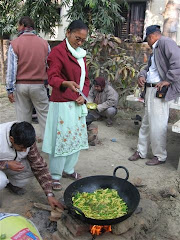
A gourmet weekend in prospect. When we arrived home on Friday, Tara and Chhatra were gathering huge armfuls of weeds from the garden. We have been invited to share them for supper on Saturday. Our usual Friday night treat at Unique Pure Veg restaurant, where the colourful Christmas decorations are a permanent feature. The range of dosas and Indian veg food is outstanding; we are were tempted by the ‘single swinder chocolate nots’ dessert, but settled for violently coloured icecream. The mango season is coming to an end, but there is now a profusion of pineapples and delicious small crisp apples from Kashmir.
Thursday night’s rain was apparently, the heaviest for 17 years. Today the air is clear, its less humid and temperatures are soaring. Our day started with the visit of Dinesh and Saraswati, a young female reporter from the Biratnagar office of Kathmandu Post, keen to write an article on the much talked about ‘old white people who cycle around town’. Our Nepali is not really up to giving coherent interviews, so it will interesting to see what appears. Our mouldy clothes are now drying out on the line. I am on the terrace listening to Monteverdi vespers. The ‘naked chef’ is in the kitchen making icecream with squidgy mangoes.
Saturday, 4 August 2007
Saturday, 28 July 2007
Swimming in the rain
We are continuing to visit the pool most days inspite of the rain, much to the amusement of Suresh, the pool manager. The filtration system has broken, so sometimes he joins us in the pool with a pair of goggles and a scouring pad in a somewhat futile attempt to remove the accumulation of algae. Frogs, ranging in size from smaller than my little finger nail to larger than David’s fist, have invaded the swimming pool, and Suresh tries optimistically to net them while we swim serenely up and down. The frog noise at night is now deafening, with occasional loud bellows followed by eerie silences. Giant snails have appeared in the garden and our friendly gecko population indoors increases daily.
The house has become increasingly full and busy, with even more workmen painting and making furniture. Whitewashing in the rain seems particularly pointless, but it keeps the painters in permanent work and our windows permanently paint spattered. Our porch has now been painted a delicate shade of pink; David has named it ‘hint of carnation’. Tanka’s (World Service correspondent) friends and family seem to have moved in upstairs, and Karna now stays downstairs. He is a delightful young man, who arrived looking for work soon after we arrived. He is 16, from a very poor Dalit family and his father cannot afford to keep him in school. He has decided to try and become independent, as he is desperate to finish his education. He will take his SLC exams (School Leaving Certificate) this year. He speaks some English, and we find some time for him every day for ‘conversation’ to help him develop his vocabulary. He is always cheerful and very helpful with our Nepali homework. Chattra employs him to do odd jobs and has now given him a room to stay in.
Rudra, the head of the ETC is to be transferred. This seems to happen frequently to government officials, often for political reasons. He is well liked, organised, efficient and a good manager. He is being sent to the DEO in Sagarmatha – the Everest region, very difficult to get to, and two days by plane and bus back to his home and family in Biratnagar. His replacement, Tulsi Narayan Adikhari , from the DEO in Dhankuta, a hill region 4 hours by bus to the north of here, arrived on Wednesday to join us. He is smiling and charming, with limited English, never having had the need to use it. He is very keen to get better and has decided that we will have ‘conversation’ for an hour each morning, in both English and Nepali. There is a real contrast with our former colleagues in Ethiopia. Most of the Nepalis we meet are much less ‘westernised’, speak little English, but love to chat. Many of our Ethiopian colleagues had studied in Europe, so had some understanding of life in the west. I am something of a curiosity for them, being female and old, with a lot of professional experience – and no children. The atmosphere at work at the moment is pleasantly relaxed – it seems that this will continue until the new budget is released, training allocated to different ETCs and participants selected by the DEO. It could be months. There is no culture of forward planning, and given the uncertainty and the current political instability, it is understandable. Although they have 54 days annual leave, they only take the 6 days for festivals, as they can accumulate the rest and be paid for it. Current activities (ie not much to do) they describe as ‘informal work’. This week I have helped Govind prepare a newsletter, written some articles, and taught Ram (a student who comes in to prepare printed documents in Nepali) to use Publisher. Anil and I have exchanged music files – he has written some music for Nepali films on his keyboard, and has been entranced by Glenn Gould playing the Goldberg variations. Durga and I have started to plan a workshop session for VSO in Kathmandu next month. In the afternoons he likes to have time to ‘make fun’. Not a lot of progress on achieving 'strategic objectives'!
Meanwhile David stays at home most days preparing for his work with schoolteachers and developing ideas for monitoring and evaluation for the DEO. He has been offered the corner of Rajendra's sofa from which to work at the DEO. His nose is much better, although he claims it is now permanently bent. He joins me three afternoons a week for Nepali lessons. This has now become a focal activity at the ETC, and yesterday afternoon all the trainers came to join in, with Khagda from the school next door also providing input.
My new all-enveloping raincoat is much admired. Even some of the cows are wearing plastic sheets this week. The potholes near the hospital have been filled in. This has the advantage of not falling into deep holes hidden by puddles and the disadvantage of having to cycle over piles of rocks. We remain permanently damp and are uncertain if our laundry will ever reappear.
The house has become increasingly full and busy, with even more workmen painting and making furniture. Whitewashing in the rain seems particularly pointless, but it keeps the painters in permanent work and our windows permanently paint spattered. Our porch has now been painted a delicate shade of pink; David has named it ‘hint of carnation’. Tanka’s (World Service correspondent) friends and family seem to have moved in upstairs, and Karna now stays downstairs. He is a delightful young man, who arrived looking for work soon after we arrived. He is 16, from a very poor Dalit family and his father cannot afford to keep him in school. He has decided to try and become independent, as he is desperate to finish his education. He will take his SLC exams (School Leaving Certificate) this year. He speaks some English, and we find some time for him every day for ‘conversation’ to help him develop his vocabulary. He is always cheerful and very helpful with our Nepali homework. Chattra employs him to do odd jobs and has now given him a room to stay in.
Rudra, the head of the ETC is to be transferred. This seems to happen frequently to government officials, often for political reasons. He is well liked, organised, efficient and a good manager. He is being sent to the DEO in Sagarmatha – the Everest region, very difficult to get to, and two days by plane and bus back to his home and family in Biratnagar. His replacement, Tulsi Narayan Adikhari , from the DEO in Dhankuta, a hill region 4 hours by bus to the north of here, arrived on Wednesday to join us. He is smiling and charming, with limited English, never having had the need to use it. He is very keen to get better and has decided that we will have ‘conversation’ for an hour each morning, in both English and Nepali. There is a real contrast with our former colleagues in Ethiopia. Most of the Nepalis we meet are much less ‘westernised’, speak little English, but love to chat. Many of our Ethiopian colleagues had studied in Europe, so had some understanding of life in the west. I am something of a curiosity for them, being female and old, with a lot of professional experience – and no children. The atmosphere at work at the moment is pleasantly relaxed – it seems that this will continue until the new budget is released, training allocated to different ETCs and participants selected by the DEO. It could be months. There is no culture of forward planning, and given the uncertainty and the current political instability, it is understandable. Although they have 54 days annual leave, they only take the 6 days for festivals, as they can accumulate the rest and be paid for it. Current activities (ie not much to do) they describe as ‘informal work’. This week I have helped Govind prepare a newsletter, written some articles, and taught Ram (a student who comes in to prepare printed documents in Nepali) to use Publisher. Anil and I have exchanged music files – he has written some music for Nepali films on his keyboard, and has been entranced by Glenn Gould playing the Goldberg variations. Durga and I have started to plan a workshop session for VSO in Kathmandu next month. In the afternoons he likes to have time to ‘make fun’. Not a lot of progress on achieving 'strategic objectives'!
Meanwhile David stays at home most days preparing for his work with schoolteachers and developing ideas for monitoring and evaluation for the DEO. He has been offered the corner of Rajendra's sofa from which to work at the DEO. His nose is much better, although he claims it is now permanently bent. He joins me three afternoons a week for Nepali lessons. This has now become a focal activity at the ETC, and yesterday afternoon all the trainers came to join in, with Khagda from the school next door also providing input.
My new all-enveloping raincoat is much admired. Even some of the cows are wearing plastic sheets this week. The potholes near the hospital have been filled in. This has the advantage of not falling into deep holes hidden by puddles and the disadvantage of having to cycle over piles of rocks. We remain permanently damp and are uncertain if our laundry will ever reappear.

Saturday, 21 July 2007
A passage to India
At dawn on Saturday we left home to walk to the bus station. Women and children were already bashing their washing with wooden bats, while men were taking early morning exercise; old men in lungis hobbled along with sticks, behind portly middle aged men in shorts and shiny white trainers. We met Dinesh, as arranged, but there was no sign of Joseph. The bus stand was alive with people, animals, sacks, buses with revving engines and honking horns, big controllers selling tickets and persuading travellers that theirs was the ‘best express bus’. Having secured our seats on the 6am bus for the border, I phoned Joseph, still operating on African time, so we eventually left without him. We stopped frequently to pick up more passengers, and Joseph managed to catch us up in a frantically pedalled rickshaw before we left the city.
The journey along the Mahendra Highway was a delight, with women in brilliant saris planting rice, men ploughing with oxen, buffalo wallowing, cow and goats grazing, ducks paddling and pot bellied pigs foraging. We travelled through dense forest, stands of bamboo, and fields of maize; crossed many potentially huge rivers bringing water from the Himalaya to Bangladesh. The Bhutanese refugee camp (in the news daily) stretched along for many kilometres. There were many Hindu temples, Buddhist chortens and prayer flags, Limbu and Tamang burial grounds, with graves marked by miniature traditional houses. As we approached Birtamod, blue-grey hills appeared to the north, and the landscape was filled with tea plantations. Many passengers left to head up to Ilam, and were replaced by a herd of very lively goats. Two decided to sit with David. After 4 hours we arrived in Kakarbhitta (125km).
We completed exit forms, got a rickshaw across the vast Mechi river bridge, and entered Indian after more form filling and passport stamping. Raniganj, in West Bengal, is much the same as Kakarbhitta. There was the usual array of small shops selling snacks, and all manner of chij bij . Buses depart every few minutes for Siliguri, and jeeps for Darjeeling. We stopped for some mango juice, then retraced our steps, to the bewilderment of the officials on each side of the border. We emigrated from India and re-entered Nepal in less than an hour. After some lunch, we visited Dinesh’s organic fertiliser project – a long open sided shed where local farmers bring their cow dung for drying and packing, and caught the bus back. 8 hours on the bus; one hour in India!
My internet has been struck by lightning
The monsoon has started dramatically with a violent storm on Sunday, destroying our internet box. It was repaired within 24 hours, but we had to buy new equipment. We are now scrupulous about disconnecting everything when not in use. It is noticeably cooler, but even more humid (can RH be greater than 100%?). Three prangs on the bike this week, with a young man determined to avoid a puddle but not me, a monstrously large buffalo and a flock of over-excited chickens. The banana trees have grown so large it is impossible to open the windows at the back of the upstairs training room. Our balcony plants are exuberant.
This week David has spent a morning with each of his three headteachers for wide ranging discussions to establish a framework for working in the schools after the monsoon break. With the help of a structured list of questions, a dictionary, gestures, drawings and descriptions, he has obtained a remarkable amount of information and a lot of good will. He had an inauspicious return to the DEO on Friday, hitting the bridge of his nose on a metal gate, producing copious amounts of blood. A colleague took him to a nearby doctor to patch him up – treatment, dressing and antibiotics for 25p. He is now sore and bruised, but cheerful, sitting on a damp terrace surrounded by his plants.
I am fortunate to have colleagues who can speak English when they need to. They did not need to until I arrived, but are getting more confident every day. I have spent a lot of time with Durga this week, getting lots of useful insights and we are starting to make plans for the new financial year. We are enjoying our language lessons with Bedu. Improvement is slow, and it still takes ages to construct sentences without writing them down first. Favourite new word this week milda julda = similar. We have a brilliant new piece of software that converts Romanised Nepali into Devanagari script, and Durga is also showing me how to type in Nepali. Next I want a microchip inserted into the language centre of my brain for instant translations. He cycled part of the way home with me on Friday, commenting that people were amused to see me riding a bicycle. “But many women ride bicycles”; “Not old women” he replied.
The journey along the Mahendra Highway was a delight, with women in brilliant saris planting rice, men ploughing with oxen, buffalo wallowing, cow and goats grazing, ducks paddling and pot bellied pigs foraging. We travelled through dense forest, stands of bamboo, and fields of maize; crossed many potentially huge rivers bringing water from the Himalaya to Bangladesh. The Bhutanese refugee camp (in the news daily) stretched along for many kilometres. There were many Hindu temples, Buddhist chortens and prayer flags, Limbu and Tamang burial grounds, with graves marked by miniature traditional houses. As we approached Birtamod, blue-grey hills appeared to the north, and the landscape was filled with tea plantations. Many passengers left to head up to Ilam, and were replaced by a herd of very lively goats. Two decided to sit with David. After 4 hours we arrived in Kakarbhitta (125km).
We completed exit forms, got a rickshaw across the vast Mechi river bridge, and entered Indian after more form filling and passport stamping. Raniganj, in West Bengal, is much the same as Kakarbhitta. There was the usual array of small shops selling snacks, and all manner of chij bij . Buses depart every few minutes for Siliguri, and jeeps for Darjeeling. We stopped for some mango juice, then retraced our steps, to the bewilderment of the officials on each side of the border. We emigrated from India and re-entered Nepal in less than an hour. After some lunch, we visited Dinesh’s organic fertiliser project – a long open sided shed where local farmers bring their cow dung for drying and packing, and caught the bus back. 8 hours on the bus; one hour in India!
My internet has been struck by lightning
The monsoon has started dramatically with a violent storm on Sunday, destroying our internet box. It was repaired within 24 hours, but we had to buy new equipment. We are now scrupulous about disconnecting everything when not in use. It is noticeably cooler, but even more humid (can RH be greater than 100%?). Three prangs on the bike this week, with a young man determined to avoid a puddle but not me, a monstrously large buffalo and a flock of over-excited chickens. The banana trees have grown so large it is impossible to open the windows at the back of the upstairs training room. Our balcony plants are exuberant.
This week David has spent a morning with each of his three headteachers for wide ranging discussions to establish a framework for working in the schools after the monsoon break. With the help of a structured list of questions, a dictionary, gestures, drawings and descriptions, he has obtained a remarkable amount of information and a lot of good will. He had an inauspicious return to the DEO on Friday, hitting the bridge of his nose on a metal gate, producing copious amounts of blood. A colleague took him to a nearby doctor to patch him up – treatment, dressing and antibiotics for 25p. He is now sore and bruised, but cheerful, sitting on a damp terrace surrounded by his plants.
I am fortunate to have colleagues who can speak English when they need to. They did not need to until I arrived, but are getting more confident every day. I have spent a lot of time with Durga this week, getting lots of useful insights and we are starting to make plans for the new financial year. We are enjoying our language lessons with Bedu. Improvement is slow, and it still takes ages to construct sentences without writing them down first. Favourite new word this week milda julda = similar. We have a brilliant new piece of software that converts Romanised Nepali into Devanagari script, and Durga is also showing me how to type in Nepali. Next I want a microchip inserted into the language centre of my brain for instant translations. He cycled part of the way home with me on Friday, commenting that people were amused to see me riding a bicycle. “But many women ride bicycles”; “Not old women” he replied.
Friday, 13 July 2007
Conversation with the hairdresser
Another new experience. Nepalis do not go on holidays or do ‘anything nice at the weekend’, so opportunities for conversation were limited, especially as the hairdresser did not speak any English. I managed to establish chhotto (short). Thinned out was more of a challenge, as I only know dublo (thin person). Eventually we established jasto keta (like a boy). After that, the conversation was rather one sided, as she talked and chopped ferociously with some very large scissors and a long handled comb, which spent a great deal of time sticking in my ear, or more painfully, my eye. Soon I was holding up my hands and saying pugyo (enough), and when that failed rocknos! (stop!), but she was intent on jasto keta, and I emerged shorn after half an hour for a very reasonable 50 rupees (38p).
Dinesh delivered by our bamboo furniture by handcart early on Tuesday morning. The next task is to get some cushions made with raw cotton stuffing and bright material from one of the many fabric shops in Main Road. We have also acquired a printer, as VSO decided that the ‘eastern cluster’ needed one. It took 2 weeks to get it across the Indian border, but is now established in our ‘hi-tech’ corner. The heat and humidity create frequent paper jams. Long print runs will have to wait until winter.
Meanwhile, the building work at the house is nearly finished, although more whitewash is liberally applied to David’s clean windows most days. Chhatra and his wife have moved into the flat downstairs. His 80 year old father has come from Dharan to stay, and sits smiling on the porch. Chhatra and his father are into the last month of a year’s mourning for his mother. They both wear traditional Hindu white mourning lungis and vests and keep their heads shaved. A team of carpenters has been working for a week making new furniture for them. The upstairs flat has been rented to a young Nepali journalist working for the BBC World Service. He has a motorbike. There is a progression in signs of affluence from bicycle, to television, mobile phone, memory stick, and motorcycle.
The first wet morning this week. Ducks and ducklings splashed happily in the puddles as I cycled to work, getting wet from the inside out from my new rain gear. I think the reverse is probably preferable. Most people ride their bicycles with an umbrella clutched in one hand; I haven’t yet mastered this technique. The cycle rickshaws are covered in sheets of plastic, and the women bunch up their saris around their knees. There is a drought in Morang (our district) as the monsoon is so late. Only 20% of the paddy has been planted.
There are examinations in Adarsha all week (the school adjoining the ETC) for students completing a 10 month primary teacher training in private colleges. ETC staff are responsible for the conduct of the exams. Cheating is rife in Nepali examinations, as is intimidation of invigilators and markers, and ETC staff are working hard to establish new standards. The first task is to clear friends and ‘helpers’ of the candidates away from the buildings, settle the students at opposite ends of the fixed wooden benches, and persuade the invigilators to watch the students rather than talk on their mobile phones or chat to each other on the balcony. Rudra, wearing his topi (traditional Nepali cap) at a jaunty angle and looking Van Gogh-like, having inflicted nasty damage to his ear while shaving, takes me on a tour of the 8 exam rooms. Several students have notebooks on their laps and edge towards their friends. More young people appear at the doors with notes, but generally its quiet and orderly. Invigilators take the notes, screw them into a ball and throw them over the balcony.
Thursday was budget day, and most people went home early to hear the news on the radio. All government employees will have a 27% increase next month, which starts on Tuesday. (I thought it was Monday, having not realised that this month has 32 days). Teachers are moderately pleased, although they are sceptical about whether they will receive it. Primary teachers currently earn £46 a month, with an extra £2.30 for the head. One of my colleagues has not been paid since he was transferred from Kathmandu 2 years ago. The budget is aid dependent, and many countries are not releasing money until security is better and the political situation more stable.
Anjana has taken me shopping for new clothes this week. £2.50 for a 3 piece kurta set in brilliant colours, plus 70p for making up. Better than the summer sales.
On Saturday we will attempt to go to India to get our visas stamped – a pre-requisite for applying for a new one next month.
Saturday, 7 July 2007
So hot it melts bananas
It is so hot that we no longer take lunch to work as it disintegrates before we get there. Melted bananas make an unpleasant mess in the bottom of our bags. I have blisters on my bottom from my white hot bicycle seat. In the afternoon huge banks of cumulus clouds build up, tinged pink and black as the sun sets; there is occasional heavy rain at night. Morning cycle rides are made more hazardous by puddles obscuring the potholes and a mass hatching of chicks and ducklings. Baby goats prance stiff-legged in our path, watched by their prettily pink striped mothers. The Young Communist League are clearing the drainage ditches at the sides of the road, leaving black decaying piles of rubbish, but its more socially useful than some of their other activities. The shops in Main Road now have rain gear hanging outside; the newspaper reports monsoon flooding in India (and in England). We look forward to its arrival here.
We have both been at Janapath secondary school for the 6 – 11am shift two days this week. David has now seen every class and every teacher. I have been observing science lessons – no resources and no attempt at anything practical, but the teachers and students can draw beautiful diagrams! I have spoiled some of these by dripping sweat onto the students’ kaapis and making the ink run. In the afternoon I work at the ETC, cycling there along deserted roads while shopkeepers sleep in doorways and rickshaw drivers curl up under their awnings. Mad dogs and English women ……
I am gradually turning brown – a combination of sun and excessive consumption of mangoes. They are now 15p a kilo, and we eat them at every meal. Anjana, my only female colleague, tells me that I am starting to look like a Nepali, and she is trying to persuade me to grow my hair and dye it black. I am resisting this. I attempted to go to the ‘beauty parlour’ she recommended three times on Sunday to get my hair cut. Each time the hairdresser was sleeping and could not be roused.
Even the swimming pool water is warm, but it’s still good to stand up to our necks in water at the end of the day. The first shower of the day is cool, but the water is always hot by the evening. It will not be when the winter comes.
Friday: David arrived home at 7:30am as school finished early for the monsoon holiday. He was clutching the laundry (including starched napkins this week!) and a kilo of cheese. A delivery had just arrived from Ilam, after a week of transport strikes. I spent the day with science teachers on the last day of their training, when they displayed some of the resources they hade made with their students. Lots of charts and diagrams, but some good working models too. I especially liked the water heater made out of bare wires and razor blades, with a rubber band for insulation. The main excitement of the day was the publication of SLC (School Leaving Certificate) results in the national papers. A supplement listed everyone of the 274,226 students who sat the examination by their role number, and teachers were frantically trying to locate their own students. The pass rate has increased this year to 58.64%, a 15% rise. This is attributed to fewer days lost by strikes , rather than students' and teachers' work. Sounds familiar. David came for the English final presentations before our Nepali lesson when we grappled with the past perfect tense. Dinesh phoned to tell us he was back from Kakarbitta, and when we called at the shop we were delighted to find that he had managed to get our new sofa and two chairs back on the bus. He will varnish them this weekend and deliver on Monday.
We are supposed to go to Dharan again on Sunday for a VSO ‘eastern cluster’ security meeting, but we have just had an urgent message from VSO telling us not to attempt to travel this weekend. Meanwhile a hot wind is blowing, covering our wonderful marble floors with grit.
We have both been at Janapath secondary school for the 6 – 11am shift two days this week. David has now seen every class and every teacher. I have been observing science lessons – no resources and no attempt at anything practical, but the teachers and students can draw beautiful diagrams! I have spoiled some of these by dripping sweat onto the students’ kaapis and making the ink run. In the afternoon I work at the ETC, cycling there along deserted roads while shopkeepers sleep in doorways and rickshaw drivers curl up under their awnings. Mad dogs and English women ……
I am gradually turning brown – a combination of sun and excessive consumption of mangoes. They are now 15p a kilo, and we eat them at every meal. Anjana, my only female colleague, tells me that I am starting to look like a Nepali, and she is trying to persuade me to grow my hair and dye it black. I am resisting this. I attempted to go to the ‘beauty parlour’ she recommended three times on Sunday to get my hair cut. Each time the hairdresser was sleeping and could not be roused.
Even the swimming pool water is warm, but it’s still good to stand up to our necks in water at the end of the day. The first shower of the day is cool, but the water is always hot by the evening. It will not be when the winter comes.
Friday: David arrived home at 7:30am as school finished early for the monsoon holiday. He was clutching the laundry (including starched napkins this week!) and a kilo of cheese. A delivery had just arrived from Ilam, after a week of transport strikes. I spent the day with science teachers on the last day of their training, when they displayed some of the resources they hade made with their students. Lots of charts and diagrams, but some good working models too. I especially liked the water heater made out of bare wires and razor blades, with a rubber band for insulation. The main excitement of the day was the publication of SLC (School Leaving Certificate) results in the national papers. A supplement listed everyone of the 274,226 students who sat the examination by their role number, and teachers were frantically trying to locate their own students. The pass rate has increased this year to 58.64%, a 15% rise. This is attributed to fewer days lost by strikes , rather than students' and teachers' work. Sounds familiar. David came for the English final presentations before our Nepali lesson when we grappled with the past perfect tense. Dinesh phoned to tell us he was back from Kakarbitta, and when we called at the shop we were delighted to find that he had managed to get our new sofa and two chairs back on the bus. He will varnish them this weekend and deliver on Monday.
We are supposed to go to Dharan again on Sunday for a VSO ‘eastern cluster’ security meeting, but we have just had an urgent message from VSO telling us not to attempt to travel this weekend. Meanwhile a hot wind is blowing, covering our wonderful marble floors with grit.
Saturday, 30 June 2007
Bandhed in Dharan
After last week’s thwarted attempt (yet another transport strike – we managed to get as far as Itahari in a rickshaw) to reach Dharan, we walked to the bus station at 8am on Sunday morning and boarded a bus about to leave. David had a permanently reclining seat, while mine remained fiercely upright. The bus stopped every few hundred yards to pick up more passengers, milk churns, baskets of mangoes, plants and assorted wild life. The 22km road to Itahari on the main east-west highway is flat and straight, with a string of villages, fields, grazing animals, paddy being ploughed by oxen before rice planting and many small industrial complexes, ranging from steel plants to biscuit making. We reached Itahari in under a hour, much more comfortably than on the back of a cycle rickshaw in blazing sun the week before.
After Itahari, the landscape changed dramatically, with increasingly dense mixed forest, even smaller and more scattered villages, and women carrying huge bundles of wood from the forests. Memories of the permanently bent firewood carriers of Ethiopia. As we approached Dharan, the first hills appeared, thickly wooded and shrouded in cloud. Dharan is an interesting town, relatively affluent, home of many former Gurkhas, with a large mixture of minority ethnic groups from the Terai and the hills. The market had fresh peaches, mushrooms, cherry tomatoes, yellow plums and pineapple, treats not currently available in Biratnagar; there is also a supermarket and a department store (do not imagine Sainsburys or John Lewis). We planned to shop before returning home. At 12:30, in the middle of a torrential downpour, we met Etienne, a young Dutch volunteer working for an NGO in HIV/AIDS education and went for lunch. Half an hour later we heard strident voices through loud hailers, and within minutes all the transport had pulled off the road, shops had pulled down their shutters and the market had packed up. We discovered that the Maoists had called a bandh for the killing of one of their members. No-one seemed to know how long it would last; ‘several days’ was estimated. ‘Ke garne?’ After lunch, Etienne went to a meeting and we wandered round for a bit, discovering that the highway was blocked in both directions by piles of burning tyres. We managed to get a hotel to open its shutters and let us in, so we secured a room for the night in case we could not get home. It is foolish to attempt to travel during a Maoist bandh! David had a shower and went to sleep; I wrote my diary. At 6pm we went out in search of supper and a toothbrush, and discovered that some minibuses were running. We checked with the police who assured us it was ‘thikchha’, but there was likely to another bandh the following day. We decided to get home while we could. The journey home was rapid – and a contender for the most people it is possible to get into a minibus prize. Those that could not get in climbed onto the roof. Police stopped us several times and removed the roof travellers; they reappeared and climbed up again as soon as the checkpoint was passed. We arrived back in a dark and deserted Biratnagar, having already telephoned the landlord to warn him of our late arrival. He is very solicitous and concerned for our well-being. Its rather like having parents again.
It feels like the end of term here – the monsoon break starts next week. Most of the teachers will be in the fields for rice planting. David is busy observing as many lessons as he can before schools close. He is working the 6 – 11am shift this week, and sets off at dawn on his bicycle. One of the 3 schools he is working with is in the countryside, where tiny children with no shoes, books or pencils cram into small poorly ventilated rooms. None of the schools has any resources, but in the town schools the children are equipped with books and pens. Most of the teachers spend most of the lesson reading from the textbook. The children are patient and well behaved; an attempt at ‘active learning’ seems to be to get all the children (sometimes over 100) to read from the book at the same time. He is very happy being with teachers and children rather than in the DEO. I am getting used to a leisurely start to the day, and cycle to the ETC at 9:30; some staff are frantically collating marks and preparing lists for the MoE, while others finish the training groups, back at the ETC for 4 days at the end of school based training. I spent Monday and Tuesday working with the primary trainees as they prepared for their final assessments, and joined in their celebrations after their examination on Thursday. Unfortunately I was required to sing. Several of them will be in schools within cycling distance after the break, so I hope to continue to work with them to monitor how training is put into practice. My enthusiasm for developing ‘training schools’ is for the longer term! The rest of the week I listened to secondary teachers ‘present’ (read aloud) their work (daily journal, case history, notes ….). I feared that they would be required to read every day of their daily journal for the five months of school based training. After two days sitting on a wooden bench listening, I suggested an alternative way of presenting the action research, which relieved the tedium and enabled teachers to learn from each other and discuss practical ways to improve their teaching. The final day was spent doing an examination. I have many questions about how these events reflect teaching competence! We have both written tentative action plans for what we hope do independently and together after the break and optimistically look forward to getting our colleagues together to discuss it. We have started Nepali lessons again with a bright young teacher, and can now ask a range of questions about teaching and learning. Unfortunately we will not understand the answers.
The weather varies between pleasantly cool (about 30oC) and windy, to blazing hot (40oC+). We are regulars at the pool to cool off at the end of the day before we make supper. David’s range of desserts continues to get even better, and we are trying to do interesting things with a variety of curiously shaped vegetables. Friday was a festival day – asadh pandhra, to elebrate the first day of rice planting, so we were invited to eat with Dinesh at his sister’s house. He is distressed that he has still not been able to get our furniture from his cottage industry project near Kakarbitta; his attempts are constantly thwarted by bandhs. After starting with the traditional asadh pandhra dish of chudra dahi (beaten rice with yoghurt), a succession of delicious vegetable dishes accompanied by yet more family members (4 generations) appeared. We cycled home in the darkness, very full, and with a year’s supply of homemade mango pickle. Our attempts to escape from the scorching plains of the Terai to the hills are scuppered again this weekend by yet another bandh.
After Itahari, the landscape changed dramatically, with increasingly dense mixed forest, even smaller and more scattered villages, and women carrying huge bundles of wood from the forests. Memories of the permanently bent firewood carriers of Ethiopia. As we approached Dharan, the first hills appeared, thickly wooded and shrouded in cloud. Dharan is an interesting town, relatively affluent, home of many former Gurkhas, with a large mixture of minority ethnic groups from the Terai and the hills. The market had fresh peaches, mushrooms, cherry tomatoes, yellow plums and pineapple, treats not currently available in Biratnagar; there is also a supermarket and a department store (do not imagine Sainsburys or John Lewis). We planned to shop before returning home. At 12:30, in the middle of a torrential downpour, we met Etienne, a young Dutch volunteer working for an NGO in HIV/AIDS education and went for lunch. Half an hour later we heard strident voices through loud hailers, and within minutes all the transport had pulled off the road, shops had pulled down their shutters and the market had packed up. We discovered that the Maoists had called a bandh for the killing of one of their members. No-one seemed to know how long it would last; ‘several days’ was estimated. ‘Ke garne?’ After lunch, Etienne went to a meeting and we wandered round for a bit, discovering that the highway was blocked in both directions by piles of burning tyres. We managed to get a hotel to open its shutters and let us in, so we secured a room for the night in case we could not get home. It is foolish to attempt to travel during a Maoist bandh! David had a shower and went to sleep; I wrote my diary. At 6pm we went out in search of supper and a toothbrush, and discovered that some minibuses were running. We checked with the police who assured us it was ‘thikchha’, but there was likely to another bandh the following day. We decided to get home while we could. The journey home was rapid – and a contender for the most people it is possible to get into a minibus prize. Those that could not get in climbed onto the roof. Police stopped us several times and removed the roof travellers; they reappeared and climbed up again as soon as the checkpoint was passed. We arrived back in a dark and deserted Biratnagar, having already telephoned the landlord to warn him of our late arrival. He is very solicitous and concerned for our well-being. Its rather like having parents again.
It feels like the end of term here – the monsoon break starts next week. Most of the teachers will be in the fields for rice planting. David is busy observing as many lessons as he can before schools close. He is working the 6 – 11am shift this week, and sets off at dawn on his bicycle. One of the 3 schools he is working with is in the countryside, where tiny children with no shoes, books or pencils cram into small poorly ventilated rooms. None of the schools has any resources, but in the town schools the children are equipped with books and pens. Most of the teachers spend most of the lesson reading from the textbook. The children are patient and well behaved; an attempt at ‘active learning’ seems to be to get all the children (sometimes over 100) to read from the book at the same time. He is very happy being with teachers and children rather than in the DEO. I am getting used to a leisurely start to the day, and cycle to the ETC at 9:30; some staff are frantically collating marks and preparing lists for the MoE, while others finish the training groups, back at the ETC for 4 days at the end of school based training. I spent Monday and Tuesday working with the primary trainees as they prepared for their final assessments, and joined in their celebrations after their examination on Thursday. Unfortunately I was required to sing. Several of them will be in schools within cycling distance after the break, so I hope to continue to work with them to monitor how training is put into practice. My enthusiasm for developing ‘training schools’ is for the longer term! The rest of the week I listened to secondary teachers ‘present’ (read aloud) their work (daily journal, case history, notes ….). I feared that they would be required to read every day of their daily journal for the five months of school based training. After two days sitting on a wooden bench listening, I suggested an alternative way of presenting the action research, which relieved the tedium and enabled teachers to learn from each other and discuss practical ways to improve their teaching. The final day was spent doing an examination. I have many questions about how these events reflect teaching competence! We have both written tentative action plans for what we hope do independently and together after the break and optimistically look forward to getting our colleagues together to discuss it. We have started Nepali lessons again with a bright young teacher, and can now ask a range of questions about teaching and learning. Unfortunately we will not understand the answers.
The weather varies between pleasantly cool (about 30oC) and windy, to blazing hot (40oC+). We are regulars at the pool to cool off at the end of the day before we make supper. David’s range of desserts continues to get even better, and we are trying to do interesting things with a variety of curiously shaped vegetables. Friday was a festival day – asadh pandhra, to elebrate the first day of rice planting, so we were invited to eat with Dinesh at his sister’s house. He is distressed that he has still not been able to get our furniture from his cottage industry project near Kakarbitta; his attempts are constantly thwarted by bandhs. After starting with the traditional asadh pandhra dish of chudra dahi (beaten rice with yoghurt), a succession of delicious vegetable dishes accompanied by yet more family members (4 generations) appeared. We cycled home in the darkness, very full, and with a year’s supply of homemade mango pickle. Our attempts to escape from the scorching plains of the Terai to the hills are scuppered again this weekend by yet another bandh.
Saturday, 23 June 2007
A day in the new life ...
Tuesday 19 June 2007 (mangalbaar 5 asaar 2064)
Woken at 2am by torrential rain, thunder, lightning and bellowing frogs. A grey damp dawn breaks at 4:50. At 7 we are up and David sets off on his bicycle to collect some plants for the house and terrace from a nearby nursery. The plants and the gardener arrive on a handcart an hour later – beautiful, mature tropical plants, some several feet tall. Burnham Wood arrives at Tintolia. At 8:30 Joseph and Hanneke (visiting from Kathmandu for a HIV workshop) arrive for breakfast – mango and banana lassi, toast and Himalayan coffee. At 9:30 we leave for the ETC – David comes with me as the ETC is always busy, and I see more of his DEO colleagues than he does. We are the first to arrive, so open the windows and get the fans started. People start to come and go; David joins the secondary teachers’ refresher training.
At 11, I walk across the road to Balmandir Primary School, where I have been several times to meet and observe trainees (8 women in their late 20s, no English). Yesterday I attended the ‘exhibition’ of the resources they have made. The night rain has resulted in a small lake where the path used to be. I roll my trousers and try unsuccessfully to avoid the worst of the mud. It’s the trainees last day in school; they look cool and elegant in their saris. I look hot and muddy. I am greeted warmly, a bindi to match my kurta is stuck on my forehead, I’m hugged by the old lady (probably younger than me) who ‘rings the bell’ (bangs a metal plate); then she walks around menacingly with a big stick. Teachers are busy wrapping presents and prizes for the children. At 11:30, after the plate has been struck, 300 excited children arrive in the main room, dragging benches and chairs which are crammed at the back, while tables and chairs are set out for the ‘honourable guests’. The head of the ETC, headteacher, supervisor from the DEO and teacher trainers arrive. We are introduced; ‘Diborah madam’ gets up to say namaste. Then there are speeches interspersed with children singing, reciting poetry and dancing. While the speeches are going on, 300 children chatter, giggle, push each other off the ends of the benches and pull each others’ hair; some minor scuffles break out. The speakers carry on unperturbed. I am invited to present the prizes. Then it’s time for ‘break the pot’, a traditional Nepali game. There is an upturned clay pot in the yard. In turn, the teachers are blindfolded, twisted round and sent off vaguely in the direction of the pot. When they think they are near it, they hit out ferociously with the stick. Get the idea? Children yell encouragement and instructions, while teachers laugh hysterically. Of course I have to take my turn. I have no sense of direction even when sighted, so quickly left the paved yard and found myself in yet another swamp.
Next: khaana belaa bhayo (food). Children have small tiffin tins and sweets, teachers have snack boxes (samosa and gulab jamon). The trainees present me with a special necklace, married women’s glass bracelets, decorated bindis in many colours and some nail varnish (obviously an attempt to smarten me up).
After thank yous and goodbyes, I paddle back through the lake. As I arrive at the ETC, Rudra comes to tell me ‘now we are training’, and I have to co-teach a session on active learning to the secondary teachers, conscious that I am covered in mud from the knees downwards. The 2 hour session overruns, with lots of questions and laughter. He thinks it goes very well. I suggest it might have been better with some forward planning.
Cycle home at 5pm; wash clothes and self; cover ankles and arms in Mossbar (a brilliant kind of soap that deters mosquitoes). We have supper and watch episode 3 of The Barchester Chronicles to the comforting sound of the fan, the frogs, chirruping geckoes and pinging grasshoppers. I wonder what Trollope would make of it here. Read the Himalayan Post; the usual stories of political inertia, strikes and Maoist activities on the front page; lead story on page 3 ’20 faint after consuming mushroom’. Manage to complete the crossword before falling asleep.
Woken at 2am by torrential rain, thunder, lightning and bellowing frogs. A grey damp dawn breaks at 4:50. At 7 we are up and David sets off on his bicycle to collect some plants for the house and terrace from a nearby nursery. The plants and the gardener arrive on a handcart an hour later – beautiful, mature tropical plants, some several feet tall. Burnham Wood arrives at Tintolia. At 8:30 Joseph and Hanneke (visiting from Kathmandu for a HIV workshop) arrive for breakfast – mango and banana lassi, toast and Himalayan coffee. At 9:30 we leave for the ETC – David comes with me as the ETC is always busy, and I see more of his DEO colleagues than he does. We are the first to arrive, so open the windows and get the fans started. People start to come and go; David joins the secondary teachers’ refresher training.
At 11, I walk across the road to Balmandir Primary School, where I have been several times to meet and observe trainees (8 women in their late 20s, no English). Yesterday I attended the ‘exhibition’ of the resources they have made. The night rain has resulted in a small lake where the path used to be. I roll my trousers and try unsuccessfully to avoid the worst of the mud. It’s the trainees last day in school; they look cool and elegant in their saris. I look hot and muddy. I am greeted warmly, a bindi to match my kurta is stuck on my forehead, I’m hugged by the old lady (probably younger than me) who ‘rings the bell’ (bangs a metal plate); then she walks around menacingly with a big stick. Teachers are busy wrapping presents and prizes for the children. At 11:30, after the plate has been struck, 300 excited children arrive in the main room, dragging benches and chairs which are crammed at the back, while tables and chairs are set out for the ‘honourable guests’. The head of the ETC, headteacher, supervisor from the DEO and teacher trainers arrive. We are introduced; ‘Diborah madam’ gets up to say namaste. Then there are speeches interspersed with children singing, reciting poetry and dancing. While the speeches are going on, 300 children chatter, giggle, push each other off the ends of the benches and pull each others’ hair; some minor scuffles break out. The speakers carry on unperturbed. I am invited to present the prizes. Then it’s time for ‘break the pot’, a traditional Nepali game. There is an upturned clay pot in the yard. In turn, the teachers are blindfolded, twisted round and sent off vaguely in the direction of the pot. When they think they are near it, they hit out ferociously with the stick. Get the idea? Children yell encouragement and instructions, while teachers laugh hysterically. Of course I have to take my turn. I have no sense of direction even when sighted, so quickly left the paved yard and found myself in yet another swamp.
Next: khaana belaa bhayo (food). Children have small tiffin tins and sweets, teachers have snack boxes (samosa and gulab jamon). The trainees present me with a special necklace, married women’s glass bracelets, decorated bindis in many colours and some nail varnish (obviously an attempt to smarten me up).
After thank yous and goodbyes, I paddle back through the lake. As I arrive at the ETC, Rudra comes to tell me ‘now we are training’, and I have to co-teach a session on active learning to the secondary teachers, conscious that I am covered in mud from the knees downwards. The 2 hour session overruns, with lots of questions and laughter. He thinks it goes very well. I suggest it might have been better with some forward planning.
Cycle home at 5pm; wash clothes and self; cover ankles and arms in Mossbar (a brilliant kind of soap that deters mosquitoes). We have supper and watch episode 3 of The Barchester Chronicles to the comforting sound of the fan, the frogs, chirruping geckoes and pinging grasshoppers. I wonder what Trollope would make of it here. Read the Himalayan Post; the usual stories of political inertia, strikes and Maoist activities on the front page; lead story on page 3 ’20 faint after consuming mushroom’. Manage to complete the crossword before falling asleep.
Subscribe to:
Posts (Atom)

.JPG)
.jpg)
.jpg)


.jpg)
.jpg)
.jpg)


.jpg)