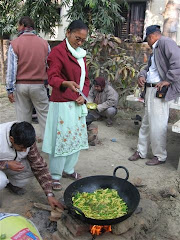
The dheraa is becoming more like a home. Last weekend was spent with BANG! (great at removing dirt and skin) making one bathroom acceptable. The living space has high ceilings and marble floors, with 3 ceiling fans. There is a good kitchen with marble worksurfaces – wonderful for rolling out rotis. We have an efficient gas burner and a small electric oven. There are frequent power cuts. The bright blue Whirlpool fridge with summer, winter and monsoon settings acts as a good store against ants as well as keeping things cold. The Indian shop nearby provides most of our needs, although 2kg bags seem to be the smallest of most staples. Its good to cook our own food, after eating out for 10 weeks. David’s banana ice cream is wonderful! Most of the washing goes to the dobi manche on the corner, and comes back clean and pressed on the back of my bicycle in the evening.
We have collected several new pieces of furniture in rickshaws and on handcarts. A sofa and two chairs will come from Dinesh’s cottage industry project next week. We have just put up the posters that we bought in Kathmandu – my favourite is a print of painted goats of the Terai – especially as there were painted goats in the garden today – white goats with fuchsia pink stripes for identification.
There are mango, banana, papaya and lychees in the garden; the mango tree attracts brilliant yellow birds, while mongooses play in the bushes – a good protection against the snakes that are supposed to appear with the rains!
There is also abundant wildlife inside the house – a paradise for entomologists, and a plentiful food supply for the delightful geckoes that chirrup loudly and wag their tails. Fireflies twinkle helpfully when the power goes.
I have found a back way to cycle to work, and pass a mixture a large houses interspersed with tiny mud and wood dwellings with cows, buffalo, goats and chickens. Many have small vegetable stalls in front selling onions, potatoes, aubergines, beans and squash. The equivalent of farm shops.
A varied week at work. I have spent 3 days observing trainee teachers in a primary school a 10 minute bike ride away from the city. I’ve enjoyed being in school and have met lively students – mostly girls, as all parents who can afford to send their sons to private school. There are classrooms, desks and books, and small classes. The situation in rural areas is much worse, with classes in excess of 100. Teachers and teaching were haphazard. I watched 4 lessons on Thursday morning, which lasted as long as the teacher wanted (not long). In the afternoon they decided to have ‘physical activity’, chasing around the field in excessive heat, avoiding the fresh cowpats. When the children were tired, they went home. Frequent bandhs do not help. None of the trainees turned up on Friday, and only 2 of the ‘regular’ teachers came. I joined Durga for a day at a UNICEF funded primary training course, with some excellent trainers from a Kathmandu based NGO that is doing innovative work in remote areas. There are good structures in place, a sound curriculum, good training, but no evidence of implementation, and no support for trainees in school. Hmm. Watching, listening and planning intervention…… Work seems to be starting to move for David at last, having spent Friday with the Resource Person responsible for the schools in which he will work. He will visit ‘his’ schools next week. I am expected to be a computer expert. We have bought a new laptop and had the internet installed; as I was leaving on Friday in an attempt to beat the storm brewing, Rudra called ‘tapaai malaai laptop chalaaunu deknos!’ from the window, so I returned to help him set up the laptop. By the time I left it was pouring, and I rode home through torrential rain skirting small shrieking children playing in puddles in their knickers. It rained hard all night. The frogs are very vocal.
Saturday – the market is open but the shops are closed, so we load our bikes with fruit and vegetables and cycle precariously home (today, shedding plums on the way). We also have internet access all day, so can read the Guardian online and catch up with The Archers. Small pleasures! Joseph is coming for supper, and tomorrow we plan to catch the bus to Dharan, about 40km away at the base of the hills.
Saturday, 16 June 2007
Saturday, 9 June 2007
Biratnagar
It’s easy (even for us) to find our way around here. We live in Tintolia, a residential area in the SE. David’s office is in the SW and mine in the NE, so we set off at right angles in the morning. There are two main N/S roads, the highway from India to the airport, which has occasional brightly painted overloaded horn honking trucks, ox carts carrying oil drums and cycle carts loaded with chij bij (stuff). Cycles and motorbikes weave in and out. There are a few restaurants, and people making baskets, pottery and wooden items. Main Road runs parallel and is the main shopping street. From south to north, the shops are roughly grocery, stationery, fruit and veg market, fabrics, kitchen equipment and electrical goods, interspersed with Hindu temples. We have established good relationships with several shopkeepers who give good discount, refunds and replacements. Chinese electrical equipment is ridiculously cheap with a short life expectancy, but it produced excellent banana lassi and toast for breakfast. David is keeping the carpenter busy making up his designs. I am revelling in my collection of kitchen plastics, to which I add daily on my way home from work. We selected some curtain material yesterday and the curtains were ready for collection by the time we had shopped for vegetables! The only china plates we’ve found in town are at the Xenial (swimming pool) hotel; not available in Nepal so the obliging chef went across the border to India for us and bought us a set (open border 5km from here for Nepalis, but not for us). The only day off is Saturday, when all the shops are closed. Maoist activists forcibly close down the ones that try to open. Our only disappointment is that there is currently no cheese in town, as there is a bandh on the highway from Ilam. Tinned Indian cheese is a poor substitute!
The move to our new home was incident packed. We loaded 14 items into the small hotel minibus. Thirteen items were unpacked – my computer bag with all my work and important documents was missing. The bus had departed to pick up students and I spent an extremely anxious hour before it returned and my bag was unearthed from under the back seat. Workmen were ‘cleaning’ with dirty rags, and Chattra the landlord insisted that they finished. Then the floor polisher came, so it was impossible to do anything. We went off to shop for some cleaning materials and were caught in a storm. Found sanctuary in ‘Maakhanu Bhog’. Lunch interrupted by chef running shrieking from kitchen brandishing a broom with which he clubbed to death a small rat. When the rain subsided we emerged to find that the sewers had overflowed.
We were able to unpack in the kitchen and set up the bed. The gas cylinder did not arrive until 7pm, so we went out to eat. Everything was locked and barred when we returned. When we eventually got in, we had a very comfortable night with 2 fans and only a few mosquitoes.
The next day was much better and I was able to cook dinner for Gerry, another volunteer here to do some IT training. The effect was spoiled by a mass hatching of lacewings, with a life span of about 3 minutes, after which they plummeted into the food.
It took less than a day to get a broadband connection - the landlord made some enquiries in the morning and by 5pm three chaps had arrived with a cable that they stuck through the window and put 2 bare wires into an electric socket. It works!
Work continues to delight and frustrate – we are meeting lots of people, speaking terrible Nepali (we will try and find a teacher next week to give us tuition a couple of mornings before work) and doing some constructive things. I planted a tree at a local primary school for World Environment day on Tuesday, helped by several hundred small children. On Friday I did some input into a science teacher training day in a open sided shed with 23 male teachers and 2 female goats. Still trying to arrange a planning meeting with all my colleagues. People meet but there are no meetings in the western sense. It’s only 2 weeks, and establishing good relationships is a priority!
The move to our new home was incident packed. We loaded 14 items into the small hotel minibus. Thirteen items were unpacked – my computer bag with all my work and important documents was missing. The bus had departed to pick up students and I spent an extremely anxious hour before it returned and my bag was unearthed from under the back seat. Workmen were ‘cleaning’ with dirty rags, and Chattra the landlord insisted that they finished. Then the floor polisher came, so it was impossible to do anything. We went off to shop for some cleaning materials and were caught in a storm. Found sanctuary in ‘Maakhanu Bhog’. Lunch interrupted by chef running shrieking from kitchen brandishing a broom with which he clubbed to death a small rat. When the rain subsided we emerged to find that the sewers had overflowed.
We were able to unpack in the kitchen and set up the bed. The gas cylinder did not arrive until 7pm, so we went out to eat. Everything was locked and barred when we returned. When we eventually got in, we had a very comfortable night with 2 fans and only a few mosquitoes.
The next day was much better and I was able to cook dinner for Gerry, another volunteer here to do some IT training. The effect was spoiled by a mass hatching of lacewings, with a life span of about 3 minutes, after which they plummeted into the food.
It took less than a day to get a broadband connection - the landlord made some enquiries in the morning and by 5pm three chaps had arrived with a cable that they stuck through the window and put 2 bare wires into an electric socket. It works!
Work continues to delight and frustrate – we are meeting lots of people, speaking terrible Nepali (we will try and find a teacher next week to give us tuition a couple of mornings before work) and doing some constructive things. I planted a tree at a local primary school for World Environment day on Tuesday, helped by several hundred small children. On Friday I did some input into a science teacher training day in a open sided shed with 23 male teachers and 2 female goats. Still trying to arrange a planning meeting with all my colleagues. People meet but there are no meetings in the western sense. It’s only 2 weeks, and establishing good relationships is a priority!

Saturday, 2 June 2007
First day at work
Friday May 25
Rudra (thulo manche = big man = boss) had invited me for an introductory meeting at 10am. David came too, as his office is still locked. The charming Durga with his gentle smile greeted us; Rudra had gone home for ‘lunch’. Normal working hours are 10 – 5 and most people do not go to work until they have eaten the first daal bhat of the day. During the day many people came and went; Rudra returned; tea was brought (boiled with milk and sugar). Durga was teaching a group of headteachers, here for a one month training. Although we were unable to understand much of what was being said (the topic was ‘non-violent discipline’), the methods were good, with different activities, case studies, discussion and laughter. We introduced ourselves in Nepali. Our meeting started at 4:10pm. A tour of the building – 2 training room, 4 offices, toilets (such a relief after Ethiopia!), and a new 2 storey building under construction with a training room, library, laboratory and offices. Formal introductions were made. There are 4 trainers (Rudra, Durga, Umapati and Govind) one administrator (Anil – a talented musician) and 2 ‘peons’ – Bhakta and Lalmani (Dalits of course), who respond to bells on the trainers’ desks and fetch things, including tea and snacks. There’s also a brown dog. Lots of part-time staff too, mostly retired headteachers, who ‘come and go’. Most of the courses are for serving teachers who have had no training. They indicated the things they need help with – new training methods, follow up of training, action research, planning, report writing and computer skills.
After work Durga invited us to meet his family and eat. He has 3 daughters, Kabita the eldest recently married and about to go to London to join her husband who is studying accountancy there. A fascinating evening, sitting under the fan in the main bedroom (the coolest place). His daughters are bright, lively, confident and speak good English. His wife speaks no English and appeared smiling shyly from time to time. Sabita, age 18 had cooked the food – daal bhat with a variety of vegetable dishes, and watched attentively while we ate with Durga - guests and men always eat first in silence, and the women ate watching TV after we left. Amazing how in one generation so much has changed for women in urban areas.
Getting used to being permanently hot and damp.
The weekend was spent house hunting with Joseph and some of our new acquaintances, looking at a variety of apartments from miniature marble palaces to filthy cockroach infested rooms. Each evening we meet our new friend Dinesh from the cane furniture enterprise and walk the back streets to see places he has scouted for early in the morning. We arrive back hot, grubby and covered in mosquito bites. Meanwhile the Ratna hotel is comfortable and cool. We have taken a year’s membership of the swimming pool, and are now more mobile with our sturdy Indian bicycles. The ‘Friends’ Restaurant’ across the road from the hotel has become a firm favourite. There are plentiful supplies of very cold water, efficient fans, whole paper napkins, the food is tasty and cheap and it’s the only place we’ve found where our arms do not stick to the table. As an alternative, there are excellent masala dosas at the unfortunately named ‘Maakhanu Bhog’.
On my second day at work (Monday), having tried to find my way around the computer system in the morning I was asked (at 1:50) to do a session on the UK Education System. Start time 2pm. As it was Nepali time I was able to produce a brief powerpoint summary of what I thought they might be interested in, and introduced items in simple English with bits of Nepali when I could remember them. There was ‘hot discussion’ – a favourite expression from Ethiopia. And it was hot; the heat from the LCD projector (amazed that they had one and that I could get it to work) added to the stifling temperature in the room. Most of the men had removed their caps (traditional Nepali or baseball), the only woman fanned herself with the end of her sari while the men rolled up their trousers to the knee and their shirts to under their armpits, revealing their sparkling white vests.
On day 3 I based myself in Govind’s office, where there is a fan and the computer. It opens onto the training room so I can observe and listen. Govind was supposed to go to observe primary teachers in school today, but the government schools are still closed, so he went to sleep instead. I have found my way around the computer system and refreshed my rudimentary knowledge of Excel. Bhakta and Lalmani are very attentive; Bhakta brings me water and mango juice; Lalmani insists on unlocking my bike and wheeling it to the path at the end of the day.
Day 4 To my amazement, when I arrived at work, Rudra was at the computer inserting columns for collect data an gender and ethnic minorities on the spreadsheets – I talked with him about inclusion (big VSO priority here) yesterday. Umapati took me to his house to meet his wife – on the bed under the fan watching TV. She provided mangoes and lychees for my lunch. We have been invited to do some input to the headteacher session on Target Groups (girls, Dalits, different tribal groups and the disabled) on Thursday. In the afternoon it was so hot that the training moved downstairs. I enjoyed watching Bhakta in his vest and pants setting up the LCD projector. David’s office is still closed, but we met Arjun (DEO) last night for a chat. Meanwhile David continues house hunting and finding places to buy furniture. The bicycles are wonderful, and we are good at weaving in and out of the traffic and avoiding hazards. I wear my scarf sash style to prevent being throttled. The scarf is such a useful part of my kurta surwaal, for frequent mopping of brow, cleaning tables, chairs, computer screen, and drying hands.
Day 5 on Target Groups was fascinating, with lots of impassioned debate. DAGs (Disadvantaged Groups) make up 53% of the population in this area. We are now an accepted part of the group and are able to join in group discussion. Made a decision on our new home too – we will move into the marble floored flat next week. Having paid our deposit last night, we tried to find a mattress and had our first experience of night time cycling. No rickshaws or bikes have lights. Neither do ox carts, cows, dogs or goats. Most motorbikes do not use them. We did find a mattress and get home unscathed.
A very good day on Friday, involved in the headteacher training and typing up some observations and suggestions. It ends on Monday - I will miss them, and am delighted at how easily I have become accepted. Plans for the weekend are scuppered as we have been invited to the headteachers’ picnic tomorrow – departure time 7am, and on Sunday I have promised to go to their final presentations.
The picnic
7:30am pickup from the centre of town in a blue van left by the British c.1940. More than 20 of us crammed in the back on 3 rickety metal benches for the 8km journey along dirt tracks to a Science Park. More followed on motorbikes. The museum and planetarium were closed, but the heads – ranging in age from 30 to nearly 60, headed straight for the children’s playground where they played on the swings, a roundabout and a rusty slide. We joined in enthusiastically. Then breakfast – stacks of white bread, omelettes and channa masala. This was followed by tree climbing until they were exhausted and retired to a shelter where we sat in a circle, told jokes and stories and sang songs for 2 hours. We now have a repertoire of Nepali folk songs, but we were required to sing solos in English. Then Durga introduced a game that lasted until lunch. Lunch part one was fried chicken or sticky sweets for the vegetarians. After a rest under the trees, vast quantities of daal bhat were dished out from metal buckets. The journey back was even more exciting, as Govind’s motorbike broke down and we had to find room for him and the bike in the back of the van. Arrived back at 4:30, full, exhausted and filthy. Just in time to pick up our new table and chairs, hire a hand cart and take them to the flat.
Rudra (thulo manche = big man = boss) had invited me for an introductory meeting at 10am. David came too, as his office is still locked. The charming Durga with his gentle smile greeted us; Rudra had gone home for ‘lunch’. Normal working hours are 10 – 5 and most people do not go to work until they have eaten the first daal bhat of the day. During the day many people came and went; Rudra returned; tea was brought (boiled with milk and sugar). Durga was teaching a group of headteachers, here for a one month training. Although we were unable to understand much of what was being said (the topic was ‘non-violent discipline’), the methods were good, with different activities, case studies, discussion and laughter. We introduced ourselves in Nepali. Our meeting started at 4:10pm. A tour of the building – 2 training room, 4 offices, toilets (such a relief after Ethiopia!), and a new 2 storey building under construction with a training room, library, laboratory and offices. Formal introductions were made. There are 4 trainers (Rudra, Durga, Umapati and Govind) one administrator (Anil – a talented musician) and 2 ‘peons’ – Bhakta and Lalmani (Dalits of course), who respond to bells on the trainers’ desks and fetch things, including tea and snacks. There’s also a brown dog. Lots of part-time staff too, mostly retired headteachers, who ‘come and go’. Most of the courses are for serving teachers who have had no training. They indicated the things they need help with – new training methods, follow up of training, action research, planning, report writing and computer skills.
After work Durga invited us to meet his family and eat. He has 3 daughters, Kabita the eldest recently married and about to go to London to join her husband who is studying accountancy there. A fascinating evening, sitting under the fan in the main bedroom (the coolest place). His daughters are bright, lively, confident and speak good English. His wife speaks no English and appeared smiling shyly from time to time. Sabita, age 18 had cooked the food – daal bhat with a variety of vegetable dishes, and watched attentively while we ate with Durga - guests and men always eat first in silence, and the women ate watching TV after we left. Amazing how in one generation so much has changed for women in urban areas.
Getting used to being permanently hot and damp.
The weekend was spent house hunting with Joseph and some of our new acquaintances, looking at a variety of apartments from miniature marble palaces to filthy cockroach infested rooms. Each evening we meet our new friend Dinesh from the cane furniture enterprise and walk the back streets to see places he has scouted for early in the morning. We arrive back hot, grubby and covered in mosquito bites. Meanwhile the Ratna hotel is comfortable and cool. We have taken a year’s membership of the swimming pool, and are now more mobile with our sturdy Indian bicycles. The ‘Friends’ Restaurant’ across the road from the hotel has become a firm favourite. There are plentiful supplies of very cold water, efficient fans, whole paper napkins, the food is tasty and cheap and it’s the only place we’ve found where our arms do not stick to the table. As an alternative, there are excellent masala dosas at the unfortunately named ‘Maakhanu Bhog’.
On my second day at work (Monday), having tried to find my way around the computer system in the morning I was asked (at 1:50) to do a session on the UK Education System. Start time 2pm. As it was Nepali time I was able to produce a brief powerpoint summary of what I thought they might be interested in, and introduced items in simple English with bits of Nepali when I could remember them. There was ‘hot discussion’ – a favourite expression from Ethiopia. And it was hot; the heat from the LCD projector (amazed that they had one and that I could get it to work) added to the stifling temperature in the room. Most of the men had removed their caps (traditional Nepali or baseball), the only woman fanned herself with the end of her sari while the men rolled up their trousers to the knee and their shirts to under their armpits, revealing their sparkling white vests.
On day 3 I based myself in Govind’s office, where there is a fan and the computer. It opens onto the training room so I can observe and listen. Govind was supposed to go to observe primary teachers in school today, but the government schools are still closed, so he went to sleep instead. I have found my way around the computer system and refreshed my rudimentary knowledge of Excel. Bhakta and Lalmani are very attentive; Bhakta brings me water and mango juice; Lalmani insists on unlocking my bike and wheeling it to the path at the end of the day.
Day 4 To my amazement, when I arrived at work, Rudra was at the computer inserting columns for collect data an gender and ethnic minorities on the spreadsheets – I talked with him about inclusion (big VSO priority here) yesterday. Umapati took me to his house to meet his wife – on the bed under the fan watching TV. She provided mangoes and lychees for my lunch. We have been invited to do some input to the headteacher session on Target Groups (girls, Dalits, different tribal groups and the disabled) on Thursday. In the afternoon it was so hot that the training moved downstairs. I enjoyed watching Bhakta in his vest and pants setting up the LCD projector. David’s office is still closed, but we met Arjun (DEO) last night for a chat. Meanwhile David continues house hunting and finding places to buy furniture. The bicycles are wonderful, and we are good at weaving in and out of the traffic and avoiding hazards. I wear my scarf sash style to prevent being throttled. The scarf is such a useful part of my kurta surwaal, for frequent mopping of brow, cleaning tables, chairs, computer screen, and drying hands.
Day 5 on Target Groups was fascinating, with lots of impassioned debate. DAGs (Disadvantaged Groups) make up 53% of the population in this area. We are now an accepted part of the group and are able to join in group discussion. Made a decision on our new home too – we will move into the marble floored flat next week. Having paid our deposit last night, we tried to find a mattress and had our first experience of night time cycling. No rickshaws or bikes have lights. Neither do ox carts, cows, dogs or goats. Most motorbikes do not use them. We did find a mattress and get home unscathed.
A very good day on Friday, involved in the headteacher training and typing up some observations and suggestions. It ends on Monday - I will miss them, and am delighted at how easily I have become accepted. Plans for the weekend are scuppered as we have been invited to the headteachers’ picnic tomorrow – departure time 7am, and on Sunday I have promised to go to their final presentations.
The picnic
7:30am pickup from the centre of town in a blue van left by the British c.1940. More than 20 of us crammed in the back on 3 rickety metal benches for the 8km journey along dirt tracks to a Science Park. More followed on motorbikes. The museum and planetarium were closed, but the heads – ranging in age from 30 to nearly 60, headed straight for the children’s playground where they played on the swings, a roundabout and a rusty slide. We joined in enthusiastically. Then breakfast – stacks of white bread, omelettes and channa masala. This was followed by tree climbing until they were exhausted and retired to a shelter where we sat in a circle, told jokes and stories and sang songs for 2 hours. We now have a repertoire of Nepali folk songs, but we were required to sing solos in English. Then Durga introduced a game that lasted until lunch. Lunch part one was fried chicken or sticky sweets for the vegetarians. After a rest under the trees, vast quantities of daal bhat were dished out from metal buckets. The journey back was even more exciting, as Govind’s motorbike broke down and we had to find room for him and the bike in the back of the van. Arrived back at 4:30, full, exhausted and filthy. Just in time to pick up our new table and chairs, hire a hand cart and take them to the flat.
Sunday, 27 May 2007
To work ... or not
All the schools in the country are closed indefinitely. The District Education Office (David’s placement) in Biratanagar has been closed for 8 days. The School Management Committees (equivalent of governors) have now become SMAC (A=agitation) and have locked the schools and taken the keys to the DEO, refusing to reopen schools until all demands are met. No-one seems very clear about what the demands are, but today’s paper reports that there are 473 of them.
However, on Monday (May 21) we were delighted that at the education partners workshop, each organisation managed to send 2 representatives. There were 8 volunteers (4 male and 4 female) with 16 male Nepalis, emphasising the gender issues here! Rudra and Durga from Biratnagar ETC had come with a carefully prepared work plan for my first 5 months. Enough work for 5 years at least. The DEO seems to be expecting David to solve all his computer and data collection problems, so he feels less positive about the day. The plan for us to return with them tomorrow has not materialised, as they have ‘business’ to attend to in Kathmandu. The DEO is expected to send their jeep to Biratnagar airport, as there are no taxis. The “how will the driver know them” question resulted in much laughter, as there are apparently no other vidhyeshi in town. I will go to the office for ‘introductions’ on Friday.
Tuesday May 22. An inauspicious start to our departure day. A photograph of teachers burning an effigy of the Minister of Education in Biratnagar dominated the front page of the Kathmandu Post. Purna phoned at 8am to tell us there is a bandh in Biratnagar, so there will be no jeep to meet us at the airport, but he thinks there may be cycle rickshaws. We’ll see. Back to the newspaper, which also reports that the idol at Bhimeshwor temple has started sweating, a sure sign that some disaster is about to happen. Comforting though, to find on the back page that ‘Armed Police win Kathmandu cup’. An uneventful taxi ride to the domestic airport, where Europeans heading for the mountains mingled with Nepali business men, sherpas with trekking provisions and elderly Tibetan nuns. I woke up the young woman in Ladies’ Security to stamp my boarding card and someone shouted in Nepali when flights were about to depart. A decrepit Buddha Air bus trundled us along the runway as an incoming flight skimmed overhead, and we boarded the 19 seater plane. We were given sweets to suck and cotton wool for our ears before take off. We bounced alarmingly upwards through the clouds, to be rewarded by stunning views of the Himalayas, as we followed them eastwards while warm Mirinda was poured into plastic cups for us. As we emerged from the cloud base after an equally bouncy descent we had our first sight of the Terai. Brilliant green rice paddy, irrigation ditches, field of crops, cattle, oxen, buffalo, goats, and small thatched villages.
Welcome to Biratnagar alt 263’ (Swagatam Biratnagar)
As anticipated, there were no jeeps at the airport, but many predatory cycle rickshaws with a captive market. My bargaining skills achieve no reduction, but we did secure two reasonably sturdy machines for the 5km journey with our luggage. And what a wonderful journey! The road was lined with vermilion flame trees, shocking pink bourganvillea and creamy frangipani alive with butterflies the size of sparrows. There were mangoes and lychees dripping from the trees, fruiting bananas and coconut palms. Brightly painted bill boards advertised Mahindra tractors and Shuka Luka noodles. The only other vehicles on the road were ox carts, and we arrived hot and excited at the Ratna Hotel. The Ratna has pretensions – charming receptionists with excellent English, the ability to correct our Nepali politely and draw maps; toilet paper with proper perforations; WiFi and fuzzy satellite TV; frequent calls from room service to see if we need anything.
In our first 2 days we have walked the town (several times); opened a bank account (2 hours in the manager’s office); got SIM cards (2 visits to NTC, complex form filling in Devanagri script – name, father’s name, grandfather’s name, photograph, signature and 2 thumbprints); found the excellent fruit and vegetable market; met several Indian shopkeepers who plied us with drinks and sweets; spoken to about half the population; found the swimming pool at the Xenial hotel; and asked a variety of helpful people about accommodation. It feels like a small country town, not an industrial city of 200,000. We have seen 3 cars.
In our wanderings this afternoon we visited a Hindu temple with accommodation and a school for Dalit children. We were invited to join their festival celebrations in the evening and arrived about 6:30 to the sound of drums and singing. Within seconds of our arrival, I had several dozen excited children sitting on me asking questions in a mixture of Nepali and English. Soon afterwards the electricity went off, and the temperature rose from a bearable 39 to an unbearable 45. By this time we were dancing, but managed to escape with a promise to return later in the week. We found our way back lit by dancing fireflies, surprising several puppy-sized frogs on the way. Joseph had called while we were out, having just arrived back from Kathmandu; he is known as kaalo manche (the black man). I am sure that David will be called aglo manche as he is a foot taller than anyone else in town. I am normal size for a Nepali woman.
The good news in today’s paper is that 2 goats have been slaughtered for the Bhimeshwor idol, and the sweaty cloth used to wipe it’s forehead has been delivered to the PM instead of the king. Although there is a fairly heavy police presence (a few guns, more big sticks) here, most of them are eating watermelon and icecream in the shade to try and keep cool.
However, on Monday (May 21) we were delighted that at the education partners workshop, each organisation managed to send 2 representatives. There were 8 volunteers (4 male and 4 female) with 16 male Nepalis, emphasising the gender issues here! Rudra and Durga from Biratnagar ETC had come with a carefully prepared work plan for my first 5 months. Enough work for 5 years at least. The DEO seems to be expecting David to solve all his computer and data collection problems, so he feels less positive about the day. The plan for us to return with them tomorrow has not materialised, as they have ‘business’ to attend to in Kathmandu. The DEO is expected to send their jeep to Biratnagar airport, as there are no taxis. The “how will the driver know them” question resulted in much laughter, as there are apparently no other vidhyeshi in town. I will go to the office for ‘introductions’ on Friday.
Tuesday May 22. An inauspicious start to our departure day. A photograph of teachers burning an effigy of the Minister of Education in Biratnagar dominated the front page of the Kathmandu Post. Purna phoned at 8am to tell us there is a bandh in Biratnagar, so there will be no jeep to meet us at the airport, but he thinks there may be cycle rickshaws. We’ll see. Back to the newspaper, which also reports that the idol at Bhimeshwor temple has started sweating, a sure sign that some disaster is about to happen. Comforting though, to find on the back page that ‘Armed Police win Kathmandu cup’. An uneventful taxi ride to the domestic airport, where Europeans heading for the mountains mingled with Nepali business men, sherpas with trekking provisions and elderly Tibetan nuns. I woke up the young woman in Ladies’ Security to stamp my boarding card and someone shouted in Nepali when flights were about to depart. A decrepit Buddha Air bus trundled us along the runway as an incoming flight skimmed overhead, and we boarded the 19 seater plane. We were given sweets to suck and cotton wool for our ears before take off. We bounced alarmingly upwards through the clouds, to be rewarded by stunning views of the Himalayas, as we followed them eastwards while warm Mirinda was poured into plastic cups for us. As we emerged from the cloud base after an equally bouncy descent we had our first sight of the Terai. Brilliant green rice paddy, irrigation ditches, field of crops, cattle, oxen, buffalo, goats, and small thatched villages.
Welcome to Biratnagar alt 263’ (Swagatam Biratnagar)
As anticipated, there were no jeeps at the airport, but many predatory cycle rickshaws with a captive market. My bargaining skills achieve no reduction, but we did secure two reasonably sturdy machines for the 5km journey with our luggage. And what a wonderful journey! The road was lined with vermilion flame trees, shocking pink bourganvillea and creamy frangipani alive with butterflies the size of sparrows. There were mangoes and lychees dripping from the trees, fruiting bananas and coconut palms. Brightly painted bill boards advertised Mahindra tractors and Shuka Luka noodles. The only other vehicles on the road were ox carts, and we arrived hot and excited at the Ratna Hotel. The Ratna has pretensions – charming receptionists with excellent English, the ability to correct our Nepali politely and draw maps; toilet paper with proper perforations; WiFi and fuzzy satellite TV; frequent calls from room service to see if we need anything.
In our first 2 days we have walked the town (several times); opened a bank account (2 hours in the manager’s office); got SIM cards (2 visits to NTC, complex form filling in Devanagri script – name, father’s name, grandfather’s name, photograph, signature and 2 thumbprints); found the excellent fruit and vegetable market; met several Indian shopkeepers who plied us with drinks and sweets; spoken to about half the population; found the swimming pool at the Xenial hotel; and asked a variety of helpful people about accommodation. It feels like a small country town, not an industrial city of 200,000. We have seen 3 cars.
In our wanderings this afternoon we visited a Hindu temple with accommodation and a school for Dalit children. We were invited to join their festival celebrations in the evening and arrived about 6:30 to the sound of drums and singing. Within seconds of our arrival, I had several dozen excited children sitting on me asking questions in a mixture of Nepali and English. Soon afterwards the electricity went off, and the temperature rose from a bearable 39 to an unbearable 45. By this time we were dancing, but managed to escape with a promise to return later in the week. We found our way back lit by dancing fireflies, surprising several puppy-sized frogs on the way. Joseph had called while we were out, having just arrived back from Kathmandu; he is known as kaalo manche (the black man). I am sure that David will be called aglo manche as he is a foot taller than anyone else in town. I am normal size for a Nepali woman.
The good news in today’s paper is that 2 goats have been slaughtered for the Bhimeshwor idol, and the sweaty cloth used to wipe it’s forehead has been delivered to the PM instead of the king. Although there is a fairly heavy police presence (a few guns, more big sticks) here, most of them are eating watermelon and icecream in the shade to try and keep cool.
Friday, 18 May 2007
In transition
Mangoes (aap) in shades of yellow, orange, green and red are abundant and cheap, while grapes (angur) are now hard to find, and tangerines (suntala) are becoming expensive (45p/kg). Jacaranda trees are in full flower, creating a bluish haze in the sky and a scattering of lilac petals on the ground. The unseasonal rain has made the parks and gardens green and helped with the fragile water and electricity supply for the city. It’s becoming hotter and more humid, with frequent heavy downpours.
A visit to the clinic and a hefty dose of tinidazole seems to have eliminated Giardia and Entamoeba from my system. A fact of life here I think. The doctor says he ‘debugs’ himself every six months.
The VSO conference in a smart hotel with beautiful gardens and pool in the northern suburbs, surrounded by wooded hills, was an excellent mix of presentations, work input and discussion, activity based sessions, practical information, opportunities to get to know other volunteers, and fun. We had input from Andrew Hall, the British Ambassador (British ‘interests’!), CK Lal, a leading newspaper columnist – the press here (2 English language dailies, and many Nepali ones) is remarkably free given the political situation, Krishna, the general secretary of the main teachers’ union, and the wonderfully charismatic Sanjay Acharya (a high caste Brahmin) who runs an NGO setting up schools for Dalit children in rural areas. The caste system is so deeply embedded here, in spite of being illegal for more than 40 years, and is an added dimension in disadvantage and poverty. Although the Dalits make up 25% of the population, there is only one Dalit MP and many children are still denied access to education. Wednesday night’s party was a team event with a nautical theme (the Nepali office staff needed careful explanations!), but was a great success in getting everyone ‘on board’. Our team won the dance competition wearing pirate hats fashioned from newspaper performing an elaborate routine led by Dunstan, an exuberant Ugandan while Mick played the Captain Pugwash theme on the melodeon.
We now feel more than ready to start work. Julie, who is working in the DEO in the far west, tells us that the contrast between the Terai and Kathmandu is greater than the contrast between Kathmandu and London. On Monday we hope to meet our ‘partners’ for a planning day. We are hopeful that they will arrive, in spite of the strike that has now closed all the schools and government offices in the country. The government has not been able to meet effectively for more than a week and no decisions are being made. I have some carefully prepared sentences, which I have been practising with Nepali colleagues here, but ‘conversation’ is a big challenge. Most of the VSOs outside Kathmandu are working in Nepali or a Nepali / English mix most of the time, so we look forward to improving. We have tickets for the 10:30 flight to Biratnagar on Tuesday, but have just heard that the flight is cancelled. There should be one at 12:30. We have a hotel booking, a cheque from VSO to buy things for our home, an emergency ticket to get back to Kathmandu and some Indian rupees should we need to leave the country to India. Although we are only 5km from the border in Biratnagar, that border is closed to foreigners, so we have to travel 4 hours by bus along the Mahendra Highway – closed frequently by the Maoists, so that may not be a viable option. We had an ‘eastern cluster’ meeting yesterday to discuss our contingency plans – us and Ugandan Joseph in Biratnagar, with Etienne, a young Dutch volunteer based in Dharan, 40km north of us. Staying put seems the best option.
We are making the most of our last weekend in the city, with a visit to a Nepali theatre, a concert at the British School, farewell dinner with new VSO friends and plans to eat lots of cheese. However, I have just learnt from Rima whose husband is from Biratnagar, that it has the biggest cheese factory in Nepal!
A visit to the clinic and a hefty dose of tinidazole seems to have eliminated Giardia and Entamoeba from my system. A fact of life here I think. The doctor says he ‘debugs’ himself every six months.
The VSO conference in a smart hotel with beautiful gardens and pool in the northern suburbs, surrounded by wooded hills, was an excellent mix of presentations, work input and discussion, activity based sessions, practical information, opportunities to get to know other volunteers, and fun. We had input from Andrew Hall, the British Ambassador (British ‘interests’!), CK Lal, a leading newspaper columnist – the press here (2 English language dailies, and many Nepali ones) is remarkably free given the political situation, Krishna, the general secretary of the main teachers’ union, and the wonderfully charismatic Sanjay Acharya (a high caste Brahmin) who runs an NGO setting up schools for Dalit children in rural areas. The caste system is so deeply embedded here, in spite of being illegal for more than 40 years, and is an added dimension in disadvantage and poverty. Although the Dalits make up 25% of the population, there is only one Dalit MP and many children are still denied access to education. Wednesday night’s party was a team event with a nautical theme (the Nepali office staff needed careful explanations!), but was a great success in getting everyone ‘on board’. Our team won the dance competition wearing pirate hats fashioned from newspaper performing an elaborate routine led by Dunstan, an exuberant Ugandan while Mick played the Captain Pugwash theme on the melodeon.
We now feel more than ready to start work. Julie, who is working in the DEO in the far west, tells us that the contrast between the Terai and Kathmandu is greater than the contrast between Kathmandu and London. On Monday we hope to meet our ‘partners’ for a planning day. We are hopeful that they will arrive, in spite of the strike that has now closed all the schools and government offices in the country. The government has not been able to meet effectively for more than a week and no decisions are being made. I have some carefully prepared sentences, which I have been practising with Nepali colleagues here, but ‘conversation’ is a big challenge. Most of the VSOs outside Kathmandu are working in Nepali or a Nepali / English mix most of the time, so we look forward to improving. We have tickets for the 10:30 flight to Biratnagar on Tuesday, but have just heard that the flight is cancelled. There should be one at 12:30. We have a hotel booking, a cheque from VSO to buy things for our home, an emergency ticket to get back to Kathmandu and some Indian rupees should we need to leave the country to India. Although we are only 5km from the border in Biratnagar, that border is closed to foreigners, so we have to travel 4 hours by bus along the Mahendra Highway – closed frequently by the Maoists, so that may not be a viable option. We had an ‘eastern cluster’ meeting yesterday to discuss our contingency plans – us and Ugandan Joseph in Biratnagar, with Etienne, a young Dutch volunteer based in Dharan, 40km north of us. Staying put seems the best option.
We are making the most of our last weekend in the city, with a visit to a Nepali theatre, a concert at the British School, farewell dinner with new VSO friends and plans to eat lots of cheese. However, I have just learnt from Rima whose husband is from Biratnagar, that it has the biggest cheese factory in Nepal!
Friday, 11 May 2007
End of Part One
On Saturday we managed to get to the final day of the ‘People at War’ photographic exhibition which has been touring Nepal with its haunting and frequently distressing photographs of the last ten years of conflict. When we reached the calm of the Patan Palace museum garden we had time to reflect on the selection, arrangement and captions of the photographs, which presented a powerful anti-Maoist, pro-government portrait. Hmm.
Patan Palace, in the midst of the spectacular buildings of Patan Durbar Square, has been beautifully restored and is now an excellent museum of Hindu and Buddhist religious art and artefacts. An excellent introduction to the many incarnations of the Hindu gods! The photographs of the square in1900 provided an insight into traditional Newari lifestyle, and apart from the destruction of some buildings in the 1934 earthquake and the invention of the motorbike, it looks remarkably similar to the way it is today.
Monday’s language proficiency test was a fairly free flowing conversation with a charming Nepali women who works as an international language trainer and assessor. Unfortunately my knowledge of grammatical structures, pronouns, postpositions, verb endings was lost in my enthusiasm to actually communicate on topics as diverse as teaching methodology in England and Ethiopia, a comparison of the status of women in England and Nepal, my response to the photographic exhibition (above), and David’s ‘habits’! Much relief when we were given feedback to find we were both in the ‘Intermediate – high’ category, “with some circumlocution to convey meaning, and evidence of some advanced structures”. There’s an end-of-term feeling, and our last task was a major shopping expedition to the market to buy ingredients for a Nepali feast that we cooked today. 20 cooks, many kilos of vegetables, lentils, paneer, chicken and rice, two gas rings and a rice cooker produced a spectacular meal by 2pm. We have a final evaluation on Sunday.
The next phase is about to begin – several of our group have already moved from the guest house into their own flats. We are ready to go and feel we have enough Nepali to find ourselves somewhere to live and meet colleagues at work. We have at last been given a departure date for Biratnagar – May 22, assuming the political situation does not change radically. Next week we will be at the annual VSO conference, and we are hoping that our new colleagues will come to Kathmandu for a briefing day on May 21. We have met several existing volunteers here this week; it’s been very useful to hear about their experiences in the more remote parts of Nepal. Our meeting with Purna (VSO Education Manager) has helped in that w have a very open brief ie to do whatever seems appropriate / possible! We look forward to the challenge! David is scrounging sturdy boxes in which to pack ‘essential items’ that he wants to buy here before we go. We’re not sure how we will get these boxes to Biratnagar, as luggage allowance is only 15kg!
Patan Palace, in the midst of the spectacular buildings of Patan Durbar Square, has been beautifully restored and is now an excellent museum of Hindu and Buddhist religious art and artefacts. An excellent introduction to the many incarnations of the Hindu gods! The photographs of the square in1900 provided an insight into traditional Newari lifestyle, and apart from the destruction of some buildings in the 1934 earthquake and the invention of the motorbike, it looks remarkably similar to the way it is today.
Monday’s language proficiency test was a fairly free flowing conversation with a charming Nepali women who works as an international language trainer and assessor. Unfortunately my knowledge of grammatical structures, pronouns, postpositions, verb endings was lost in my enthusiasm to actually communicate on topics as diverse as teaching methodology in England and Ethiopia, a comparison of the status of women in England and Nepal, my response to the photographic exhibition (above), and David’s ‘habits’! Much relief when we were given feedback to find we were both in the ‘Intermediate – high’ category, “with some circumlocution to convey meaning, and evidence of some advanced structures”. There’s an end-of-term feeling, and our last task was a major shopping expedition to the market to buy ingredients for a Nepali feast that we cooked today. 20 cooks, many kilos of vegetables, lentils, paneer, chicken and rice, two gas rings and a rice cooker produced a spectacular meal by 2pm. We have a final evaluation on Sunday.
The next phase is about to begin – several of our group have already moved from the guest house into their own flats. We are ready to go and feel we have enough Nepali to find ourselves somewhere to live and meet colleagues at work. We have at last been given a departure date for Biratnagar – May 22, assuming the political situation does not change radically. Next week we will be at the annual VSO conference, and we are hoping that our new colleagues will come to Kathmandu for a briefing day on May 21. We have met several existing volunteers here this week; it’s been very useful to hear about their experiences in the more remote parts of Nepal. Our meeting with Purna (VSO Education Manager) has helped in that w have a very open brief ie to do whatever seems appropriate / possible! We look forward to the challenge! David is scrounging sturdy boxes in which to pack ‘essential items’ that he wants to buy here before we go. We’re not sure how we will get these boxes to Biratnagar, as luggage allowance is only 15kg!
Saturday, 5 May 2007
More Nepali
Language continues – so many new grammatical structures, reams of new vocabulary, a notebook (kaapi) full of exercises, listening comprehensions, dictation in script, and most challenging of all a 20 minute 1:1 conversation with one of our teachers. I talked with Krishna (or more accurately, she asked me questions and I stumbled through some answers), but I did discover that she had lived in Biratnagar for 2 years. She was full of good advice: “keep under your mosquito net at all times” (I visualise myself riding my bicycle looking like a shrouded beekeeper), “always take a flashlight when you go to the charpi (toilet) to scare away the snakes” (we will be looking for an apartment with an inside charpi). We have (at last) learned some ‘weather’ vocabulary – I’m sure this would come earlier in an English language school. The weather in the late afternoon has been stormy this week, with some heavy rain, thunderstorms and wind strong enough to blow boxes through the air and trees down. In Pokhara, 3 people were killed by 1kg hailstones!
Walks to school have been enlivened by weddings this week – it is an auspicious time apparently – and the wedding day starts with the local band at the bride’s house. The band consists of a group of young men wearing ill-fitting red jackets with a variety of instruments that make a great deal of noise. Sometimes language lessons have to be halted until the noise stops.
While the Dutch were invited to a smart hotel for a day to celebrate their Queen’s birthday, we were only able to observe the celebrations for ours from outside the high, heavily guarded wall of the British Embassy. There were separate entrances for superior (red) and inferior (blue) people (or in the case of VSOs no entry). When we tried to sneak a look through the gates where a military band was playing, we were moved away at gunpoint.
‘Democracy day’ (April 24) – a year after the king gave up his power was marked by a public holiday, but not for us. The roads were relatively quiet, with offices and schools closed. Families were enjoying a day out; we were nearly run down (a frequent hazard) by a group of 5 on a motor bike, with a small girl dressed in sunglasses and flounced pink net party dress at the front. Inspite of the excitement about democracy and change, in reality nothing really seems to have happened in the last year, with increasing frustration, especially in the Terai.
April 25 saw the launch of the Global Campaign for Education and some of us attended a ‘solidarity’ rally in the centre of the city before school. Lots of school children in uniforms, ragged street children, some of whom now have access to informal education in the evenings, some teachers, lots of VSOs(!), organisers of local NGOs, the director of UNICEF and the State Minister of Education. Lots of speeches in Nepali, with particularly moving ones from street children demanding their right to a decent education. Powerful stuff.
Cultural events have included sessions on child marriage – still very common in rural areas, with horrendous figures for deaths in childbirth. The discussion centred around a very moving DVD that we watched upstairs from the language school, which occupies the ground floor of a Tibetan house. When we went upstairs, the male members of the family were sprawled on cushions in vest and pants watching the TV. A huge glass display cabinet occupying one wall contained many large bottles of different brands of whisky proudly flanking pictures of the Dalai Lama and other Tibetan memorabilia.
On Saturday we caught a bus to Bhaktapur, a world heritage site and the largest temple complex in Nepal, only 15km away. The journey took 2 ½ hours, partly because a banda (strike) had been called and the main road blocked. Our enterprising driver found a way through at his third attempt, across fields and pathways. It was good to get away from the traffic of the city and we had a delightful weekend wandering through the ancient temples and the artisans’ areas with potters, wood and stone carvers and metal workers, observing an impassioned Maoist rally in one of the old squares, watching the night market and the evening puja at the temples. On Sunday morning we walked across the river and into the hills to the Ganesh temple where wedding couples came for blessings to ensure their children will be healthy.
A challenge at the beginning of this week was a specific brief to talk to ’real people’. While David got a taxi (with an English speaking driver) to the eastern bus park to check out bus times (he found an English speaking and signed counter), I was expected to talk to local girls about their education and their family. Not as easy as it sounds. As I approached a pair of little girls in smart maroon and blue uniforms, a young heifer from outside the hotel escaped and ran amok through the building site, causing everyone to scatter in an attempt to avoid both heifer and the large puddles that had collected during the morning rain. The next girl I met and spoke to, looked horrified, then laughed and ran away. With Alina, aged 11, I did rather better, after she understood that I was actually trying to speak Nepali. I then decided to try slightly older girls. The trio I homed in on turned out to be 21 (they looked about 14) and studying for degrees in hotel management. Rashima’s father has a restaurant in Bournemouth, and we were able to chat in both English and limited Nepali. Homework siddhiyo!
On Buddha’s birthday (this year on May 2, to coincide with the new moon) a group of us went out to Boudanath after school to join the celebrations. Thousands of Buddhists were walking around the stupa chanting and twirling prayer wheels: an assortment of maroon and orange clad monks, young Tibetan women in splendid new stripy ‘aprons’, tiny, shaven nuns in saffron robes, young men in jeans and football shirts, business men with brief cases, young monks prostrating themselves every 2 steps for the ritual 26 circuits (special ‘prostration boards’ were available for hire). As darkness fell, the moon rose and the stupa was illuminated by thousands of jhillimilli (coloured lights) and traditional diyo (butter lamps). We watched until late in the evening from the roof top of the Saturday café, sipping lemon sodas and eating fresh strawberry sorbet (unlikely but true!)
Tonight we are going to the Friday movie at the Lazimpat Arts Café to see ‘To kill a mockingbird’ (again). All the latest films arrive here eventually!
The challenge for this weekend is revision, as we learnt today that external assessors will come on Monday & Tuesday for our ‘SATs’. We will all be examined for 30 minutes individually and then levelled.
Walks to school have been enlivened by weddings this week – it is an auspicious time apparently – and the wedding day starts with the local band at the bride’s house. The band consists of a group of young men wearing ill-fitting red jackets with a variety of instruments that make a great deal of noise. Sometimes language lessons have to be halted until the noise stops.
While the Dutch were invited to a smart hotel for a day to celebrate their Queen’s birthday, we were only able to observe the celebrations for ours from outside the high, heavily guarded wall of the British Embassy. There were separate entrances for superior (red) and inferior (blue) people (or in the case of VSOs no entry). When we tried to sneak a look through the gates where a military band was playing, we were moved away at gunpoint.
‘Democracy day’ (April 24) – a year after the king gave up his power was marked by a public holiday, but not for us. The roads were relatively quiet, with offices and schools closed. Families were enjoying a day out; we were nearly run down (a frequent hazard) by a group of 5 on a motor bike, with a small girl dressed in sunglasses and flounced pink net party dress at the front. Inspite of the excitement about democracy and change, in reality nothing really seems to have happened in the last year, with increasing frustration, especially in the Terai.
April 25 saw the launch of the Global Campaign for Education and some of us attended a ‘solidarity’ rally in the centre of the city before school. Lots of school children in uniforms, ragged street children, some of whom now have access to informal education in the evenings, some teachers, lots of VSOs(!), organisers of local NGOs, the director of UNICEF and the State Minister of Education. Lots of speeches in Nepali, with particularly moving ones from street children demanding their right to a decent education. Powerful stuff.
Cultural events have included sessions on child marriage – still very common in rural areas, with horrendous figures for deaths in childbirth. The discussion centred around a very moving DVD that we watched upstairs from the language school, which occupies the ground floor of a Tibetan house. When we went upstairs, the male members of the family were sprawled on cushions in vest and pants watching the TV. A huge glass display cabinet occupying one wall contained many large bottles of different brands of whisky proudly flanking pictures of the Dalai Lama and other Tibetan memorabilia.
On Saturday we caught a bus to Bhaktapur, a world heritage site and the largest temple complex in Nepal, only 15km away. The journey took 2 ½ hours, partly because a banda (strike) had been called and the main road blocked. Our enterprising driver found a way through at his third attempt, across fields and pathways. It was good to get away from the traffic of the city and we had a delightful weekend wandering through the ancient temples and the artisans’ areas with potters, wood and stone carvers and metal workers, observing an impassioned Maoist rally in one of the old squares, watching the night market and the evening puja at the temples. On Sunday morning we walked across the river and into the hills to the Ganesh temple where wedding couples came for blessings to ensure their children will be healthy.
A challenge at the beginning of this week was a specific brief to talk to ’real people’. While David got a taxi (with an English speaking driver) to the eastern bus park to check out bus times (he found an English speaking and signed counter), I was expected to talk to local girls about their education and their family. Not as easy as it sounds. As I approached a pair of little girls in smart maroon and blue uniforms, a young heifer from outside the hotel escaped and ran amok through the building site, causing everyone to scatter in an attempt to avoid both heifer and the large puddles that had collected during the morning rain. The next girl I met and spoke to, looked horrified, then laughed and ran away. With Alina, aged 11, I did rather better, after she understood that I was actually trying to speak Nepali. I then decided to try slightly older girls. The trio I homed in on turned out to be 21 (they looked about 14) and studying for degrees in hotel management. Rashima’s father has a restaurant in Bournemouth, and we were able to chat in both English and limited Nepali. Homework siddhiyo!
On Buddha’s birthday (this year on May 2, to coincide with the new moon) a group of us went out to Boudanath after school to join the celebrations. Thousands of Buddhists were walking around the stupa chanting and twirling prayer wheels: an assortment of maroon and orange clad monks, young Tibetan women in splendid new stripy ‘aprons’, tiny, shaven nuns in saffron robes, young men in jeans and football shirts, business men with brief cases, young monks prostrating themselves every 2 steps for the ritual 26 circuits (special ‘prostration boards’ were available for hire). As darkness fell, the moon rose and the stupa was illuminated by thousands of jhillimilli (coloured lights) and traditional diyo (butter lamps). We watched until late in the evening from the roof top of the Saturday café, sipping lemon sodas and eating fresh strawberry sorbet (unlikely but true!)
Tonight we are going to the Friday movie at the Lazimpat Arts Café to see ‘To kill a mockingbird’ (again). All the latest films arrive here eventually!
The challenge for this weekend is revision, as we learnt today that external assessors will come on Monday & Tuesday for our ‘SATs’. We will all be examined for 30 minutes individually and then levelled.
Subscribe to:
Posts (Atom)

.JPG)
.jpg)
.jpg)


.jpg)
.jpg)
.jpg)


.jpg)