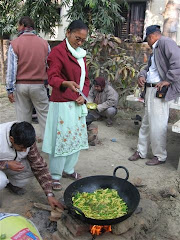
Mangoes (aap) in shades of yellow, orange, green and red are abundant and cheap, while grapes (angur) are now hard to find, and tangerines (suntala) are becoming expensive (45p/kg). Jacaranda trees are in full flower, creating a bluish haze in the sky and a scattering of lilac petals on the ground. The unseasonal rain has made the parks and gardens green and helped with the fragile water and electricity supply for the city. It’s becoming hotter and more humid, with frequent heavy downpours.
A visit to the clinic and a hefty dose of tinidazole seems to have eliminated Giardia and Entamoeba from my system. A fact of life here I think. The doctor says he ‘debugs’ himself every six months.
The VSO conference in a smart hotel with beautiful gardens and pool in the northern suburbs, surrounded by wooded hills, was an excellent mix of presentations, work input and discussion, activity based sessions, practical information, opportunities to get to know other volunteers, and fun. We had input from Andrew Hall, the British Ambassador (British ‘interests’!), CK Lal, a leading newspaper columnist – the press here (2 English language dailies, and many Nepali ones) is remarkably free given the political situation, Krishna, the general secretary of the main teachers’ union, and the wonderfully charismatic Sanjay Acharya (a high caste Brahmin) who runs an NGO setting up schools for Dalit children in rural areas. The caste system is so deeply embedded here, in spite of being illegal for more than 40 years, and is an added dimension in disadvantage and poverty. Although the Dalits make up 25% of the population, there is only one Dalit MP and many children are still denied access to education. Wednesday night’s party was a team event with a nautical theme (the Nepali office staff needed careful explanations!), but was a great success in getting everyone ‘on board’. Our team won the dance competition wearing pirate hats fashioned from newspaper performing an elaborate routine led by Dunstan, an exuberant Ugandan while Mick played the Captain Pugwash theme on the melodeon.
We now feel more than ready to start work. Julie, who is working in the DEO in the far west, tells us that the contrast between the Terai and Kathmandu is greater than the contrast between Kathmandu and London. On Monday we hope to meet our ‘partners’ for a planning day. We are hopeful that they will arrive, in spite of the strike that has now closed all the schools and government offices in the country. The government has not been able to meet effectively for more than a week and no decisions are being made. I have some carefully prepared sentences, which I have been practising with Nepali colleagues here, but ‘conversation’ is a big challenge. Most of the VSOs outside Kathmandu are working in Nepali or a Nepali / English mix most of the time, so we look forward to improving. We have tickets for the 10:30 flight to Biratnagar on Tuesday, but have just heard that the flight is cancelled. There should be one at 12:30. We have a hotel booking, a cheque from VSO to buy things for our home, an emergency ticket to get back to Kathmandu and some Indian rupees should we need to leave the country to India. Although we are only 5km from the border in Biratnagar, that border is closed to foreigners, so we have to travel 4 hours by bus along the Mahendra Highway – closed frequently by the Maoists, so that may not be a viable option. We had an ‘eastern cluster’ meeting yesterday to discuss our contingency plans – us and Ugandan Joseph in Biratnagar, with Etienne, a young Dutch volunteer based in Dharan, 40km north of us. Staying put seems the best option.
We are making the most of our last weekend in the city, with a visit to a Nepali theatre, a concert at the British School, farewell dinner with new VSO friends and plans to eat lots of cheese. However, I have just learnt from Rima whose husband is from Biratnagar, that it has the biggest cheese factory in Nepal!
Friday, 18 May 2007
Friday, 11 May 2007
End of Part One
On Saturday we managed to get to the final day of the ‘People at War’ photographic exhibition which has been touring Nepal with its haunting and frequently distressing photographs of the last ten years of conflict. When we reached the calm of the Patan Palace museum garden we had time to reflect on the selection, arrangement and captions of the photographs, which presented a powerful anti-Maoist, pro-government portrait. Hmm.
Patan Palace, in the midst of the spectacular buildings of Patan Durbar Square, has been beautifully restored and is now an excellent museum of Hindu and Buddhist religious art and artefacts. An excellent introduction to the many incarnations of the Hindu gods! The photographs of the square in1900 provided an insight into traditional Newari lifestyle, and apart from the destruction of some buildings in the 1934 earthquake and the invention of the motorbike, it looks remarkably similar to the way it is today.
Monday’s language proficiency test was a fairly free flowing conversation with a charming Nepali women who works as an international language trainer and assessor. Unfortunately my knowledge of grammatical structures, pronouns, postpositions, verb endings was lost in my enthusiasm to actually communicate on topics as diverse as teaching methodology in England and Ethiopia, a comparison of the status of women in England and Nepal, my response to the photographic exhibition (above), and David’s ‘habits’! Much relief when we were given feedback to find we were both in the ‘Intermediate – high’ category, “with some circumlocution to convey meaning, and evidence of some advanced structures”. There’s an end-of-term feeling, and our last task was a major shopping expedition to the market to buy ingredients for a Nepali feast that we cooked today. 20 cooks, many kilos of vegetables, lentils, paneer, chicken and rice, two gas rings and a rice cooker produced a spectacular meal by 2pm. We have a final evaluation on Sunday.
The next phase is about to begin – several of our group have already moved from the guest house into their own flats. We are ready to go and feel we have enough Nepali to find ourselves somewhere to live and meet colleagues at work. We have at last been given a departure date for Biratnagar – May 22, assuming the political situation does not change radically. Next week we will be at the annual VSO conference, and we are hoping that our new colleagues will come to Kathmandu for a briefing day on May 21. We have met several existing volunteers here this week; it’s been very useful to hear about their experiences in the more remote parts of Nepal. Our meeting with Purna (VSO Education Manager) has helped in that w have a very open brief ie to do whatever seems appropriate / possible! We look forward to the challenge! David is scrounging sturdy boxes in which to pack ‘essential items’ that he wants to buy here before we go. We’re not sure how we will get these boxes to Biratnagar, as luggage allowance is only 15kg!
Patan Palace, in the midst of the spectacular buildings of Patan Durbar Square, has been beautifully restored and is now an excellent museum of Hindu and Buddhist religious art and artefacts. An excellent introduction to the many incarnations of the Hindu gods! The photographs of the square in1900 provided an insight into traditional Newari lifestyle, and apart from the destruction of some buildings in the 1934 earthquake and the invention of the motorbike, it looks remarkably similar to the way it is today.
Monday’s language proficiency test was a fairly free flowing conversation with a charming Nepali women who works as an international language trainer and assessor. Unfortunately my knowledge of grammatical structures, pronouns, postpositions, verb endings was lost in my enthusiasm to actually communicate on topics as diverse as teaching methodology in England and Ethiopia, a comparison of the status of women in England and Nepal, my response to the photographic exhibition (above), and David’s ‘habits’! Much relief when we were given feedback to find we were both in the ‘Intermediate – high’ category, “with some circumlocution to convey meaning, and evidence of some advanced structures”. There’s an end-of-term feeling, and our last task was a major shopping expedition to the market to buy ingredients for a Nepali feast that we cooked today. 20 cooks, many kilos of vegetables, lentils, paneer, chicken and rice, two gas rings and a rice cooker produced a spectacular meal by 2pm. We have a final evaluation on Sunday.
The next phase is about to begin – several of our group have already moved from the guest house into their own flats. We are ready to go and feel we have enough Nepali to find ourselves somewhere to live and meet colleagues at work. We have at last been given a departure date for Biratnagar – May 22, assuming the political situation does not change radically. Next week we will be at the annual VSO conference, and we are hoping that our new colleagues will come to Kathmandu for a briefing day on May 21. We have met several existing volunteers here this week; it’s been very useful to hear about their experiences in the more remote parts of Nepal. Our meeting with Purna (VSO Education Manager) has helped in that w have a very open brief ie to do whatever seems appropriate / possible! We look forward to the challenge! David is scrounging sturdy boxes in which to pack ‘essential items’ that he wants to buy here before we go. We’re not sure how we will get these boxes to Biratnagar, as luggage allowance is only 15kg!

Saturday, 5 May 2007
More Nepali
Language continues – so many new grammatical structures, reams of new vocabulary, a notebook (kaapi) full of exercises, listening comprehensions, dictation in script, and most challenging of all a 20 minute 1:1 conversation with one of our teachers. I talked with Krishna (or more accurately, she asked me questions and I stumbled through some answers), but I did discover that she had lived in Biratnagar for 2 years. She was full of good advice: “keep under your mosquito net at all times” (I visualise myself riding my bicycle looking like a shrouded beekeeper), “always take a flashlight when you go to the charpi (toilet) to scare away the snakes” (we will be looking for an apartment with an inside charpi). We have (at last) learned some ‘weather’ vocabulary – I’m sure this would come earlier in an English language school. The weather in the late afternoon has been stormy this week, with some heavy rain, thunderstorms and wind strong enough to blow boxes through the air and trees down. In Pokhara, 3 people were killed by 1kg hailstones!
Walks to school have been enlivened by weddings this week – it is an auspicious time apparently – and the wedding day starts with the local band at the bride’s house. The band consists of a group of young men wearing ill-fitting red jackets with a variety of instruments that make a great deal of noise. Sometimes language lessons have to be halted until the noise stops.
While the Dutch were invited to a smart hotel for a day to celebrate their Queen’s birthday, we were only able to observe the celebrations for ours from outside the high, heavily guarded wall of the British Embassy. There were separate entrances for superior (red) and inferior (blue) people (or in the case of VSOs no entry). When we tried to sneak a look through the gates where a military band was playing, we were moved away at gunpoint.
‘Democracy day’ (April 24) – a year after the king gave up his power was marked by a public holiday, but not for us. The roads were relatively quiet, with offices and schools closed. Families were enjoying a day out; we were nearly run down (a frequent hazard) by a group of 5 on a motor bike, with a small girl dressed in sunglasses and flounced pink net party dress at the front. Inspite of the excitement about democracy and change, in reality nothing really seems to have happened in the last year, with increasing frustration, especially in the Terai.
April 25 saw the launch of the Global Campaign for Education and some of us attended a ‘solidarity’ rally in the centre of the city before school. Lots of school children in uniforms, ragged street children, some of whom now have access to informal education in the evenings, some teachers, lots of VSOs(!), organisers of local NGOs, the director of UNICEF and the State Minister of Education. Lots of speeches in Nepali, with particularly moving ones from street children demanding their right to a decent education. Powerful stuff.
Cultural events have included sessions on child marriage – still very common in rural areas, with horrendous figures for deaths in childbirth. The discussion centred around a very moving DVD that we watched upstairs from the language school, which occupies the ground floor of a Tibetan house. When we went upstairs, the male members of the family were sprawled on cushions in vest and pants watching the TV. A huge glass display cabinet occupying one wall contained many large bottles of different brands of whisky proudly flanking pictures of the Dalai Lama and other Tibetan memorabilia.
On Saturday we caught a bus to Bhaktapur, a world heritage site and the largest temple complex in Nepal, only 15km away. The journey took 2 ½ hours, partly because a banda (strike) had been called and the main road blocked. Our enterprising driver found a way through at his third attempt, across fields and pathways. It was good to get away from the traffic of the city and we had a delightful weekend wandering through the ancient temples and the artisans’ areas with potters, wood and stone carvers and metal workers, observing an impassioned Maoist rally in one of the old squares, watching the night market and the evening puja at the temples. On Sunday morning we walked across the river and into the hills to the Ganesh temple where wedding couples came for blessings to ensure their children will be healthy.
A challenge at the beginning of this week was a specific brief to talk to ’real people’. While David got a taxi (with an English speaking driver) to the eastern bus park to check out bus times (he found an English speaking and signed counter), I was expected to talk to local girls about their education and their family. Not as easy as it sounds. As I approached a pair of little girls in smart maroon and blue uniforms, a young heifer from outside the hotel escaped and ran amok through the building site, causing everyone to scatter in an attempt to avoid both heifer and the large puddles that had collected during the morning rain. The next girl I met and spoke to, looked horrified, then laughed and ran away. With Alina, aged 11, I did rather better, after she understood that I was actually trying to speak Nepali. I then decided to try slightly older girls. The trio I homed in on turned out to be 21 (they looked about 14) and studying for degrees in hotel management. Rashima’s father has a restaurant in Bournemouth, and we were able to chat in both English and limited Nepali. Homework siddhiyo!
On Buddha’s birthday (this year on May 2, to coincide with the new moon) a group of us went out to Boudanath after school to join the celebrations. Thousands of Buddhists were walking around the stupa chanting and twirling prayer wheels: an assortment of maroon and orange clad monks, young Tibetan women in splendid new stripy ‘aprons’, tiny, shaven nuns in saffron robes, young men in jeans and football shirts, business men with brief cases, young monks prostrating themselves every 2 steps for the ritual 26 circuits (special ‘prostration boards’ were available for hire). As darkness fell, the moon rose and the stupa was illuminated by thousands of jhillimilli (coloured lights) and traditional diyo (butter lamps). We watched until late in the evening from the roof top of the Saturday café, sipping lemon sodas and eating fresh strawberry sorbet (unlikely but true!)
Tonight we are going to the Friday movie at the Lazimpat Arts Café to see ‘To kill a mockingbird’ (again). All the latest films arrive here eventually!
The challenge for this weekend is revision, as we learnt today that external assessors will come on Monday & Tuesday for our ‘SATs’. We will all be examined for 30 minutes individually and then levelled.
Walks to school have been enlivened by weddings this week – it is an auspicious time apparently – and the wedding day starts with the local band at the bride’s house. The band consists of a group of young men wearing ill-fitting red jackets with a variety of instruments that make a great deal of noise. Sometimes language lessons have to be halted until the noise stops.
While the Dutch were invited to a smart hotel for a day to celebrate their Queen’s birthday, we were only able to observe the celebrations for ours from outside the high, heavily guarded wall of the British Embassy. There were separate entrances for superior (red) and inferior (blue) people (or in the case of VSOs no entry). When we tried to sneak a look through the gates where a military band was playing, we were moved away at gunpoint.
‘Democracy day’ (April 24) – a year after the king gave up his power was marked by a public holiday, but not for us. The roads were relatively quiet, with offices and schools closed. Families were enjoying a day out; we were nearly run down (a frequent hazard) by a group of 5 on a motor bike, with a small girl dressed in sunglasses and flounced pink net party dress at the front. Inspite of the excitement about democracy and change, in reality nothing really seems to have happened in the last year, with increasing frustration, especially in the Terai.
April 25 saw the launch of the Global Campaign for Education and some of us attended a ‘solidarity’ rally in the centre of the city before school. Lots of school children in uniforms, ragged street children, some of whom now have access to informal education in the evenings, some teachers, lots of VSOs(!), organisers of local NGOs, the director of UNICEF and the State Minister of Education. Lots of speeches in Nepali, with particularly moving ones from street children demanding their right to a decent education. Powerful stuff.
Cultural events have included sessions on child marriage – still very common in rural areas, with horrendous figures for deaths in childbirth. The discussion centred around a very moving DVD that we watched upstairs from the language school, which occupies the ground floor of a Tibetan house. When we went upstairs, the male members of the family were sprawled on cushions in vest and pants watching the TV. A huge glass display cabinet occupying one wall contained many large bottles of different brands of whisky proudly flanking pictures of the Dalai Lama and other Tibetan memorabilia.
On Saturday we caught a bus to Bhaktapur, a world heritage site and the largest temple complex in Nepal, only 15km away. The journey took 2 ½ hours, partly because a banda (strike) had been called and the main road blocked. Our enterprising driver found a way through at his third attempt, across fields and pathways. It was good to get away from the traffic of the city and we had a delightful weekend wandering through the ancient temples and the artisans’ areas with potters, wood and stone carvers and metal workers, observing an impassioned Maoist rally in one of the old squares, watching the night market and the evening puja at the temples. On Sunday morning we walked across the river and into the hills to the Ganesh temple where wedding couples came for blessings to ensure their children will be healthy.
A challenge at the beginning of this week was a specific brief to talk to ’real people’. While David got a taxi (with an English speaking driver) to the eastern bus park to check out bus times (he found an English speaking and signed counter), I was expected to talk to local girls about their education and their family. Not as easy as it sounds. As I approached a pair of little girls in smart maroon and blue uniforms, a young heifer from outside the hotel escaped and ran amok through the building site, causing everyone to scatter in an attempt to avoid both heifer and the large puddles that had collected during the morning rain. The next girl I met and spoke to, looked horrified, then laughed and ran away. With Alina, aged 11, I did rather better, after she understood that I was actually trying to speak Nepali. I then decided to try slightly older girls. The trio I homed in on turned out to be 21 (they looked about 14) and studying for degrees in hotel management. Rashima’s father has a restaurant in Bournemouth, and we were able to chat in both English and limited Nepali. Homework siddhiyo!
On Buddha’s birthday (this year on May 2, to coincide with the new moon) a group of us went out to Boudanath after school to join the celebrations. Thousands of Buddhists were walking around the stupa chanting and twirling prayer wheels: an assortment of maroon and orange clad monks, young Tibetan women in splendid new stripy ‘aprons’, tiny, shaven nuns in saffron robes, young men in jeans and football shirts, business men with brief cases, young monks prostrating themselves every 2 steps for the ritual 26 circuits (special ‘prostration boards’ were available for hire). As darkness fell, the moon rose and the stupa was illuminated by thousands of jhillimilli (coloured lights) and traditional diyo (butter lamps). We watched until late in the evening from the roof top of the Saturday café, sipping lemon sodas and eating fresh strawberry sorbet (unlikely but true!)
Tonight we are going to the Friday movie at the Lazimpat Arts Café to see ‘To kill a mockingbird’ (again). All the latest films arrive here eventually!
The challenge for this weekend is revision, as we learnt today that external assessors will come on Monday & Tuesday for our ‘SATs’. We will all be examined for 30 minutes individually and then levelled.
Monday, 23 April 2007
Temples and mountains
Temples and mountains
Our cultural activity this week was a visit to Pashupatinath, an important Shiva temple and cremation site. It resembled a school outing as we were bundled into taxis to take us across the city to meet in front of the huge temple complex, with the usual array of stall holders, souvenir sellers, flowers, fruit and young men wanting to act as guides and be suitable rewarded afterwards. The Bagmati river is to Nepali Hindus what the Ganges is for Indians. A filthy trickle (it’s the dry season) flows through the temple site. Our arrival coincided with a coffin, and the body was then ritually bathed in the water before being taken to a burning platform, Several bodies were already smouldering. The burning ghats to the left of the entrance are traditionally reserved for the royal family, but last week a leading Maoist was burnt there, a symbol of the new ‘democratic’ Nepal. (We heard today that the election scheduled for June 20 will be delayed.) We climbed up through rows of stupas, where saddhus sat and monkeys frolicked and sat and watched what was happening below, with explanations from our teachers and the young men we hadn’t managed to shake off. While everyone else went to lunch, we walked on with Laura, newly arrived from VSO Rwanda to Boudhanath, a huge Buddhist stupa with surrounding monasteries. After a brief diversion to a Tibetan carpet factory, we followed the monks and Tibetan women in their striped aprons clockwise round the stupa, then sat overlooking the stupa and drank many cups of coffee before wandering through the back lanes to the Senchen monastery for supper. The evening music and chanting was wonderful, with big drums, long horns and conch shells. Hundreds of kilos of chamal (uncooked rice), kilos of fruit and packets of biscuits were donated and shared among the monks at the end of the prayers.
On Friday, having successfully survived our ‘mid-term evaluation’, we left school a bit early during a riotous and highly competitive game of pictionary in Nepali, devised by our teachers for the 9 of us still fit and well (diet and dust are taking their toll). A nearby hotel provides a free shuttle to their hotel at Nagarkot, perched on a high ridge 35km from Kathmandu, and gives a VSO discount . We were given the feature room Sagarmatha (Mt Everest) with spectacular views over the Kathmandu valley to the Himalayas beyond. What luxury! A long hot bath (the first since leaving England), listening to music on the MP3 and speakers (thanks Richard!), delicious dinner, moon, stars and a silent night. We got up (briefly) at dawn for the sunrise, and tried to make out the mountains, but decided that the snowy peaks were clouds. After breakfast we walked to the centre of the village, and saw many buses heading uphill, full of women, children and old men, with far more young people on top, waving huge red hammer-and sickle flags and cheering. A Maoist picnic outing! We caught the local bus, which wobbled precariously down the hairpin bends, as far as Telkot. Biswas, a young student on the bus, showed us the way to Changu Narayan, and we enjoyed a wonderful ridge walk, through steeply terraced fields with ripening wheat and barley, soon to be harvested, and replanted with rice after the monsoon rains. The village houses are 3 or 4 storeys tall, with intricately carved wooden windows; animals and an eating area downstairs, sitting and sleeping above, and kitchen and a prayer room at the top. Changu Narayan has apparently been a World Heritage site for the last 10 years, but there are no signs to indicate this, and it appeared to be an adventure playground for local children eating lollies. It’s a curious fusion of north Indian Hindu temple architecture and the Buddhist temples of Laos. Ominous thunderclouds were building and huge spots of rain started as we found the way to the bus. We were able to get a seat, but after a couple of kilometres, David had acquired a small girl on his lap and I had an old woman and a sack of potatoes on mine. We managed to extricate ourselves on the outskirts of Bhaktapur, where we had been told we would find the Nagarkot bus. We didn’t. However, after 20 minutes of walking and asking ‘Nagarkot janne bus kahaa chha?’ we were successful and managed to squeeze onto the back seat with Bishal and his mother Laxmi. Bishal is nine, and grew increasingly confident as he corrected our Nepali pronunciation and verb endings, and encouraged by his mother, practised his English. The 15km journey took 1½ hours through thunder, lightening and heavy rain. After a restorative bath and dinner, we slept through the storm until woken by a cuckoo at 05:10. The spectacular sunrise turned the cloud filled valley apricot – but still no Himalayas. I have just written an account of our weekend in Nepali. I think Bishal would have done better.
Our cultural activity this week was a visit to Pashupatinath, an important Shiva temple and cremation site. It resembled a school outing as we were bundled into taxis to take us across the city to meet in front of the huge temple complex, with the usual array of stall holders, souvenir sellers, flowers, fruit and young men wanting to act as guides and be suitable rewarded afterwards. The Bagmati river is to Nepali Hindus what the Ganges is for Indians. A filthy trickle (it’s the dry season) flows through the temple site. Our arrival coincided with a coffin, and the body was then ritually bathed in the water before being taken to a burning platform, Several bodies were already smouldering. The burning ghats to the left of the entrance are traditionally reserved for the royal family, but last week a leading Maoist was burnt there, a symbol of the new ‘democratic’ Nepal. (We heard today that the election scheduled for June 20 will be delayed.) We climbed up through rows of stupas, where saddhus sat and monkeys frolicked and sat and watched what was happening below, with explanations from our teachers and the young men we hadn’t managed to shake off. While everyone else went to lunch, we walked on with Laura, newly arrived from VSO Rwanda to Boudhanath, a huge Buddhist stupa with surrounding monasteries. After a brief diversion to a Tibetan carpet factory, we followed the monks and Tibetan women in their striped aprons clockwise round the stupa, then sat overlooking the stupa and drank many cups of coffee before wandering through the back lanes to the Senchen monastery for supper. The evening music and chanting was wonderful, with big drums, long horns and conch shells. Hundreds of kilos of chamal (uncooked rice), kilos of fruit and packets of biscuits were donated and shared among the monks at the end of the prayers.
On Friday, having successfully survived our ‘mid-term evaluation’, we left school a bit early during a riotous and highly competitive game of pictionary in Nepali, devised by our teachers for the 9 of us still fit and well (diet and dust are taking their toll). A nearby hotel provides a free shuttle to their hotel at Nagarkot, perched on a high ridge 35km from Kathmandu, and gives a VSO discount . We were given the feature room Sagarmatha (Mt Everest) with spectacular views over the Kathmandu valley to the Himalayas beyond. What luxury! A long hot bath (the first since leaving England), listening to music on the MP3 and speakers (thanks Richard!), delicious dinner, moon, stars and a silent night. We got up (briefly) at dawn for the sunrise, and tried to make out the mountains, but decided that the snowy peaks were clouds. After breakfast we walked to the centre of the village, and saw many buses heading uphill, full of women, children and old men, with far more young people on top, waving huge red hammer-and sickle flags and cheering. A Maoist picnic outing! We caught the local bus, which wobbled precariously down the hairpin bends, as far as Telkot. Biswas, a young student on the bus, showed us the way to Changu Narayan, and we enjoyed a wonderful ridge walk, through steeply terraced fields with ripening wheat and barley, soon to be harvested, and replanted with rice after the monsoon rains. The village houses are 3 or 4 storeys tall, with intricately carved wooden windows; animals and an eating area downstairs, sitting and sleeping above, and kitchen and a prayer room at the top. Changu Narayan has apparently been a World Heritage site for the last 10 years, but there are no signs to indicate this, and it appeared to be an adventure playground for local children eating lollies. It’s a curious fusion of north Indian Hindu temple architecture and the Buddhist temples of Laos. Ominous thunderclouds were building and huge spots of rain started as we found the way to the bus. We were able to get a seat, but after a couple of kilometres, David had acquired a small girl on his lap and I had an old woman and a sack of potatoes on mine. We managed to extricate ourselves on the outskirts of Bhaktapur, where we had been told we would find the Nagarkot bus. We didn’t. However, after 20 minutes of walking and asking ‘Nagarkot janne bus kahaa chha?’ we were successful and managed to squeeze onto the back seat with Bishal and his mother Laxmi. Bishal is nine, and grew increasingly confident as he corrected our Nepali pronunciation and verb endings, and encouraged by his mother, practised his English. The 15km journey took 1½ hours through thunder, lightening and heavy rain. After a restorative bath and dinner, we slept through the storm until woken by a cuckoo at 05:10. The spectacular sunrise turned the cloud filled valley apricot – but still no Himalayas. I have just written an account of our weekend in Nepali. I think Bishal would have done better.
Saturday, 14 April 2007
Another week
Weekend
On Saturday morning we walked out of the city to Swayambhunath temple, finding our way through narrow back streets, where hand carts became more common than cars and motorbikes, then through a stretch of countryside. The temple is on a high hill, so even we could not get lost The long climb up to the temple through leafy trees and stalls was swarming with well fed monkeys and poorly nourished children. It’s a curious mixture of Buddhist and Hindu, with Buddhas, prayer wheels and prayer flags, many stupas and an array of familiar Hindu figures. We escaped the throngs of Nepalis and a few scantily dressed tourists in the old Buddhist monastery where monks were saying prayers, and we sat peacefully until they had finished and came to talk with us. We were warmly welcomed and able to converse in halting Nepali. In the afternoon, the ‘old’ VSOs had organised a ‘treasure hunt’ for the newcomers, which was great fun and helped us get to know each other as well as test our knowledge of the city and give us some more language practice. We discovered many hidden temples, little squares and beautiful old buildings behind the tourist facades. My Nepali is now acknowledged, and I am frequently addressed as ‘didii’ – literally ‘big sister’, and preferable to the ‘mama’ I often called in Africa! Many words are very similar and differ only in emphasis of a letter, so didii is remarkably like didi which means greenfly! The end point was the Buddha bar, where drinks and more ‘snacks’ (little fried bits of which Nepalis are very fond) were waiting. The evening was made more dramatic by heavy thunder showers, which helped clear the air and settle the dust.
A beautiful bright morning on Sunday, but the snowy peaks sometimes visible from the top of the guest house were still obscured by a haze of pollution. We spent a wonderfully relaxing morning in the lovely garden of the Manaslau hotel, surrounded by a hedge of sweet peas, swimming in the cool waters of a big blue mosaic pool, fed by spouting Hindu figures. Lovely to get some sun, and catch up on homework and reading. In the afternoon we were invited to Kumbeshwar Technical School where Jan from B-on-A had been a VSO almost 20 years ago. Kiran’s (the current director) father had founded the school to provide basic education for local untouchables, and it now has a small orphanage, primary school for 260 children and a technical school for carpentry, carpet weaving and knitting, with nearly 500 women knitting in their homes and in the women’s prison. The products are exported through People Tree to Europe and America. An extraordinary achievement. We were able to meet several of the knitters, the boys in the woodwork shop, several weavers, a young blind man ‘rescued’ from the streets who had just completed his first carpet, and the women attending a basic literacy class. We talked and played with the children in the orphanage, who initially were very shy and stared at us with huge brown eyes. Later we climbed the stairs to the top floor of the family house, where four generations of the extended family live, and shared their daal bhaat (rice, dhal and vegetables) dinner. Hajur baa and hajur aamaa (grandparents) speak no English and cackled delightedly at our attempts to converse in Nepali. I know we will return before we leave Kathmandu.
Walking to school
We love the walk to the language school each morning and are already getting to know some of the people we meet on our way. First across the building site, and right at the Nest café. Marijuana plants grow in profusion by the roadside. On past the Kid’s Paradise Montessori school and the New Wanted bakery, before turning left into a busy road, lined with ‘general’ stores. Across from the Guarantee Pile Treatment Centre we take a flight of steps up to a small Hindu temple, and then through a small vegetable market. The path goes straight through the next, larger Ganesh temple, with drums cymbals and bells every morning and many local people with prasad (offerings) for the elephant god. We have to negotiate an expanse of waste ground busy with fruit stalls, men selling ice cream from tin boxes on the back of bicycles, cycle rickshaws, old taxis, piles of stones and rubbish skips before entering a lane with a dairy. Several men in wellingtons are packing milk into plastic bags as we pass in the morning. By lunchtime the little shop is stocked with slices of yak cheese, paneer, jars of ghee and small pots of bright yellow yoghurt. On our way home the butter is being scooped out of a tin drum by hand and pushed into a wooden mould before being wrapped and stacked. Next come several shops selling stationery and school books. We especially like the ‘New Golden Guess exam papers’ series, which seem to be multiple choice questions. Finally a left turn by the Snow Farm all vegetarian ice cream parlour gets us to school.
The week
We have settled into a comfortable routine, starting with curd and muesli sitting on cushions at the guest house, leaving about 8:40 to walk to school. The language is progressing very well, and we have been ‘setted’ this week. Our hard work before we left has earned us places in the top set, with Pradipta, who speaks Hindi and a bright young Dutch volunteer, Kors. We are now working very fast, in both transliteration and Devanagari script. Some afternoons we have a break from intensive language for cultural and etiquette lessons. Wednesday’s ‘toilet training’ ie using a squat toilet and bathing in public reduced those unused to such things to hysteria. On Friday we learnt lots of food and eating vocabulary in the morning, and walked to a Nepali restaurant for lunch where we were able to practice ordering food, giving compliments, eating with our right hand while sitting cross legged on the floor, and drinking without the bottle or glass touching our lips (wet!). Evenings are spent doing homework (lots!), shopping, chatting, and finding interesting local places to eat. I ordered my first kurta surwaal yesterday from a tailor nearby, who has just received her new summer materials. Spread on the floor, the contrasting colours making up the 3 piece set are amazing. On reflection, I suspect I will resemble a Christmas tree when the outfit is completed! I’ve also discovered a shop selling Anoukhi fabric in the bazaar, so if the first outfit is successful, there will be more. The ‘set’ – trousers, long top and scarf costs £5 –8. Nepalis like us to wear traditional clothes, and I suspect Biratnagar will be more conservative than Kathmandu. Yesterday was New Year’s Eve, and we went to a party and then ate in an Indian restaurant with splendid balloons, decorations and a Christmas tree! Today is 1st Baisakh 2064.
nayaa barsha shubhakamanaa!
On Saturday morning we walked out of the city to Swayambhunath temple, finding our way through narrow back streets, where hand carts became more common than cars and motorbikes, then through a stretch of countryside. The temple is on a high hill, so even we could not get lost The long climb up to the temple through leafy trees and stalls was swarming with well fed monkeys and poorly nourished children. It’s a curious mixture of Buddhist and Hindu, with Buddhas, prayer wheels and prayer flags, many stupas and an array of familiar Hindu figures. We escaped the throngs of Nepalis and a few scantily dressed tourists in the old Buddhist monastery where monks were saying prayers, and we sat peacefully until they had finished and came to talk with us. We were warmly welcomed and able to converse in halting Nepali. In the afternoon, the ‘old’ VSOs had organised a ‘treasure hunt’ for the newcomers, which was great fun and helped us get to know each other as well as test our knowledge of the city and give us some more language practice. We discovered many hidden temples, little squares and beautiful old buildings behind the tourist facades. My Nepali is now acknowledged, and I am frequently addressed as ‘didii’ – literally ‘big sister’, and preferable to the ‘mama’ I often called in Africa! Many words are very similar and differ only in emphasis of a letter, so didii is remarkably like didi which means greenfly! The end point was the Buddha bar, where drinks and more ‘snacks’ (little fried bits of which Nepalis are very fond) were waiting. The evening was made more dramatic by heavy thunder showers, which helped clear the air and settle the dust.
A beautiful bright morning on Sunday, but the snowy peaks sometimes visible from the top of the guest house were still obscured by a haze of pollution. We spent a wonderfully relaxing morning in the lovely garden of the Manaslau hotel, surrounded by a hedge of sweet peas, swimming in the cool waters of a big blue mosaic pool, fed by spouting Hindu figures. Lovely to get some sun, and catch up on homework and reading. In the afternoon we were invited to Kumbeshwar Technical School where Jan from B-on-A had been a VSO almost 20 years ago. Kiran’s (the current director) father had founded the school to provide basic education for local untouchables, and it now has a small orphanage, primary school for 260 children and a technical school for carpentry, carpet weaving and knitting, with nearly 500 women knitting in their homes and in the women’s prison. The products are exported through People Tree to Europe and America. An extraordinary achievement. We were able to meet several of the knitters, the boys in the woodwork shop, several weavers, a young blind man ‘rescued’ from the streets who had just completed his first carpet, and the women attending a basic literacy class. We talked and played with the children in the orphanage, who initially were very shy and stared at us with huge brown eyes. Later we climbed the stairs to the top floor of the family house, where four generations of the extended family live, and shared their daal bhaat (rice, dhal and vegetables) dinner. Hajur baa and hajur aamaa (grandparents) speak no English and cackled delightedly at our attempts to converse in Nepali. I know we will return before we leave Kathmandu.
Walking to school
We love the walk to the language school each morning and are already getting to know some of the people we meet on our way. First across the building site, and right at the Nest café. Marijuana plants grow in profusion by the roadside. On past the Kid’s Paradise Montessori school and the New Wanted bakery, before turning left into a busy road, lined with ‘general’ stores. Across from the Guarantee Pile Treatment Centre we take a flight of steps up to a small Hindu temple, and then through a small vegetable market. The path goes straight through the next, larger Ganesh temple, with drums cymbals and bells every morning and many local people with prasad (offerings) for the elephant god. We have to negotiate an expanse of waste ground busy with fruit stalls, men selling ice cream from tin boxes on the back of bicycles, cycle rickshaws, old taxis, piles of stones and rubbish skips before entering a lane with a dairy. Several men in wellingtons are packing milk into plastic bags as we pass in the morning. By lunchtime the little shop is stocked with slices of yak cheese, paneer, jars of ghee and small pots of bright yellow yoghurt. On our way home the butter is being scooped out of a tin drum by hand and pushed into a wooden mould before being wrapped and stacked. Next come several shops selling stationery and school books. We especially like the ‘New Golden Guess exam papers’ series, which seem to be multiple choice questions. Finally a left turn by the Snow Farm all vegetarian ice cream parlour gets us to school.
The week
We have settled into a comfortable routine, starting with curd and muesli sitting on cushions at the guest house, leaving about 8:40 to walk to school. The language is progressing very well, and we have been ‘setted’ this week. Our hard work before we left has earned us places in the top set, with Pradipta, who speaks Hindi and a bright young Dutch volunteer, Kors. We are now working very fast, in both transliteration and Devanagari script. Some afternoons we have a break from intensive language for cultural and etiquette lessons. Wednesday’s ‘toilet training’ ie using a squat toilet and bathing in public reduced those unused to such things to hysteria. On Friday we learnt lots of food and eating vocabulary in the morning, and walked to a Nepali restaurant for lunch where we were able to practice ordering food, giving compliments, eating with our right hand while sitting cross legged on the floor, and drinking without the bottle or glass touching our lips (wet!). Evenings are spent doing homework (lots!), shopping, chatting, and finding interesting local places to eat. I ordered my first kurta surwaal yesterday from a tailor nearby, who has just received her new summer materials. Spread on the floor, the contrasting colours making up the 3 piece set are amazing. On reflection, I suspect I will resemble a Christmas tree when the outfit is completed! I’ve also discovered a shop selling Anoukhi fabric in the bazaar, so if the first outfit is successful, there will be more. The ‘set’ – trousers, long top and scarf costs £5 –8. Nepalis like us to wear traditional clothes, and I suspect Biratnagar will be more conservative than Kathmandu. Yesterday was New Year’s Eve, and we went to a party and then ate in an Indian restaurant with splendid balloons, decorations and a Christmas tree! Today is 1st Baisakh 2064.
nayaa barsha shubhakamanaa!
Sunday, 8 April 2007
First week
Tuesday April 3 9pm
Lying on the bed listening to Sherlock Holmes on the World Service and eating grapes. We are getting into a comfortable routine now, but in a few weeks I am sure we will be desperate to find a home of our own and be able to cook for ourselves. Karma is used to healthy eating veggie volunteers and is able to provide yoghurt, fruit and muesli for breakfast. The yoghurt comes in clay bowls, ranging in size from the circumference of a dustbin to that of a teacup. There is plentiful fruit (apples, tangerines, bananas, and grapes are in season, pineapples and mangoes just starting) and we buy a selection for our lunch each day. There and there are many small restaurants near the hotel serving local food. The current gas shortage as a result of the frequent transport strikes means many have to limit their opening hours and some are now closed altogether. In nearby tourist Thamel there are hundreds of restaurants with menus from all over the world at inflated prices.
We have 5 intensive hours of language teaching each day. Amita, my teacher this week (the youngest member of our group of 5), is excellent and it is good to experience the ‘communicative technique’ – no English or translation allowed. We move so fast and I am so pleased with the efforts we made before we came. I have finished my homework for this evening.
We had a language free day on Monday at the VSO office, situated in a beautiful house in the south of the city. Good resources, library and fast internet, but it is far from anywhere and difficult to find so it is not used much by volunteers. The staff were helpful, and we were overloaded with information and lunch, as a result of which 3 of our group were sick today. It will be very different from Ethiopia, when we were used to being in the office at least once a week when we were in Addis.
After work today, we took a taxi south to Patan, and followed (or tried to) the Lonely Planet route through old Patan. SatNav would have been very helpful. We followed tiny alleys with old 5 storey brick houses and elaborately carved balconies that led to open courtyards with shrines and temples. There were plenty of opportunities to practice our Nepali to get us back on track. We spent an enjoyable hour sitting in Kumbeshwar temple, surrounded by sheep, goats, and ragged children, watching women in bright saris, young people in jeans and T shirts, smartly dressed men with briefcases on their way home from work all coming for evening puja (prayers). Eventually we found our way to the magnificent Patan Durbar - as we approached there were tourist shops selling brassware, and a rickety ladder leading to a broadband internet café. The square was full of market traders, selling everything from temple paraphernalia to candyfloss and big knickers. We ate momos 5 floors up watching the lights go on in the square, a parade and band, practising our Nepali on the waiter, who had a remarkable knowledge of ‘literature’ from Milton and Shakespeare, to George Bernard Shaw and Rabindranath Tagore.
The attitude to volunteering here is very different to the incomprehension we encountered in Ethiopia. Here ‘ma swayamsewak hun’ immediately earns a friendly smile, no hassle to buy or inflated prices from shopkeepers, free entry to tourist sites and 10% off the bill in many of the smarter restaurants in Thamel. The hotel staff, local shopkeepers and people we meet in the streets are endlessly patient and helpful as we practice our language.
Friday April 6
We have visited the International Clinic today, a small house in a back street specialising in help for tourists and mountaineers. There was a group of young medical students there about to set off for Everest base camp to do some research into high altitude medicine. Dr Bashan was very reassuring about potential problems; frequent bouts of bacterial diarrhoea are common, followed by respiratory (the dust and pollution in the city are terrible) and skin problems. He tells us that Biratnagar is lovely, but very hot, and that the bicycle is still the main form of transport. We look forward to getting away from Kathmandu traffic. The evening was spent at our welcome party in the Decheling tea garden, starting with ‘snacks’ of which Nepali are very fond at 5:30pm. Most of the Kathmandu volunteers were there, and we met Joseph, the Ugandan volunteer from Biratnagar – he is delightful, and Biratnagar sounds like our kind of place. He is already looking for a house for us and for a couple of second-hand bicycles. The evening traffic jams consist of ox carts and bicycles, which after the horrible pollution and traffic here will be a welcome relief.
Lying on the bed listening to Sherlock Holmes on the World Service and eating grapes. We are getting into a comfortable routine now, but in a few weeks I am sure we will be desperate to find a home of our own and be able to cook for ourselves. Karma is used to healthy eating veggie volunteers and is able to provide yoghurt, fruit and muesli for breakfast. The yoghurt comes in clay bowls, ranging in size from the circumference of a dustbin to that of a teacup. There is plentiful fruit (apples, tangerines, bananas, and grapes are in season, pineapples and mangoes just starting) and we buy a selection for our lunch each day. There and there are many small restaurants near the hotel serving local food. The current gas shortage as a result of the frequent transport strikes means many have to limit their opening hours and some are now closed altogether. In nearby tourist Thamel there are hundreds of restaurants with menus from all over the world at inflated prices.
We have 5 intensive hours of language teaching each day. Amita, my teacher this week (the youngest member of our group of 5), is excellent and it is good to experience the ‘communicative technique’ – no English or translation allowed. We move so fast and I am so pleased with the efforts we made before we came. I have finished my homework for this evening.
We had a language free day on Monday at the VSO office, situated in a beautiful house in the south of the city. Good resources, library and fast internet, but it is far from anywhere and difficult to find so it is not used much by volunteers. The staff were helpful, and we were overloaded with information and lunch, as a result of which 3 of our group were sick today. It will be very different from Ethiopia, when we were used to being in the office at least once a week when we were in Addis.
After work today, we took a taxi south to Patan, and followed (or tried to) the Lonely Planet route through old Patan. SatNav would have been very helpful. We followed tiny alleys with old 5 storey brick houses and elaborately carved balconies that led to open courtyards with shrines and temples. There were plenty of opportunities to practice our Nepali to get us back on track. We spent an enjoyable hour sitting in Kumbeshwar temple, surrounded by sheep, goats, and ragged children, watching women in bright saris, young people in jeans and T shirts, smartly dressed men with briefcases on their way home from work all coming for evening puja (prayers). Eventually we found our way to the magnificent Patan Durbar - as we approached there were tourist shops selling brassware, and a rickety ladder leading to a broadband internet café. The square was full of market traders, selling everything from temple paraphernalia to candyfloss and big knickers. We ate momos 5 floors up watching the lights go on in the square, a parade and band, practising our Nepali on the waiter, who had a remarkable knowledge of ‘literature’ from Milton and Shakespeare, to George Bernard Shaw and Rabindranath Tagore.
The attitude to volunteering here is very different to the incomprehension we encountered in Ethiopia. Here ‘ma swayamsewak hun’ immediately earns a friendly smile, no hassle to buy or inflated prices from shopkeepers, free entry to tourist sites and 10% off the bill in many of the smarter restaurants in Thamel. The hotel staff, local shopkeepers and people we meet in the streets are endlessly patient and helpful as we practice our language.
Friday April 6
We have visited the International Clinic today, a small house in a back street specialising in help for tourists and mountaineers. There was a group of young medical students there about to set off for Everest base camp to do some research into high altitude medicine. Dr Bashan was very reassuring about potential problems; frequent bouts of bacterial diarrhoea are common, followed by respiratory (the dust and pollution in the city are terrible) and skin problems. He tells us that Biratnagar is lovely, but very hot, and that the bicycle is still the main form of transport. We look forward to getting away from Kathmandu traffic. The evening was spent at our welcome party in the Decheling tea garden, starting with ‘snacks’ of which Nepali are very fond at 5:30pm. Most of the Kathmandu volunteers were there, and we met Joseph, the Ugandan volunteer from Biratnagar – he is delightful, and Biratnagar sounds like our kind of place. He is already looking for a house for us and for a couple of second-hand bicycles. The evening traffic jams consist of ox carts and bicycles, which after the horrible pollution and traffic here will be a welcome relief.
Sunday, 1 April 2007
First impressions
Flying from Delhi over the grey brown expanse of the north Indian plains. Slowly the landscape changes to small terraced fields and vibrant green rice paddies. The horizon to the north is what appears to be huge banks of cumulus cloud, but as we get closer the jagged snowy shapes of mountain tops start to appear, and we fly parallel to the magnificent mountain range before descending through the foothills into what seems to be the centre of Kathmandu. We are greeted by VSO staff, festooned with marigold and cornflowers garlands, and bussed through narrow streets lined with stalls selling everything from toothpaste to TVs, avoiding cows, stray dogs and children (we learn later that this was the ring road). We arrive at the Pacific (as in peaceful, not ocean) Guest House, run by a helpful Buddhist family, which is to be our home for the next few weeks. We have a big room, with screened windows on two sides, frayed carpet and curtains, a few pieces of rickety wooden furniture, and a narrow bathroom, where the drain for the shower is downhill (an unusual advantage) and there is hot water from the solar panels on the roof amongst the Buddhist prayer flags. Its tempting to spend the afternoon observing from the balcony, as we overlook what appears to be a rubbish dump, but closer inspection reveals rag pickers, a cricket game, children flying kites, a small 'farmyard' with 2 cows, 3 goats and sheep, with a dung patties covered wall behind. There is a steady procession of people – women in brightly coloured saris, old men with bow legs and embroidered caps, school boys in smart striped shirts, small children leading brown sheep on lengths of string. Poles are festooned with electric wires, conveniently looped at head height for easy maintenance. In the distance we can see foothills of the mountains.
Our group is a mixture of different nationalities and ages – we are probably oldest - from England, Australia, the Netherlands, Spain, the Philippines, India and Uganda. Most of the Eurpeans arrived with us. We have our usual orientation evening wandering the local streets, going into shops, talking to people. Already it begins to feel like home (and we are excited by the potential furnishings for the house!) A gentle couple of days before we start at the language school on Sunday – a six day week here, with only Saturdays free.
We have explored the tourist area of Thamel, lined with shops selling trekking equipment, souvenirs, textiles, clothes and jewellery, visited the magnificent Kathmandu Durbar Square, and have lost ourselves in the back streets around our hotel. We are just outside the tourist area, so it seems relatively peaceful. However, after dark the dogs that sleep in the sun all day start an amazing symphonic performance that continues on and off til dawn. The music at the Hindu temple starts at 5am, and by 6 the builders are delivering materials opposite.
Sunday. We started Language School today - a 15 minute walk through the back lanes, threading our way between cows, motorcycles, bikes, rickshaws, dogs and children, through a temple complex and a left turn by an ice cream shop leads us to the apartment block where the school issituated. Will we find it again tomorrow? We sit cross legged on cushions on the floor (until the knee joints can't take it any longer. Showing the soles of one's feet is taboo in Nepali culture, so we have to be very caredful!) The first day was for us a revision of vocabulary we already knew, but it has been very helpful to speak with native Nepali speakers to try and get the sounds right. Perhaps the stall holders will not look at us with total incomprehension tomorrow! Pradeep and Silke speak Hindi so are well ahead. We have 5 teachers for 16 of us, so will get lots of help and the opportunity to work at our own pace. I love being back in a classroom!
Our group is a mixture of different nationalities and ages – we are probably oldest - from England, Australia, the Netherlands, Spain, the Philippines, India and Uganda. Most of the Eurpeans arrived with us. We have our usual orientation evening wandering the local streets, going into shops, talking to people. Already it begins to feel like home (and we are excited by the potential furnishings for the house!) A gentle couple of days before we start at the language school on Sunday – a six day week here, with only Saturdays free.
We have explored the tourist area of Thamel, lined with shops selling trekking equipment, souvenirs, textiles, clothes and jewellery, visited the magnificent Kathmandu Durbar Square, and have lost ourselves in the back streets around our hotel. We are just outside the tourist area, so it seems relatively peaceful. However, after dark the dogs that sleep in the sun all day start an amazing symphonic performance that continues on and off til dawn. The music at the Hindu temple starts at 5am, and by 6 the builders are delivering materials opposite.
Sunday. We started Language School today - a 15 minute walk through the back lanes, threading our way between cows, motorcycles, bikes, rickshaws, dogs and children, through a temple complex and a left turn by an ice cream shop leads us to the apartment block where the school issituated. Will we find it again tomorrow? We sit cross legged on cushions on the floor (until the knee joints can't take it any longer. Showing the soles of one's feet is taboo in Nepali culture, so we have to be very caredful!) The first day was for us a revision of vocabulary we already knew, but it has been very helpful to speak with native Nepali speakers to try and get the sounds right. Perhaps the stall holders will not look at us with total incomprehension tomorrow! Pradeep and Silke speak Hindi so are well ahead. We have 5 teachers for 16 of us, so will get lots of help and the opportunity to work at our own pace. I love being back in a classroom!
Subscribe to:
Posts (Atom)

.JPG)
.jpg)
.jpg)


.jpg)
.jpg)
.jpg)


.jpg)